
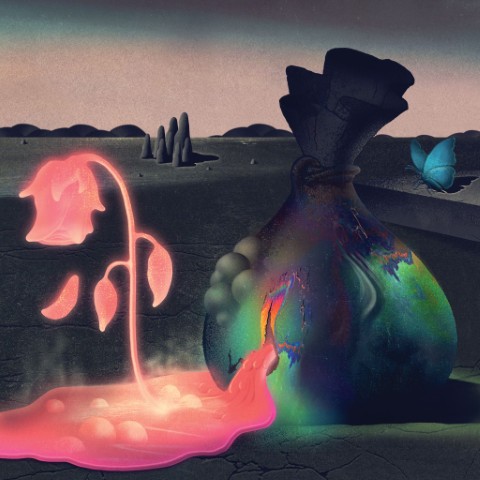
HAIR CONTROL Transform Existential Anxiety Into Euphoric Synth-Pop Release on “TV in the Afterlife”
Calgary, AB art duo HAIR CONTROL (Ryan Bourne & Rebecca Reid) share “TV in the Afterlife,” an anthemic synth-pop workout jam that transcends both the celebratory and the existential. Ebullient art pop with dream-drenched ‘80s-inspired textures, the track transforms apocalypse anxiety and digital-era disconnection into a strangely uplifting, physically charged release.
Originally written by Ryan as a three-chord guitar sketch with a post-punk edge, the song first appeared in earlier form on his Plant City record. Revisited through HAIR CONTROL’s lens, it evolved into an ‘80s-leaning synth pop piece with Rebecca stepping in on lead vocals, reshaping it into what the duo affectionately dubs their “existential workout jams.”
Lyrically, “TV in the Afterlife” muses on waning attention spans, engineered isolation, apocalypse anxiety, the threat of technofascism, and the consolation, as well as the existential horror, of “never being alone”. Rather than settling into dystopia, the track pushes through it, arriving at a defiant celebration of human connection – a kind of sexy, spiritual illumination realizing itself in spite of the trouble we’re in.
Production leans fully into HAIR CONTROL’s signature aesthetic: immersive, psychedelic, and dance-forward, where lo-fi instincts meet expansive electronic design. The result is both playful and profound, balancing satire with sincerity in equal measure.
Arpeggiated synths, pulsing rhythms, and layered hooks turn existential weight into something almost physical. “TV in the Afterlife” is a song that registers as much in the body as it does in the ears.
First off, care to introduce yourself to our readers?
REBECCA: We are HAIR CONTROL, an experimental pop unit based in Mokhinstsis (Calgary, Canada). We bring you the Existential Workout: a melding of throbbing, thoroughly psychedelic avant-dance pop with melodic, nuanced musings on love, death, sex, altered states, and apocalypse anxiety.
HAIR CONTROL is Ryan Bourne and myself, Rebecca Reid, multidisciplinary artists channeling dream-pop, post-disco, synthwave energy into performances that operate somewhere between concert, installation, and participatory ritual — treating the dancefloor as a portal for ‘transcendental fun’ and transformative exuberance, one where we hope people feel compelled to ‘work out’ with us; to join us in the Existential Workout.
“TV in the Afterlife” tackles some pretty weighty ideas, but wraps them in an upbeat, danceable package. What drew you to exploring those contradictions?
RYAN: I’m drawn to this paradox in pop I suppose… in some ways it goes back to my first musical discoveries: Jimi Hendrix’s “Manic Depression”, most of Dylan, Velvet Underground’s “Heroin” and “Beginning to See the Light” and then groups like Of Montreal and Broadcast being formative in that sense… On the other hand, as with a lot of my lyrics, these came out of automatic writing experiments, pulling phrases I liked or that worked with the melody, allowing the next line to be informed by the previous… And of course there’s humour implicit in these – lines like “indecision of the third eye” and “into the transcendental fun” are evocative and sometimes broadly satirical but are also just play.
You’ve described your music as “existential workout jams.” How did that phrase come about, and what does it capture about your artistic philosophy?
RYAN: HAIR CONTROL began in late 2018, when a friend was in search of live dance music for a garage party, and in a flash of inspiration, I said “I’ll do it.” I loaded up my Tascam 246 cassette four-track recorder with woozy beats and glowing synth environments, and after listening back to the first set worth of cassette arrangements, the phrase “existential workout jams” just sprung to mind as a pretty apt description of what was starting to take shape.
I performed a high energy, lo-fi dance set, blending pre-recorded tracks with live vocals and percussion and, after a few more house party sets, invited Rebecca to join, initially offering spoken word to what would become the title track of our new record, Electric Pleasure. We have extensive backgrounds in set design and visual art practices, and the project soon morphed into a kind of performance art vehicle, developing a physical language with handmade props, a mock exercise segment, gongs, and a large fluorescent, hand-painted eye with neon tassels obscuring Rebecca’s face. And so the Existential Workout is what we call this transportive, mulit-sensory happening we invite people to participate in.
The lyrics touch on attention spans, isolation, apocalypse anxiety, and our increasingly digital lives. Were there any particular experiences or observations that sparked these themes?
RYAN: I have a vague recollection of walking along a sidewalk at night, and noticing someone staring into their phone smiling, at a humorous text or a video call or whatever – their smiling face illuminated by that bluish glow – and at the time it was a strong image… And a black hole seemed an apt metaphor for what feels like a point of no return relative to how technology is shaping and otherwise threatening human destiny.
Rather than ending in despair, the song arrives at a celebration of human connection. Why was it important for you to leave listeners with hope instead of hopelessness?
RYAN: I mean I think we’re ultimately optimists and have a spiritual view of things, and we want to share something that resonates in an uplifting way. Human connection, and the countering of the diffusive, separative, fear-based impulse that’s at the core of so many destructive directions we’re moving as a species seems in some sense like the way through the accumulating darkness. Our prior unity, our realization of our singleness as a species, as a human family, even quantumly – panpsychically – how else to we navigate the chaos we’ve created through a hyper-individualist ego-culture that is disintegrating before our eyes? And again, the outro lyrics were formed intuitively, riding on the feeling of the music, and were intended to be a kind of ecstatic, slightly nonsensical bit of play (and hopefully at least a little frustrating to the rational mind).
The track feels equally suited for a dance floor and a quiet moment of reflection. How important is it for your music to connect on both a physical and emotional level?
REBECCA: A guiding intention in our work is to create conditions for an embodied listening experience in which physical resonance opens into feeling perception, regardless of whether you are experiencing the sound on a collective dance floor in a live setting or more intimately through headphones in private.
I feel like the dance floor functions as a place of embodied perception as much as a place of collective release. Sound is not simply received by the ear; it is encountered physically across the body in ways that often precede conscious thought. Emerging research into cellular responses suggests that vibrational sound is felt in the body on a molecular level. Research indicates that the body’s cells respond to sound, with vibration influencing the nervous system in ways that can create a sense of alignment, where movement emerges less as a conscious decision than an instinctive response. It’s so natural. I don’t feel I’m alone in the sensation of when sound just hits right—the body responds through dance, ecstasy, or release. This touches on the importance of physical connection. I would hope anyone listening would feel a physical connection that resonates and translates into an emotional experience. The physical encounter feels inseparable from the emotional one.
Finally, what’s next for HAIR CONTROL? Is this single a glimpse of a larger project, or are you enjoying releasing music one chapter at a time?
REBECCA: “Electric Pleasure”, the debut album, arrives on October 30, 2026. It’s a multi-faceted record, an art-pop song cycle that moves between multiple eras and sonic touchstones. “Seeing In The Dark”, our power-pop future-classic is out next on July 23, and we’ll continue to build toward the LP release with some collaborative singles (Chad VanGaalen drops some new age magic on one and Tea Fannie raps gorgeously on the other). We have our first European Festival performance this August at the “Motovun Music Festival” in Motovun, Croatia on a medieval hilltop. Honestly, a month-long residency somewhere warm near water would be ideal, space to focus entirely on where to place our development as a duo and quietly gain clarity on what move is next. Either way the work continues to evolve through live performance, visual expansion, and ongoing studio development.
Connect with HAIR CONTROL:
Instagram