
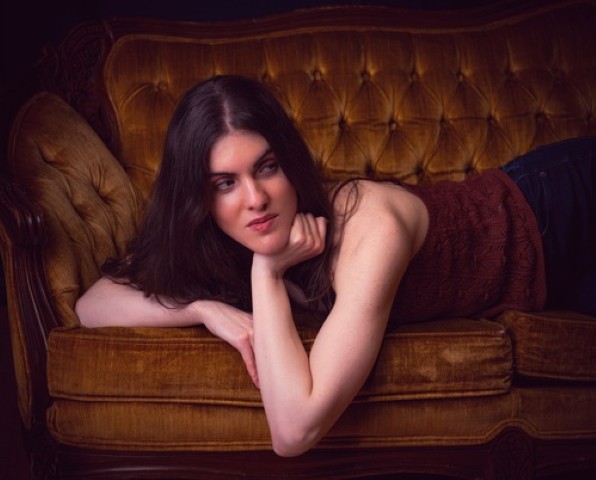
Aurora, ON Singer-Songwriter Laura Fortini Introduces Herself With Debut Single “Lights Went Out”
Aurora, Ontario singer-songwriter, Laura Fortini, releases her debut single for radio, “Lights Went Out,”: a warm, narrative-driven pop song built from a real memory she carried for years before finding the right way to tell it. The third song in her released collection, coming after her previous songs, “Look In” and “Shattered”, it’s a flirty, nostalgic track that reminisces a late-summer/early-Autumn memory. Written when Fortini was just fifteen, the track marks the first official radio release from the 23-year-old artist, who also performs under her own name as she works toward a full length, self-titled album.
The song traces back to a single night at her family’s annual community festival, an all-day gathering held every Labour Day weekend that draws hundreds of family members and close friends within her tightly knit, Italian Canadian community. Fortini wrote “Lights Went Out” not long after that festival, reflecting on a near relationship that had become the subject of good-natured community chatter, and on her own hesitation to pursue it further at the time. Rather than approach the memory with regret, she wrote from a place of curiosity, imagining what it might look like to reconnect without any of the earlier complications attached.
That reflective, open-hearted quality shapes the entire song. Writing from her grandparents’ spare room, where her family was temporarily living while their new home was under construction, Fortini found herself drawn to the sensory details of that night; the brown wooden pavilion strung with glowing yellow and orange lights, the secluded park in the middle of a wide stretch of woods, and the collective energy of a community gathered in one place. The song captures that yearning directly, translating a very specific personal memory into something broader and more universally felt.
“Lights Went Out” is a reflective look at a relationship that unraveled before it ever had the chance to fully bloom, capturing the bittersweet longing to return to a time when hope outweighed heartbreak. Through vivid imagery of “thorns and roses,” “bright-red flags,” and the recurring refrain: “take me back to the moment before the lights went out,” Fortini explores the tension between nostalgia and acceptance, acknowledging how love can feel beautiful even when it is ultimately unsustainable. The lyrics balance vulnerability with self-awareness, tracing the emotional arc from devotion and optimism to the realization that some connections, despite every effort, are simply not meant to last.
“Lights Went Out” was recorded at Songsbury Studios in Vaughan, Ontario, with producer Mathew Teofilo, and released independently through Fortini’s own publishing. It arrives as the next angle of the chapter of her life this album appears in, on the edge of a fourteen-track long-playing record that’s currently in progress. Now, three songs into completion, this is a project Fortini continues to pursue and describes it as a way of using her own experiences to connect with listeners who may recognize themselves in similar moments.
Fortini’s musical foundation runs deep. She began piano lessons at four and voice lessons at six, going on to complete Royal Conservatory of Music examinations with honours and First-Class Honours, before picking up guitar and songwriting together at twelve. Fortini wrote her first song after witnessing Taylor’s concert for 1989, as her first-ever live concert she attended. Alongside years of choir, theatre, and live performance throughout her school years, she taught herself basic production skills, tools she now uses to shape her own demos. Though she calls them “humiliating”, and “rough drafts”, those demos were the ones she used to give to producers and is what her current producer accepted the terms to work with her on. She is currently continuing her Royal Conservatory studies while pursuing a degree at York University in Toronto. Studying English, History and Humanities, Fortini has also taken a course in Concert Choir, within the Fine Arts/Music Program. She is looking to continue taking more courses in that field for a potential minor degree.
With “Lights Went Out” now introducing her sound to a broader range of listeners, Fortini continues building toward her debut album one song at a time, guided by the same instinct that has defined her songwriting since childhood, using music as her clearest way of processing experience and connecting with the people who hear it.
Hi, Laura! Good to meet you! Care to introduce yourself to the readers for those not familiar with your music?
Hey! So nice to meet you. I’m Laura Fortini. I’m 23, I’m a current University student, and with that, I write songs. This is something I’ve been doing for essentially the last decade or so: I started writing them when I was 12. However, I’ve only been doing music to the point of being able to release it (recording, distributing and releasing songs) for the last 3 years. My songs are always pieces of writing/art that I make from what’s going on at any given time; how I feel, any circumstance(s) I’m in, people I meet and interact with, an event that takes place…. really, whatever’s going on at the time. It always comes from my personal life, and is pretty-much a direct diary-entry in one of the pages of my journal, maybe in more abstract terms. My songs tend to be abstract, emotional, and introspective. Sometimes, they can be, or feel like they are, a lot heavier [as per the second song I have in my discography, called, “Shattered”, which is the most complete and genuine reflection of my heart and the type of person I am, as a whole]. But, from my perspective, I’ve always wanted to be understood– so I try to detail situations when they happen as best as I can, even if that means the lyrics and sounds in the song hold some weight. I want to reach and help the same people that have also felt misinterpreted, and so I feel like it’s just better to give a more in-depth, microscopic view of the way I feel in situations when they happen, in order to do that.
“Lights Went Out” is based on a real memory from when you were 15. What made you decide that this was the story you wanted to introduce yourself to the world with?
This song was one that, as soon as I started writing it, I knew I loved. I knew I wanted it to be for radio– and I knew exactly how I wanted it to sound. At that moment, I kind of took that as a bit of inspiration for making the gut-decision of this piece of music someday, maybe getting into more people’s ears. When I was actually writing it: I was thinking about a situation that had already passed, with some months in between — so there was already a bit of distance in the heat of the emotional turmoil that I felt. It was a public setting, so having to field questions and commentary was a little difficult, then. But, by the time that I was in my bedroom writing this, it was quite hilarious to think about and look back on.
I don’t have a lot of material that really focuses on romantic relationships, as that isn’t something that I’ve had very much of. This was the first time in my having-begun-songwriting that this sort of overall feeling came about. At the time, I was also nervous in general, just as I had gone through some criticism and emotional pain during middle school. Due to that, my writing and mentality were quite consistently very hesitant and fearful. That being said: so, when I noticed that I was writing in such a way that seemed curious, interested, and not half-as-doubtful/insecure as I was normally used to feeling, I got really excited. At that point, I was also just interested in the idea of trying to rekindle the same relationship that the public event focused its attention on. It’s a song that references relationships in a way that I didn’t otherwise do in my writing before that point, but also in a way that I think a lot of others can understand/relate to themselves. It was new, but it was very fun to write, though. It was kind of an interesting time. And, I think I just took that for what it was.
You wrote your first song after seeing Taylor Swift’s 1989 tour. What did that concert teach you about the kind of songwriter you wanted to become?
That is the most thoughtful question, and I’m so grateful you asked that.
It was my first-ever concert. I hadn’t ever been to one before, and I was only 12. I had watched performances on DVD’s with my family when I was a really little girl. I had also watched Taylor in the largest capacity I could, for hours a day, everyday, for a long time by this point. I was in the middle of the roughest, darkest period of my life emotionally in middle school, and I always used her songs as solace and therapy before then. But, I wanted to go to the concert, from at least a week before (which was when I found out she was coming, since Red; which was one I had previously also wanted to attend, and couldn’t. I’ve been a Swiftie since 2008.) because I thought that would help make me feel better. I didn’t actually think I was going to go at all, because my Mom had already told me it was too expensive and that it had sold out. The way this worked, and how it got to happen, was through my Uncle’s ticket side-business. He had extra, and so he told my Mom to tell me that we could go with my aunt and cousin, who had the other remaining tickets. But: I only found out about this at all, on the evening before the show.
As I said, I hadn’t ever been to a concert before this. I understood the idea in general, as an event where you hear live music, so that you get to experience it being played live instead of listening to it on the radio. But….. I did not know any of what the atmosphere/physical environment, and the community of strangers being together in one place was going to be like. Moreover, what it was going to do for me. At that concert, I finally felt, for the first time in about a year or so, that I was allowed to just be the unfinished, changing and flawed person I was, without somehow being judged and criticized for it. That was the space that Taylor made herself: that’s what I directly felt from being in the same room as her. I loved how it felt to perform, as I had already done many different performances by then. This, though, just felt like an entirely-different thing, by the people who were there and the amount of care that was being shown. On top of that, the fact that I was with another 50,000+ people: having never been in a group that large before, and was able to feel the same sense of acceptance, kindness and bond with complete strangers – was wild. Though, it did feel like that during the whole thing: and most particularly when it was during the more intimate sets of the show. The Clean Speech is a standout point for that, and for my memory of the concert (you can watch it from almost any night that it was given, there are so many videos on YouTube for it. My night was Toronto Night 1, Oct. 2nd, 2015). I felt more seen and heard by Taylor and what she was describing; with the types of advice she was giving to us, than by any other person I was around at the time: family-included. I felt like she was my older sister, and I felt how everyone else in the crowd took everything she said to heart. I said to myself “If this is what happens at a concert, then I have to at least try.” This was all my very-first time experiencing this, and I was just absorbing it.
It made me know what empathy was, in a time where I felt almost-wholly isolated and broken. It made me know I was allowed to care about things deeply, and how to better understand myself. Being there made me learn that type of compassion better, and want to do the same for others.
That’s now what I want to do in my songs.
You’ve been studying music since you were a child, but songwriting is a different skill. When did you realize writing your own songs was just as important as performing them?
I realized that writing my own songs were as important as performing them, at the same time that I saw Taylor’s concert. I always loved writing since I was very young, but this was definitely a new skill. I didn’t have any teachers, either: I was entirely self-taught, based on everything that Taylor had said. This was because I knew, by then, within my own situation, that I was the only person that could communicate anything I had wanted to say. It was where I, from what Taylor described it as, could fully fill out all the details in the situation and make it as precise as I would want: with the music, and the way you choose to write the lyrics. I also found out, just shortly after, when I wrote my third song (and my first personal one, that didn’t have to reference some sort of a fairytale or other external trope) that this was the best way that I could communicate. It got the most understanding from people who were otherwise shutting down feelings and opinions I had. It was, overall, just a really good way to process stuff.
It definitely felt like you could fully express the emotion, and it really did help me feel better.
You’re introducing yourself to a wider audience with this release. If someone hears one Laura Fortini song for the first time, what do you hope they remember about you afterward?
I want people to know that what I’m doing is only trying to be open and honest about the situation, whether it’s a current situation or past one that I’m writing about. I just want to tell people what’s going on, in a way that holds space and allows for other people to have the same sort of process/outlet as I’ve had with music– at all times. The things that I write are going to be transparent: they will be open and honest, in where I’m coming from and what I say. I just want this to be a process where I can be understanding towards others, which is what I’ve wanted for myself, and then understand myself better. I hope that at some point, my work can relate to others. I want to be present in situations: be able to take accountability for my own thoughts and actions, try to understand other people, and hopefully become a better person from doing it.