
Toronto Dora Award-winner, singer, composer, producer Kunlé releases new album, Kunlé – The Journey
on June 26, 2026 via DistroKid
Dora Mavor Moore Award-winning Toronto singer, composer, multi-instrumentalist, and producer Kunlé has officially announced the release date for his highly anticipated sophomore album Kunlé – The Journey, arriving June 26, 2026 via DistroKid.
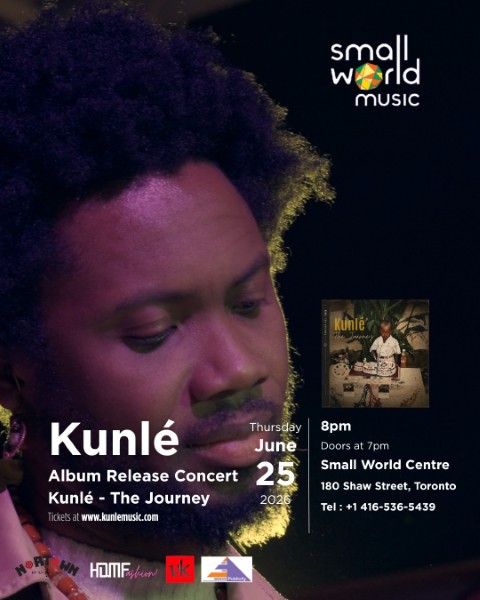
To mark the announcement, Kunlé has released a new lyric video for “So Dear” (track three), alongside details for his special album release concert taking place at Small World Centre in Toronto on Thursday, June 25.
The new album will be available in both digital and vinyl formats and features seven deeply personal, rooted compositions that showcase Kunlé’s expansive musical identity. All music and lyrics are written by Kunlé, who also performs vocals and guitar across the project.
Collaborations play a key role in shaping The Journey. Track two, “Ayé Mo Júbà,” features second verse lyrics written and performed by Nigerian artist Adédèjì, while track four, “Ọ̀rọ̀ Kan,” includes contributions from Nigerian-born, Canada-based artist Dipo.
The album’s instrumental landscape is equally rich, featuring performances from a wide roster of musicians including Stephen San Juan (electric guitar), Thomas Hammerton (piano), Junior Riggan (electric bass), Oluwadamilare Odede (drums), Amado Dedeu Garcia (percussion), Temitayo Ayo (drum arrangement), Oluwakayode Sodunke (talking drums), Kobena Acquaa-Harrison (drums and electric guitar), and Nelson Sobral (slide guitar).
Background vocals are performed by Natalie Morris—known for her Golden Buzzer run on Canada’s Got Talent and as the official national anthem singer for the Toronto Maple Leafs—alongside Venessa Morgan.
Kunlé – The Journey was recorded between Kunlé’s home studio in Toronto and Catherine North Studios in Hamilton, Ontario. The project was produced and mastered at Catherine North, with Kunlé serving as co-producer alongside Will Crann, whose credits include Blue Rodeo, Whitehorse, Feist, and The Glorious Sons.
Alongside the announcement, Kunlé also shared additional visuals for the project, including the lyric video for “So Dear” and the previously released single “Ilé L’àbọ̀,” which debuted March 6, 2026.
With its blend of global influences, collaborative depth, and deeply personal songwriting, Kunlé – The Journey positions itself as a significant artistic statement from one of Toronto’s most distinctive creative voices.
The album release concert takes place at Small World Centre, Studio 101, 180 Shaw St., Toronto, ON (M6J 2W5) on Thursday, June 25, 2026, with doors opening at 7:00 p.m. and the show starting at 8:00 p.m. General admission is $30 and includes seated entry plus a handwritten thank-you card from Kunlé, while the $45 supporter ticket includes seated admission along with a limited-edition red coral bead bracelet handcrafted by Kunlé and a handwritten thank-you card keepsake.
Learn more about release show here. Get tickets, here.
Check out the lyric video for “So Dear” below.
Congratulations on the upcoming release of Kunlé – The Journey. What inspired the title, and what does this journey represent for you personally and artistically?
Thank you.
‘Kunlé – The Journey’ felt like the most honest title because this project is really a reflection of the path I’ve been on over the last decade. A lot has happened in that time—leaving the country of my birth, moving between cultures, and changing careers from marine engineering to pursuing a life in the arts. I’ve spent those years studying, performing, navigating challenges, and learning who I am outside of other people’s expectations. Growing up, there were certain ideas about what success was supposed to look like, and becoming an artist wasn’t one of them—haha. This project is, in many ways, the story of choosing that path anyway.
Artistically, the project represents a reintroduction. I haven’t released music in a long time, but I’ve never stopped creating. During that period, I was developing my craft, performing, and gathering life experiences that eventually shaped these songs. Rather than rushing to release music, I wanted to create something that felt true to who I am.
‘Kunlé – The Journey’ isn’t just about where I’ve been—it’s an invitation for listeners to reflect on their own journeys while walking alongside mine.
You’ve described the album as a collection of reflections and experiences gathered through time. Was there a particular moment when you realized these songs belonged together as one project?
It wasn’t one defining moment. As the songs came together, I started to notice a consistent thread in how they were written and what they were expressing, even though they were created at different times. They felt connected in a way that made the project clearer as a whole, so bringing them together as one body of work felt like the most honest approach—while still allowing listeners to bring their own perspective and find their own meaning within the music.
Many of the songs on the album have Yoruba titles and cultural significance. How important is it for you to incorporate your heritage into your music?
It’s very important to me, but never in a forced or decorative way. It flows naturally through how I think and how I hear music — it’s a language I understand on a deeper level, beyond the surface.
I often joke that when nuances get lost in English and someone is struggling to explain themselves, I’ll say, “Don’t worry, I understand English,” sarcastically. That’s what Yoruba feels like for me and beyond: instinctive. Even among friends back home and in the diaspora, they tease that my Yoruba is “conc” — meaning concentrated, very pure.
A lot of the Yoruba titles on this project carry real meaning, ideas, and context from the world I grew up in. So even when I’m working with different sounds or production styles, that influence is already there — in how I phrase ideas, build rhythm, and approach storytelling. It’s not something I consciously insert into the music. It’s just part of how I create.
The album features guest appearances from Adédèjì and Dipo. How did those collaborations come together?
Adédèjì is a virtuoso I’ve looked up to since I first discovered his work—disciplined yet very fluid in his approach. I followed him and his music closely for a long time, almost like an elder brother from afar. He’s someone whose work has reached some of the world’s great stages, like the Montreux Jazz Festival. I’ve always admired his tenacity, but what truly connected me to him was the deeply personal way his music speaks. Even though we hadn’t met in person, we had kept in touch over time, so it felt like a natural conversation rather than a cold outreach. When I eventually shared the project with him and asked if he would be open to featuring on the song, he simply said, “why not,” and it just clicked. It felt like the song was already waiting for him. He took it to another level entirely.
Dípò’s story sits in a similar space, but in a different way. I was aware of him years ago back in Nigeria—very polished, almost “corporate” in presence at the time, with undeniable vocals. I reconnected with him and his music again in 2022 through “Ain’t No Love,” and shortly after he came to one of my shows. I had just written “Ọ̀rọ̀ Kan” and he heard it and immediately connected with it. From that point, it felt like the song either belonged to him or we built it together. I won’t lie, there was a moment where I felt proud seeing him connect with something I had written, but more than that, once he recorded it, it became exactly what I had heard in my head, maybe even better.
In both cases, it wasn’t about reaching out to “feature” someone. It was more about relationships forming naturally over time and the music finding the right voices when it was ready.
What was it like working with producer and engineer Will Crann, whose credits include Blue Rodeo, Feist, and The Glorious Sons?
Will is a reputable and gracious human, and I don’t think I could have asked for a better co-producer and engineer for this project. We had crossed paths from a distance before, and when I was looking for studios in 2023—yes, the project really took that long, story for another day—I reached out to both Catherine North and Union Sound Company. Will responded in such a warm way and showed genuine excitement for the music. He first connected with the production work in the songs and then proposed coming on as a co-producer, which immediately felt right.
From the first sessions, there was a sense of ease in the room. It reminded me of when I recorded my first project in Berlin with German virtuoso Arian Stechert, though this time in a much larger space that could fully support the scale of what I was trying to achieve. I had spent years shaping these songs at home, and finally being in a studio where they could breathe—alongside a co-producer who listened and truly understood the vision—felt like a blessing. I knew I was onto something when Will would bring out his phone to film—he’s not usually someone who even has his phone out in the studio.
The album was recorded between your home studio and Catherine North Studios. How did those two environments influence the sound of the record?
Home was where the initial soundscape was conceived. That’s where the ideas took shape—demonstrations, rewriting, erasing, starting again, taking them to stage, then back to edit. It was a very iterative process, sometimes frustrating, sometimes instinctive, but it was where the foundation of the record was built.
Catherine North Studios, on the other hand, felt like the space where the music could finally breathe. It took what had been developed at home and gave it room, depth, and a sense of scale. It helped shape the songs into what they were meant to become in the world. Will brings out his pedalboard and starts shaping the guitar tones in real time, I’d just think, “this is why I’m here.” His signature is all over the sound design — whether it’s the emotive piano arrangement on “Ilé L’àbò,” those haunting guitar swells in “Àjà-Whirlwind,” or the way the guitars pulsate and drive “Ọ̀rọ̀ Kan.”
Looking beyond this release, where do you see the next chapter of your musical journey taking you?
Right now, I’m focused on letting this body of work live in the world properly—performing it in different spaces and formats, to audiences of all sizes, connecting with people, and really building from that experience.
Beyond that, I see the next chapter becoming more expansive. This project was very intentional and detailed in its construction, so moving forward I’m interested in opening things up more—collaborating more freely, exploring new sonic directions, and letting the music evolve in a less guarded way.
At the core though, it’s still the same intention: telling honest stories and creating music that feels lived-in. I think the next phase is just about trusting that even more, and allowing it to grow without overthinking it.
Upcoming Shows:
June 25 – Album release concert, Small World Centre, Toronto, ON.
July 2&3 – Porchside Festival (Theatre Collingwood), 288 Beech St, Collingwood, ON.
July 4 & 5 – Mariposa Folk Festival, J.B. Tudhope Memorial Park , Orillia, ON.
July 25 – Ossfest, Ossington Avenue BIA street festival, Toronto, ON.
August 9 – Habari Africa Festival, Harbourfront Centre, Toronto, ON.
August 22 – Afrofest Sudbury, Bell Park, Sudbury, ON.
September 12 – Guitar Trail Festival, Summitview Pavilion, Blue Mountain, ON.
September 13 – Tim Horton’s Southside Shuffle, World Stage, Mississauga, ON.