
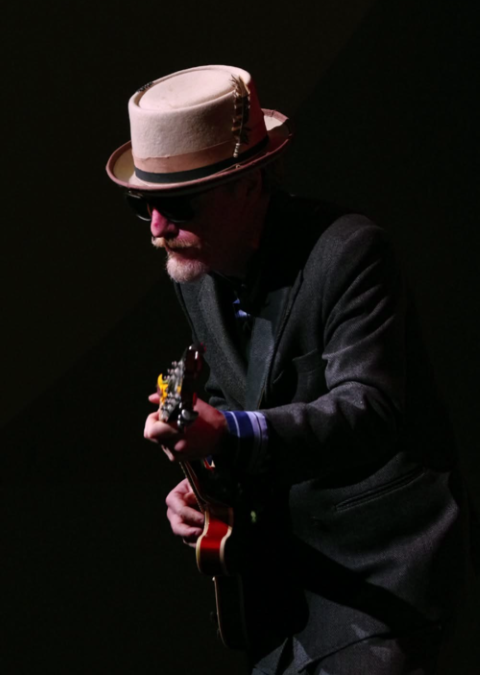
Brandon Isaak Serves Up Electrifying New Blues Album With a Knockout Blend of Grit, Groove and Guitar Magic
Horns blazing, piano rolling and a big, generous heart at the centre of it all, Brandon Isaak is back with “World’s Got the Blues,” a rousing new single from his eighth solo album, Lookin’ Out My Window, both out now on Modern Primitive Records. The album follows his triumphant 2025 release Walkin’ With the Blues, which won three of its five Canadian Blues Music Award nominations: Electric Blues Album of the Year, Blues Song of the Year and Blues Guitar Player of the Year.
“I came home from Toronto incredibly grateful,” Isaak says, “and then I did what I always do. I went back to work.”
“World’s Got the Blues” takes stock of hard times, from rising prices to the shouting matches on the nightly news, and answers them with a warm, irresistible invitation to come together. “Let’s try something new, don’t seem that hard to do / Let’s love one another, and I’m starting with you,” Isaak sings, before rallying listeners in the final verse: “Let’s do better, you know we can / We the people, well we’ll make a stand.” For Isaak, writing songs like this one comes with the job.
“I believe part of my responsibility as an artist is to hold up a mirror to the world around me,” he explains. “Music can reflect what we’re going through, ask questions, challenge us, and sometimes simply remind us that we’re not the only ones feeling what we’re feeling.”
Across Lookin’ Out My Window, Isaak found inspiration everywhere he looked: a phrase that caught his ear, a conversation with a friend, a headline he couldn’t shake. He even wrote through the eyes of his 20-year-old daughter as she embarked on her own adventures in love.
“For this album, I even found myself writing through my daughter’s eyes and her new adventures in love and relationships,” he says. Every day he headed down to his studio or out to the back porch to sharpen those ideas, trusting that each rough sketch could bloom into something special. “Bad ideas can be the best fertilizer,” he says with a grin. “You throw them on the ground, give them some attention, keep digging, and every once in a while, something starts to grow.”
Once the songs were ready, Isaak called in his band, The Saints of Swing, a crew of A list players drawn from the Vancouver blues scene: Darryl Havers on piano, keys and organ, Rob Becker on bass, Chris “The Wrist” Nordquist on drums and tambourine, Jerry Cook and Paul Wainwright on saxophones, Marty Shepard on trumpet and Nadine States on backing vocals. Cook, who co-wrote the album’s horn arrangements with Isaak, was named Sax Player of the Year at the 2025 Canadian Blues Music Awards.
“They listen, they feel it, they add things, subtract things, change things and bring their own personalities and experience into the music,” Isaak says. “Sometimes they take an idea somewhere I never would have thought of going. That collaboration is one of my favourite parts of making a record.”
Isaak produced, engineered and mixed the album himself at Modern Primitive Studios, then sent it to Marc L’Esperance at Vancouver’s heavyOsonic Studios for mastering.
“Every song passed through my hands from the first rough idea all the way to the final mix,” he says.
The album features cover art by painter David Goatley and liner notes by Dan Casavant, who calls Isaak “a thinking man’s blues artist” whose music also has “a very joyful, playful and, at times humorous side.” Isaak’s wife, Cindy Mae, coordinated the project, and he credits her as “my rock and shining light.”
Born in Whitehorse, Yukon and now based in the Cowichan Valley on Vancouver Island, Isaak grew up watching his father play music professionally. Over 39 years in music, he has carried his songs across three continents and eight countries, including 13 European tours, and picked up three JUNO Award nominations along the way. His sound carries echoes of Taj Mahal, B.B. King and Lightnin’ Hopkins, along with the guitar and vocal styles of heroes like Ronnie Earl, Anson Funderburgh, Sam Myers and T-Bone Walker, all filtered through a songwriting voice that moves easily from thoughtful to funny to spiritual. Onstage, the multi-instrumentalist pairs firebrand guitar and harmonica with a gravelly voice that surprises everyone who hears it, pulling every crowd into the show and sending fans home humming his melodies. His catalogue includes ‘Bluesman’s Plea’ (2011), ‘Here on Earth’ (2014), ‘Big City, Back Country Blues’ (2017), ‘Rise n’ Shine’ (2018), ‘Modern Primitive’ (2021), ‘One Step Closer’ (2023) and ‘Walkin’ With the Blues’ (2025).
Above all, Isaak hopes the album brings people together.
“Being part of this vibrant Canadian blues community fills me with pride,” he says. “We need to stick together to nurture and grow this fantastic blues community, ensuring that this timeless music remains alive and well in our beautiful country.”
And true to form, he is already hard at work on what comes next.
“I make them from the heart,” he says. “I give them 100% of whatever I’ve got. And the funny thing is, the second one is finished, I’m already looking for the next song.”
Hi, Brandon! Good to see you again! Care to introduce yourself to the readers for those not familiar with your music?
My name is Brandon Isaak. Born in the Yukon, raised on the blues. I grew up playing in my folks’ blues club in Whitehorse, cutting my teeth on the bandstand and backing some great blues artists. I learned early that the blues isn’t about how many notes you can play — it’s about how much truth you can put into them.
I believe in keeping the blues honest, soulful, and true to its roots. I play with purpose, respect the spaces between the notes, and treat every bend, every phrase, and every last note like it’s got a story to tell. Because the blues deserves more than flash. It deserves feeling, conviction, and a little bit of lived-in heartache.
The blues doesn’t need showing off. It needs telling straight, playing hard, and feeling every damn note.
I’ll leave the wanking to the kids. I’m here to play the blues.
After winning three Canadian Blues Music Awards, you said you came home and went right back to work. What is it about making music that keeps you chasing the next song instead of looking back at the last success?
I’m not one to sit around polishing old trophies. The past is the past, and yesterday’s victories don’t write tomorrow’s songs. I’m interested in what’s happening right now and what’s coming around the next bend. The fire’s still burning, the wheels are still turning, and I’m already halfway through writing songs for my next album.
For me, making music is a lot like baking bread. You pull one loaf out of the oven, and it’s time to get your hands into the next batch of dough. I’m not interested in living off stale bread or feeding people yesterday’s leftovers. There’s always another song to write, another story to tell, and another stretch of road to travel.
“World’s Got the Blues” looks at a world that can feel divided, but instead of pointing fingers, it offers hope. Do you think that’s one of the blues’ greatest strengths—that it can acknowledge pain without surrendering to it?
A lot of people think the blues is all darkness, heartbreak, and hard times. They couldn’t be more wrong. Even in the earliest roots of the blues, there’s a glimmer of light pushing through the clouds. Because the blues was never just about suffering — it was about survival. It was about people finding a way to carry on, to laugh through the tears, to dance through the hard times, and to turn life’s bruises into something beautiful.
To me, the blues is the human story, in all its messy glory — the good, the bad, and everything in between. It’s pain, joy, love, loss, hope, and the stubborn refusal to let life get the last word.
I’ve always believed there’s a silver lining somewhere, even when the skies turn black and the storm rolls in. Maybe you can’t always stop the rain, but you can sure find a way to sing through it.
You talk about writing through your daughter’s eyes on this album, which is a fascinating shift for a songwriter. What did stepping into someone else’s perspective teach you about yourself?
I’ve always been a listener. People have stories to tell, and if you pay attention, you’ll find songs hiding in the most unexpected places. I’ve spent much of my life listening to people’s experiences, their loves, their losses, their triumphs, and their heartbreaks, then finding a way to turn those moments into music. Sometimes I tell the story straight; other times, I disguise it, turn it inside out, or look at it from a completely different angle. The truth is always in there somewhere.
Writing from my daughter’s stories is a different experience altogether. It’s more personal. There’s a protective instinct that comes with being a father, but there’s also something wonderful about hearing the world through her eyes. Her fresh perspective on love, heartbreak, and figuring out life has opened up a whole new well of inspiration for me. It reminds me that even when you think you’ve heard it all, there’s always another way to feel, another way to see, and another story waiting to be told.
I’ve come to believe that you can’t spend your life writing only about yourself. You have to listen beyond your own experiences, step into other people’s shoes, and let their lives move you. That’s where the real stories live
You’ve spent nearly four decades playing the blues, and you say every song starts as just a rough idea. After all these years, what still gives you that feeling of excitement when you pick up a guitar and think, ‘There might be a song in here.
Songwriting is a muscle. You’ve got to work it, stretch it, and put it through its paces if you want it in fighting shape. The more I write, the stronger that muscle gets, and the quicker the songs seem to find their feet. Ideas come faster, melodies fall into place, and sometimes the whole thing practically writes itself.
The other day, I sat down with absolutely nothing. No theme, no concept, no road map, not even a faint idea of where I was headed. Before I knew it, a great tune had found its way onto the page. A few little lyrical tweaks here and there, and it was off and running. That’s the beauty of keeping the muscle working — you learn to trust your instincts and follow the song wherever it wants to go.
Of course, that doesn’t mean every song is a masterpiece. I can still churn out a sow’s ear with the best of them! But you keep showing up, keep putting in the work, and keep turning over stones. The good songs don’t always announce themselves at the door. Sometimes you have to write your way to them.