
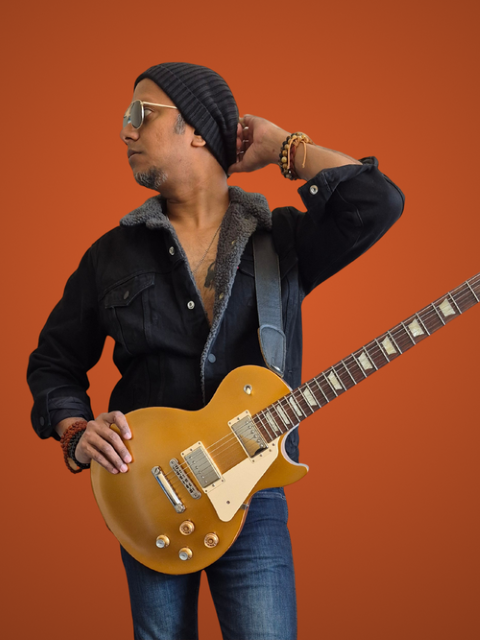
Ottawa Blues Guitar-Driven Singer-Songwriter Ash Ravens Sends Out Letters from an Alien Oct. 20, Led by Starlit Single “Last Letter from an Alien”
At 3 a.m., with sleep nowhere in sight, Ash Ravens reached for his gold top Les Paul and started playing a rhythmic figure over and over until a song took shape around it. By sunrise, “Last Letter from an Alien” was finished. That late night burst of inspiration now opens Letters from an Alien, the raw, intimate, and beautifully personal new album from the Ottawa singer, songwriter and guitarist, arriving Oct. 20 on Raven’s Nest Music. Ravens wrote, performed, recorded, mixed, and mastered nearly every note himself, crafting a seven-song collection about being a stranger in the world and finding the way home.
The album grows from a feeling Ravens has carried across three continents.
“I’ve felt like an outsider in most rooms for as long as I can remember,” he says. “I’ve lived in Bangladesh, the US, and Australia, and I think part of the reason I keep moving is that I’m searching for the room where that feeling goes quiet. ‘Last Letter from an Alien’ is what came out of that.” The single answers that restless spirit with tenderness and grace, as Ravens sings, “I’m just a wandering soul / Never made to stay long,” before reaching across the cosmos with a promise of connection: “Maybe from another world / I’ll be looking for you too.”
The song came together with remarkable speed.
“The riff showed up at 3 a.m. on a night I couldn’t sleep,” Ravens recalls. “I picked up my gold top Les Paul and started playing a rhythmic figure, then played it again, and again.” Two hours later, it was complete. “That’s how I work,” he explains. “I’m methodical, but I don’t get paralyzed by analysis. When a song is there, I finish it.”
That instinct shaped the entire record. Ravens tracked ‘Letters from an Alien’ at his home studio, Raven’s Nest Studios, and played guitars, basses and keyboards, programmed the drums and sang every vocal.
“Most of it is drums, guitars, keys, bass, and voice, recorded directly, one take and done,” he says. “I wanted to keep the honesty in the performances, so I kept the arrangements small and didn’t go back and fix things.”
Two soft instrumentals built on nylon string guitars and chilled beats glide between the songs, and the credits proudly note that no AI was used at any stage of the music or artwork. The striking cover photo was shot by Shamuna Mizan, whom Ravens thanks in the liner notes as his wife and “loudest cheerleader.”
The album’s most powerful moment of self-discovery arrives on “Save Me,” which grew out of a demanding stretch in which Ravens wrote and recorded three albums and more than 70 songs in three years.
“At some point I understood that nobody was coming to save me,” he says. “If it was going to happen, it would have to be me. That’s why the chorus, ‘will you save me, save me from myself,’ is rhetorical. I already knew who the answer was.”
It’s also the only song on the album with a vocal recorded outside his home studio, tracked with engineer Dean Watson at Studio Buckingham.
“This one is raw and personal,” Ravens says of the new album. “The lyrics are more intimate and more real, and I didn’t shy away from being open or vulnerable. Underneath it all, it’s about being a stranger, to rooms and to yourself, and working out that you’re the one who has to bring yourself home.”
Ravens is a guitar-driven songwriter who rarely writes the same song twice, moving freely between blues, rock and country-tinged songwriting with anthemic range. After building his career across Los Angeles and Melbourne, Australia, he made Ottawa his home and quickly became one of the capital’s most exciting live performers. His albums ‘One Way Ticket,’ ‘Joyride Blues’ and ‘Side A’ have earned him two Capital Music Award nominations, multiple City of Ottawa Arts Grants and a coveted spot at RBC Ottawa Bluesfest in 2023. He has also collaborated with a wonderfully wide circle of artists, including Bif Naked, cellist Raphael Weinroth-Browne and Kristine St-Pierre.
Onstage, Ravens treats every audience as part of the band, and inviting fans up to sing with him has become a joyful tradition at his high-energy shows with his band. With ‘Letters from an Alien’ on the way, he’s ready to welcome even more listeners into the room.
Hi, Ash! Good to see you again! Care to introduce yourself to the readers for those not familiar with your music?
Hi Canadian Beats! Always good to be back here and share my journey with you! For readers who aren’t familiar with my music, I’m Ash Ravens, an Ottawa-based singer-songwriter whose music is driven by guitar, blending roots, blues, rock, and global sounds with stories shaped by a life lived across three continents.
The title Letters from an Alien speaks to feeling like an outsider. After living on three continents, have you come any closer to finding where you belong, or has your definition of “home” changed?
For me, the search for “home” will probably remain a constant for as long as I’m alive. Home has always been an elusive concept, and sometimes a special someone can feel more like home than any postcode. That’s a feeling I’ll always carry with me.
The song came from a raw and authentic place inside me. When you’ve travelled so much that your roots never really take hold anywhere in particular, you can end up feeling like an outsider in most rooms you walk into. It’s not just about international borders, either. I haven’t always felt at home even in the country of my origin, which made me wonder, “Am I even from around here?”
Interestingly, many people have reached out to tell me they’ve felt exactly the same way, like an alien in a familiar environment. Knowing that others share this feeling was genuinely comforting. Perhaps we’re all trying to find our true tribes.
“Last Letter from an Alien” came to you in the middle of the night and was finished within hours. Do your best songs come from instinct, and how do you know when not to overthink them?
Having been an overthinker all my life, I’m learning to trust my instincts and follow the faintest whisper of my muse. I used to focus more on crafting a song, and that approach has certainly helped me build a catalogue of more than 75 published songs. It still has its place, but these days I’m trying to capture my raw instincts and see where they lead.
I can’t say whether those songs are my best. I’ll let the listeners decide that. But they’re definitely new territory for me: being open to receiving music from some mysterious place and making the most of it before the moment passes.
Some editing is still necessary to make a song work within modern song formats, but I try to rein myself in when I find myself spending more than five minutes on a musical or artistic decision. More often than not, I go with my first instinct. If it gives me goosebumps, it’s going in.
You say the turning point came when you realized nobody was coming to save you. How did that realization change not only this album, but the way you approach your life and your music?
“Save Me” is probably the most vulnerable song I’ve ever written and had the courage to release. I’m a private person, so sharing it with the world was a big step for me.
It came from a place of extreme burnout, something many independent musicians will recognize. We’re expected to wear a hundred different hats, constantly create content, maintain an online presence, and feed algorithms, often at the expense of the music itself. After writing, recording, and releasing more than 50 pieces of music, including songs and instrumentals, over three years, the pressure took a heavy toll on my mind and body.
At one point, I realized that if I kept going at that pace, I’d eventually walk away from music altogether. I knew I had to stop, or at least slow down.
I have people in my life who love me very much, but the musician’s journey can be a solitary one, and it’s not always easy for others to understand what you’re going through. I realized that if anything was going to change, I’d have to make those changes myself.
I think I have a much more balanced approach now. Going forward, I want to make music while also making room for the other things that give life meaning. I don’t want to lose my love for music by pushing myself to the point where I can no longer enjoy it.
You recorded most of the album in one take and resisted the urge to fix imperfections. What did you gain by letting the performances stay raw instead of chasing perfection?
The most important things I gained were freedom and the ability to see beauty in imperfection. We live in an era when almost every detail, even a single breath on a recording, can be edited and perfected to the point where the music risks losing its soul.
Yet the records that shaped my musical DNA weren’t made that way. The music of the ’60s, ’70s, and ’80s has imperfections that became part of its sonic signature. Records by Led Zeppelin, Deep Purple, and many others let the musicians’ personalities shine through rather than trying to fix every little detail.
That’s exactly what I wanted for this album. I wanted the performances to feel human, with all the character and emotion that comes with that.
And in a way, by allowing those imperfections to remain, I saved myself, too. I stopped burning myself out by going back and fixing every little detail and learned to trust what I’d captured in the moment.