
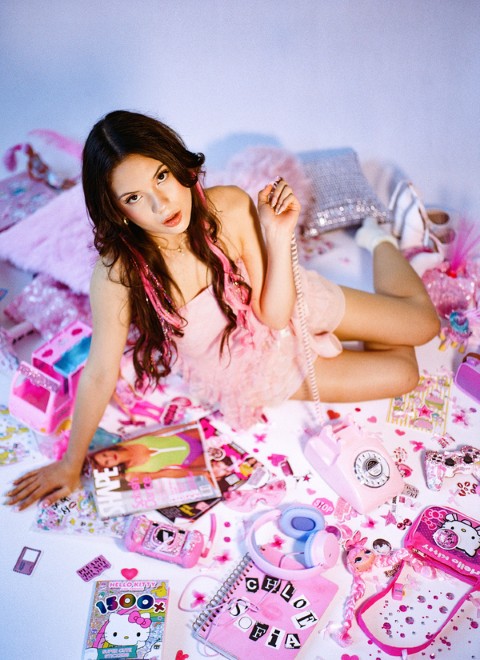
Chloe Sofia Confronts Online Harassment Head On With New Single “Girl on the Internet”
Like far too many women, Chloe Sofia learned at just 16 what it means to have strangers cross the line online, unsolicited messages and images sliding into her DMs from men she’s never met. In “Girl on the Internet,” out now, the Toronto pop/pop-rock singer-songwriter turns that experience into a hook built for shouting back, delivering a pointed, propulsive answer to online harassment that refuses to apologize for taking up space.
The song was born out of two moments that landed within days of each other. Chloe received an unsolicited explicit photo from a stranger online, and around the same time, a family friend called her mother with concerns about how Chloe was dressing and posting. Different situations, same message underneath: watch yourself, cover up, be careful. “Girl on the Internet” opens inside that instinct to shrink and apologize, then spends the rest of its runtime dismantling it. By the chorus, Chloe draws the line plainly:
“He’s just a creepy guy but I don’t know why I should be the one to apologize, for wearing what I want, for posting what I like.” The bridge closes the argument entirely: “Get the hell off my page, cause baby I am not your age.”
Chloe co-wrote “Girl on the Internet” with producer Kayla Diamond in under a week. Notably, nothing was scratched or rewritten along the way, every lyric was well thought out and meticulously placed, and what made it onto the track is what came out first, word for word. Sessions moved between Diamond’s studio and Chloe’s home setup, with Diamond also handling production, keeping the arrangement driving and pop-rock forward so the song feels less like a confession and more like a takedown.
Chloe’s experience reflects a broader reality, encountering unsolicited and inappropriate messaging that so many women face online. Assumptions that a woman’s clothing invites judgment are things girls and women across every age group encounter. Women are held accountable for what they wear, but men should be held accountable for their behaviour. Chloe is using her platform to name the behaviour directly rather than let it go unspoken. For an artist who sees fashion as a form of self expression, the song makes a clear separation: what someone wears has nothing to do with who they are or what they deserve.
“Girl on the Internet” continues a breakout year for Chloe, who first drew international attention when her debut single “Pulse” placed as a runner-up in the Unsigned Only song competition. That result led to a partial scholarship to Prodigy Camp, an invite-only program that selects just thirteen musicians from around the world each year and counts Chappell Roan among its alumni. Chloe attended this past July. She is also the recipient of Massey Hall’s Young Musician’s Commission, has been featured on Spotify’s official “Pop All Day” editorial playlist, and was recently nominated for Emerging Talent of the Year at the Mississauga Music Awards.
Chloe’s songwriting has always leaned into vivid, visual storytelling paired with an unflinching willingness to say what other artists shy away from, and “Girl on the Internet” carries that instinct into its most direct territory yet. She works alongside an accomplished production team that includes JUNO nominated producer Kayla Diamond of Kolossal Records and Sony, The Orchard, along with LA based producer Stephen Conley, whose credits include a billion-stream placement on Disney’s “Descendants 2.” She has also trained for four years under songwriting instructor Mike Siracusa at Merriam Music.
With “Girl on the Internet,” Chloe Sofia proves she has both the melodic instincts and the nerve to turn an uncomfortable moment into a song that demands to be heard, and to make sure the right people are the ones left uncomfortable.
Hi, Chloe! Good to meet you! Care to introduce yourself to the readers for those not familiar with your music?
I’m Chloe Sofia, a 16-year-old artist who writes pop music! I’m big on expressing my opinion and unleashing my feelings in my songs, and I tend to have a lot to say. My sound is definitely more edgy but still very mainstream, similar to Olivia Rodgrio or Adéla with its own unique perspective and musical elements.
You were only 16 when the experiences that inspired “Girl on the Internet” happened. Was there a moment when you realized, “This isn’t just happening to me, this is happening to a lot of girls”?
At first, I just wrote this song as a way to tell my own story and point out a very normalized and under-treated issue. But after I released Girl on the Internet there were so many girls DMing me about how “relatable” the song was and sharing their experiences with online predators and creeps. That’s really the moment when it clicked to me that this wasn’t just happening to other girls on the internet, but to close friends and family around me, which is when the message became so much more important to me.
You’ve said fashion is a form of self-expression. Have you ever caught yourself changing what you wanted to wear or post because you were thinking about how someone else might react?
As a teenage girl, this is what we call a canon event. I’m constantly thinking about how my clothes might make others feel about me or how they might view me differently based on what I choose to wear. Things like a low cut top, or a lace bra peeking out, or a mini skirt seem to make people feel entitled to make up their own narrative of you. I believe fashion can be a statement, but I don’t believe it should tell others how to treat you or influence how you feel about yourself.
If a 14- or 15-year-old girl hears “Girl on the Internet” after going through something similar, what do you hope she takes away from it that maybe you didn’t know at that age?
I’d want them to know that dressing “slutty” is a social construct, and in fact, not real. The majority of the time girls are just being themselves and wearing what they think is cute or cool, but it’s how other people are choosing to view it that’s making it “slutty”. The perspective that people take on how you dress is what’s sexualizing you, not the way you dress.
You’ve had an incredible year, from Prodigy Camp to the Massey Hall commission and award nominations. Has finding your voice as an artist also made you more confident about using your voice as an advocate?
I think as I’ve grown into my writing I’ve really started to deliver messages through my songs, about things I believe in, what I stand for, and how I feel. I’ve written my share of love songs and breakup songs but in finding my voice over the past year, I’ve also found that I have so much more to say beyond that. I have a unique perspective and strong opinions, which is what fuels my art.