
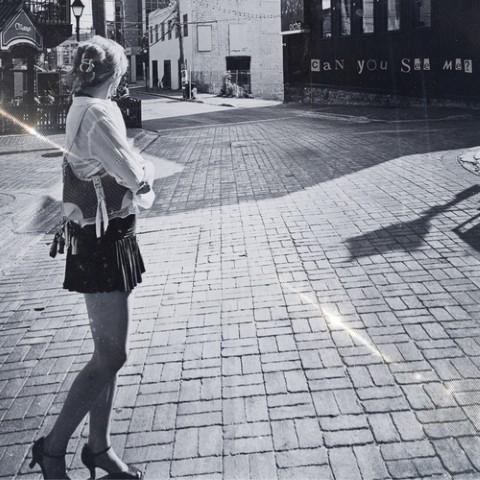
Canadian Folk Artist Irish Millie Releases New Album ‘Can You See Me?’ Featuring Single “Boy At My Funeral”
Irish Millie has spent her entire life turning the way her mind works into music, and on her most ambitious project to date, the Peterborough, Ontario singer, songwriter, and fiddler steps fully into that instinct. Her new album, Can You See Me?, is out now, and with it comes the release of “Boy At My Funeral,” a sweeping, cinematic single featuring Marshall Pula that captures the record at its most emotionally dramatic.
Can You See Me? is a coming-of-age album told through the eyes of a young woman who has always felt like an outsider. Growing up neurodivergent and intensely sensitive to the world around her, Millie found herself repeatedly pushed toward a version of normal that never quite fit. Rather than let that experience diminish her, she built an entire artistic world out of it, one she calls her inner cinema, where sound, colour, and story collide. Across the record’s seven tracks, that world expands into love, grief, self-doubt, and eventually something close to peace, culminating in a title track that turns the album’s central question outward toward everyone who has ever felt unseen.
“Boy At My Funeral” arrives at the album’s most operatic turn, the moment the story’s protagonist falls into a love so consuming it borders on mythic, only to question whether it was ever returned in equal measure. “Falling out of the car on the interstate, my love for you has turned to hate,” Millie sings, before the song’s emotional crux surfaces in its most vulnerable line, “if I faded away, would you come too?” What began as a stripped-down folk demo built around acoustic guitar transformed, through the input of nearly every collaborator involved, into a full pop rock production, giving the song’s heartbreak the scale it needed. Pula’s harmonies, which arrived largely unplanned during the session, added a haunting counterpoint that turned the track into a genuine conversation between two voices rather than one.
Millie’s musical foundation runs back to childhood, when she was first immersed in Celtic fiddle traditions in a musical household. That instrumental grounding continues to inform her sound today, even as her songwriting, direct, unguarded, and built from lived experience, has become the true centre of her artistic identity. A seven time Canadian Folk Music Award nominee, she has been recognized across three separate releases, her debut Thirteen, her album GRACE, which earned praise from Celtic icons Natalie MacMaster and Donnell Leahy, and her 2026 EP Between Then and Now, which picked up nominations for both Young Performer of the Year and Single of the Year.
This year alone has brought a string of milestones. Millie was named a Robinson Emerging Artist Award winner at the Goderich Celtic Roots Festival, and she was selected as the 2026 Breakthrough Artist through North2North, a first of its kind competition connecting Canadian independent artists with Sweden’s Lilla By Festivalen. That honour sent her to Rinkaby, Sweden in June to perform on the festival’s main stage and in its Canada Barn, where festival co-founders Malin Östh and Jonas Tancred singled out her Celtic pop rock energy as representative of the best of Canadian independent music.
Millie’s rise has been closely tracked by Canadian media, with coverage from CBC’s Daybreak Alberta and Fresh Air with Ismaila Alfa, Global News, CityNews, Roots Music Canada, and Cashbox Canada. She has performed to audiences of more than ten thousand at Peterborough Musicfest and shared stages across Canada, the United States, and Europe, all while completing her degree in Music Industry and Technology at the University of Toronto Scarborough. Her commitment to community runs alongside her music career, reflected in initiatives like Fiddling for Fox, which earned her the Peterborough Civic Award for Community Betterment.
With Can You See Me? now released, Irish Millie continues to prove that the qualities which once made her feel out of step with the world are the same qualities driving one of the most distinctive voices to emerge from the Canadian folk scene in recent memory.
Hi, Millie! Good to see you again! Care to introduce yourself to the readers for those not familiar with your music?
Hi! I’m Irish Millie. I’m a Canadian singer-songwriter and fiddle player, and I grew up in a very musical household surrounded by Celtic and traditional music. The fiddle was really my first language musically, and for a long time that was how I understood myself as an artist.
Over the last few years, though, my music has expanded a lot. I started writing more, singing more, playing piano, experimenting with production, and letting myself pull from all of the music I actually love rather than feeling like I had to fit into one genre. So now there is still a very strong Celtic and roots foundation in what I do, but it collides with pop, rock, singer-songwriter music and some much more cinematic production.
My new album, Can You See Me, is probably the clearest picture of who I am creatively right now. It’s a coming-of-age record about being different, being misunderstood, love, grief, getting lost in some very dark places, finding your way back to yourself, and ultimately asking what it really means to be seen.
You’ve built this whole album around what you call your inner cinema, where sound, colour, and story collide. Can you walk me through what that actually looks like for you, what does it feel like inside your head when a song is taking shape?
It is genuinely very visual for me. I don’t usually experience a song as just a melody and lyrics. It becomes a place.
There are colours, movement, people, lighting, little scenes, sometimes almost a whole storyline happening in my head. A sound can have a colour or a texture to it, or a particular instrument can suddenly make the whole scene change. I can picture where the person in the song is standing, what the room looks like, what time of day it is, what they are wearing. It can get ridiculously specific!
For a long time I think I experienced that intensity as something that made me a bit strange or different. With this record, I started realizing that it is actually one of the most useful things I have as an artist. Instead of trying to turn it down, I built the album around it.
That is really where the idea of the “inner cinema” came from. These songs feel like little films to me. And over the course of the album there is also this larger shift where I stop feeling like I’m watching everyone else’s life from the outside and start becoming the main character in my own story. That became a huge part of what Can You See Me means to me.
“Boy At My Funeral” started as a stripped-down folk demo built around acoustic guitar and grew into a full pop rock production through the input of nearly every collaborator involved. What was it like watching a song change that dramatically from what you originally imagined it to be?
It was wild, because the original version really was so different.
“Boy At My Funeral” started as this very intimate, acoustic folk song. At its core it is actually a pretty sad little story. I imagined this huge, almost Romeo-and-Juliet-level love in my head, and then this girl dies and watches the boy at her funeral only to realize that maybe his grief isn’t as enormous as she imagined it would be. There is this awful realization of, “Wait. Did this mean the same thing to you that it meant to me?”
And then everyone started touching it!
Murray Shadgett brought in the acoustic guitar, Marshall Pula became part of the track, and when Tyler Martin and I started building the production at Electric Alchemy, it just kept getting bigger. Different people heard different possibilities in it, and somehow this sad folk song turned into this huge pop-rock moment.
Normally you would think that making it bigger would take away some of the vulnerability, but I actually think the opposite happened. The production made the emotion feel enormous, which is exactly how that kind of heartbreak feels when you’re inside of it.
It was also a really important lesson for me in collaboration. I had to learn that changing the original idea doesn’t necessarily mean losing the song. Sometimes other musicians hear something hiding inside your song that you couldn’t hear yet.
You grew up immersed in Celtic fiddle traditions in a musical household, and that instrumental grounding still runs through your sound today. How do you personally balance that traditional foundation with the more cinematic, pop rock direction this album takes?
I don’t really think of them as being in conflict anymore.
Celtic music taught me almost everything I know about communicating emotion through music. It is incredibly rhythmic, but it is also full of story. There is grief in it, humour, history, dancing, community, longing, home. You can say an unbelievable amount without ever singing a word.
That absolutely follows me into the music I make now.
Even when a song becomes very pop or rock or heavily produced, the instincts I have as a fiddle player are still there. The way I phrase something, the way I build tension, the way I want a melody to move, or the way I think about energy in a live performance all comes from that foundation.
The difference now is that I don’t feel like honouring that tradition means I have to stay inside it. I can put the fiddle beside electric guitars or synths or huge drums and it is still part of the same musical story. I love Celtic music, and I’m incredibly proud that it is part of where I come from, but I never wanted “Irish Millie” to mean that I could only be a Celtic fiddler.
For me, this album is about letting all of those parts exist at once.
You performed at Sweden’s Lilla By Festivalen this year, where the festival’s co-founders specifically singled out your Celtic pop rock energy as representative of the best of Canadian independent music. What was it like hearing your sound described that way by people completely outside the Canadian folk scene you grew up in?
That was incredibly meaningful.
There is something very strange and wonderful about taking music that grew out of your little world in Canada, carrying it across the ocean, and then having people in Sweden connect with it without having any of the context you grew up with.
I think sometimes when you are close to your own music, you spend so much time wondering where it fits. Is it Celtic? Is it folk? Is it pop? Is it rock? Is it too traditional for one space and too modern for another?
And then you travel thousands of kilometres and someone hears it and basically says, “No, this makes sense. This is you.”
Having the festival recognize that combination of Celtic music and pop-rock energy as something exciting, and as something representative of Canadian independent music, was a huge compliment. It made me realize that maybe the thing I sometimes worried was difficult to categorize is actually the thing that makes the music identifiable.
Playing Lilla By Festivalen was also such a reminder of how universal music can be. You can come from completely different places and traditions, and somehow rhythm, melody and energy create a common language almost immediately.
I came home from Sweden feeling even more confident about leaning into that combination rather than trying to simplify it.
Connect with Irish Millie:
Website
Bandcamp
Facebook
Instagram
TikTok