
Shy-Anne Hovorka Releases “Raise My Fist” With More Than 30 Indigenous and Ally Artists
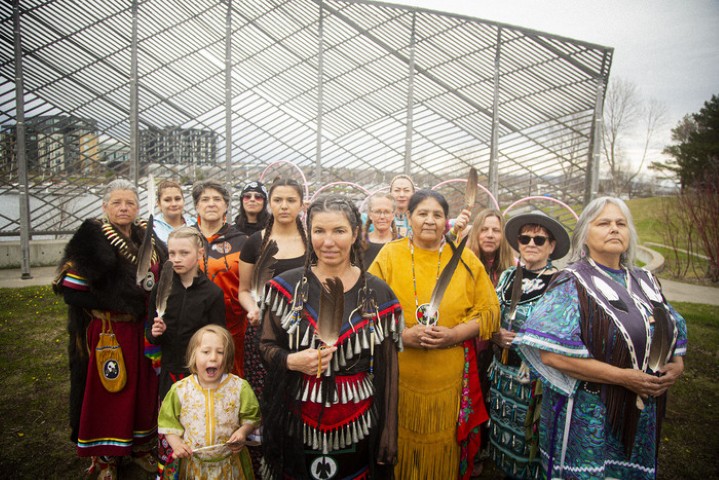
Award winning Ojibwe singer songwriter, multi-instrumentalist, humanitarian, and educator Shy-Anne Hovorka releases her new single and music video, “Raise My Fist,” out now. Inspired by former Long Lake #58 First Nation Chief Judy Desmoulin, the song stands as a celebration of Indigenous strength, unity, and the ongoing journey of reconciliation, brought to life by a community of more than 30 Indigenous and ally artists from First Nations, Métis communities, and organizations across Canada.
A member of Lake Helen First Nation, also referred to as Red Rock Indian Band, with roots in Matachewan First Nation, Hovorka has spent more than two decades building one of the most quietly remarkable careers in Canadian music, one built on authenticity, community, and a refusal to separate art from purpose. Her first three albums, ‘Black Thunderbird,’ ‘Pseudo,’ and ‘Interwoven Roots,’ have sold more than 15,000 copies worldwide and earned airplay across Canadian commercial radio, while her song “Can’t Change the World” secured a licensing deal for the television series Blackstone and earned a spot in the opening ceremonies of the 2010 World Interfaith G8 Summit, where she also served as headline act for the 2010 Indigenous Festival with the Winnipeg Symphony Orchestra. Those three early albums together drew 25 award nominations and multiple wins, including six 2012 Aboriginal Peoples Choice Music Awards for ‘Interwoven Roots.’
Hovorka’s 2014 album ‘Bones’ proved to be a defining moment in her catalogue, capturing 3 Aboriginal Peoples Choice Music Awards for Best Country Album, Single of the Year for “Be Your Girl,” and Best Album Design, while Hovorka herself took home the 2014 APCMA Entertainer of the Year award, one of 3 times she has earned that honour throughout her career. The album remains a testament to her ability to guide listeners through multiple genres, moods, and emotional registers within a single body of work.
In 2022, Hovorka released her fifth album, ‘And Then,’ quietly and without fanfare. Written in response to the discovery of children’s remains at former residential school sites, the album was released as a limited edition, sold by donation only, with all proceeds directed to the Residential School Survival Society. CBC partnered with Hovorka on a gradual rollout, showcasing five songs from the album to the public, and in 2023 she extended the album’s reach further by releasing “I Miss You” to radio.
That same spirit of community and purpose defines “Raise My Fist.” The song began three years ago, after Hovorka attended a cultural sensitivity gathering at Long Lake #58 First Nation, where former Chief Judy Desmoulin shared stories from her childhood growing up under the Indian Agent system, including a memory of finding the courage, as a young girl, to stand up to the Indian Agent himself.
“Her story stayed with me long after the gathering ended,” Hovorka says.
During the two-hour drive home to the Nipigon area, the song’s chorus and melody arrived almost fully formed.
“I grabbed my iPhone and recorded the song into the Voice Memos app while I drove so I wouldn’t lose it,” she recalls. “By the time I pulled into my driveway, Raise My Fist already existed in its simplest form.”
Rather than recording it right away, Hovorka let the song sit for 3 years, believing it was waiting to become something bigger than a solo recording.
“What surprised me most was that it stopped feeling like my song,” she says. As people heard it, they began asking to be part of it, and Hovorka welcomed every one of them without audition or expectation. “What began as one person’s song became a community project,” she explains. “Indigenous singers, youth, dancers, hand drummers, traditional drummers, Métis artists, First Nations community members, settler allies, families, and friends all added their voices, talents, and hearts.”
For Hovorka, the song’s title carries a meaning often misunderstood.
“The image of the raised fist is often misunderstood,” she says. “For me, it isn’t a symbol of anger. It represents the courage to stand together, to speak the truth, and to refuse to let history or injustice define who we are.” The eagle, central to the song’s imagery, carries additional significance in Anishinaabe teachings. “In Anishinaabe teachings, the eagle carries our prayers to the Creator and reminds us to live with wisdom, love, respect, bravery, honesty, humility, and truth.”
The recording reflects that same collaborative philosophy, blending traditional drumming with contemporary instrumentation and pairing children’s voices with experienced vocalists. The accompanying music video features dancers, families, and community members sharing their own cultures and identities rather than actors portraying them, with footage gathered from both professional videographers and community members who wanted to help tell the story. “Raise My Fist” was co produced by Jean-Paul De Roover and Hovorka at Blueprints Studio, with De Roover also handling the mix and Jim Zolis mastering the final track.
“I hope Raise My Fist encourages people to look honestly at the ongoing barriers and inequities Indigenous Peoples continue to face, while also recognizing the strength, beauty, and resilience that have always existed within our communities,” Hovorka says. “I hope it encourages people to learn the true history of Turtle Island, the lands now known as Canada and North America, and reminds listeners that reconciliation isn’t only about acknowledging the past. It’s about the choices we make together today.”
“I may have written the first words into my phone on a drive home from Long Lake #58, but this was never meant to be my song,” Hovorka reflects. “Every person who stepped into this project brought a piece of themselves, their family, their community, and their Nation with them. Raise My Fist became a community carrying one message with many voices.”
Hovorka’s artistry extends well beyond the recording studio. She is among Canada’s most respected motivational speakers, with presentations that have inspired thousands across the country, and she has appeared on Breakfast Television and Global News, alongside interviews with numerous radio stations including CBC Radio, drawing more than 300,000 views on her official YouTube channel. Her most ambitious project to date, the orchestral collaboration ‘Granddaughter’s Song,’ co written with composer Micah Pawluk and developed with the Thunder Bay Symphony Orchestra and respected Indigenous Elders, is rooted in the Seven Grandfather Teachings and earned a 2026 Northern Ontario Music and Film Award nomination for Outstanding Album of the Year, alongside a licensing agreement with ON-Core Music that has expanded the work’s reach into film, television, and educational programming. She has performed as featured soloist with the Thunder Bay Symphony under conductors Paul Haas, Simon Rivard, Maria Fuller, David Bowser, Arthur Post, and Dan Bartholomew-Poyser, earning numerous honours at classical music festivals along the way, and has shared festival stages with Canadian icons like Don Amero, and Digging Roots.
Hovorka holds an Honours Bachelor of Music, a Bachelor of Education, and a Master of Education, and when she is not touring as a solo artist, with her band, or alongside a symphony, she works in education as Manager of Indigenous Education for a Northern Ontario School Board, guiding youth in community through music, Ojibwe language instruction, reconciliation in education and time spent reconnecting with the land.
It is that same dedication to community and teaching that shapes “Raise My Fist,” a song that began as one woman’s memory of a two-hour drive home and grew into a collective voice for an entire community determined to be heard.
Hi, Shy-Anne! Good to meet you! Care to introduce yourself to the readers for those not familiar with your music?
Boozhoo! My name is Shy-Anne Hovorka. I’m an Anishinaabe singer-songwriter, live-off-the-land-as-much-as-possible person and educator from Northern Ontario. I’m originally from Matachewan First Nation and am now a member of Lake Helen First Nation, Red Rock Indian Band, and I live near Nipigon, Ontario.
Music has always been much more than a career for me. It has been a way of telling stories, working through identity, connecting with community and sometimes saying the things that are difficult to say in ordinary conversation. Much of my work is rooted in where I come from, the people around me and the responsibility I feel to use whatever platform I have to create space for voices and stories that deserve to be heard.
Raise My Fist is very much part of that journey.
You recorded the chorus and melody into your Voice Memos app while driving home, so it existed before you’d even had time to think it through. What was it like listening back to that raw recording later, hearing the song in the state it first arrived in?
It was actually quite emotional, because when I listened back, I could hear that the song already knew what it wanted to be before I did.
I hadn’t sat down and decided, “I’m going to write a song about this.” The chorus and melody just came while I was driving, and I grabbed my phone and recorded it before it disappeared. It was very raw. There was no production, no planning and no thought about where it might go.
For some of us, there is also a belief that songs come to us from the Spirit World. In that understanding, songs don’t necessarily belong to us. Spirit brings them to us, and we have a responsibility to carry them and bring them to the people around us. I’ve always tried to honour that in the way I approach music.
So when I listened back to that original Voice Memo, I didn’t hear something that needed to be perfected. I heard something that had been given to me, and I felt a responsibility not to interfere with it too much before I understood where it wanted to go.
Looking back now, I think that little Voice Memo was the first moment of a much larger journey. I just didn’t know it yet.
You let “Raise My Fist” sit for three years before recording it, believing it was waiting to become something bigger. What was happening during those three years, was there a specific moment you knew it was finally time?
For those three years, the song never really left me. I knew I could have gone into a studio and recorded it as a Shy-Anne song, but every time I thought about doing that, something told me to wait.
The song was inspired by former Chief Judy Desmoulin of Long Lake #58 First Nation and by a conversation that stayed with me. The raised fist can carry so many meanings: resistance, anger, survival, solidarity and power. But what kept coming back to me was the idea that our strength doesn’t have to be rooted in hatred. We can raise our fists and still choose love. We can be strong without becoming what has hurt us.
Eventually I realized that if I truly believed this song had come through Spirit, then I also had to trust Spirit with what happened next. That meant allowing other people to bring their own ideas to it rather than deciding beforehand exactly what the finished song was supposed to sound like.
Julie Michano bringing hand drum into the song, for example, was her idea. And I remember thinking that it wasn’t really up to me to decide whether that idea belonged. My job was to give the song room to grow into whatever it was trying to become.
The same thing happened with the big drum. A couple of other groups had expressed interest along the way, but for different reasons it didn’t work out. Then the Suckle Creek Drum Group came into my world. If I’m being completely honest, I didn’t even know they existed before this project! Somehow our paths crossed, they wanted to be part of the song, and suddenly the big drum had found its place.
And then I realized what had happened.
Suckle Creek is from Long Lake #58 First Nation.
This song that began through the inspiration of former Chief Judy Desmoulin had travelled for three years, gathering voices, singers, youth, dancers, hand drum and community along the way, and then somehow found its way back to Long Lake #58 through the big drum.
For me, that was the full circle.
I don’t think I could have planned that if I tried. And maybe that is the point. I had to get out of the way enough to let the song become what it was supposed to become.
So when people ask when I knew it was finally time, I don’t know that there was one specific moment when I decided. It felt more like the people who were supposed to be part of it began finding their way to it.
From the first melody in that Voice Memo to the final recording, I really tried to let Spirit guide the project.
The song wasn’t waiting for me to finish it.
It was waiting for all of us to find each other.
More than 30 Indigenous and ally artists contributed to this, singers, youth, dancers, hand drummers, traditional drummers, families. How do you even begin to organize something that size while making sure every voice actually gets to be heard, not just included?
That was probably one of the most important parts of the entire project for me. I didn’t want people to become names in a credit list. If I was inviting people into this, they needed to actually be part of it.
And yes, logistically, it was a little crazy! There were recordings, videos, dancers, singers, drummers, youth, families and people contributing from different places. But I think what held everything together was understanding that Raise My Fist was never supposed to be about one person standing at the front while everyone else stood behind them.
The message itself required community.
I also wanted Indigenous people and allies to be able to stand together without pretending that our experiences or responsibilities are the same. Reconciliation doesn’t mean erasing those differences. It means understanding them and deciding how we move forward together.
So I tried to create room for people to bring themselves to the project rather than asking everyone to simply fit into my vision. Sometimes that meant letting go of control, which can be difficult as an artist, but the result became much more powerful because of it.
There are many voices in this project, but I think that is precisely why it became one voice.
You’ve said reconciliation isn’t only about acknowledging the past, it’s about the choices we make together today. After spending three years living with this song before it became what it is now, what do you hope people actually do differently after they hear it, not just feel?
I hope they speak.
Feeling something is important, but eventually feeling has to become action.
For Indigenous people, I hope this song reminds us that our voices matter, that our cultures, languages, families and communities are still here, and that raising our voices does not have to mean carrying hatred. There is incredible power in standing firmly in who we are while still choosing love.
For non-Indigenous people, I hope the song asks something more than sympathy. I hope it encourages people to listen, to learn, to question the things they were taught, to challenge racism when they encounter it and to understand that reconciliation isn’t something Indigenous people can accomplish by ourselves.
It lives in everyday choices.
Who do you listen to? Who do you stand beside? What do you say when nobody Indigenous is in the room? What do you teach your children? What assumptions are you willing to question?
If someone hears Raise My Fist, feels something for four minutes and then carries on exactly as before, the song hasn’t done everything I hope it can do.
But if it causes someone to speak when they might once have stayed silent, to listen when they might once have dismissed, or to stand beside someone when they might once have looked away, then that raised fist has become something more than a symbol.
It has become a choice.