
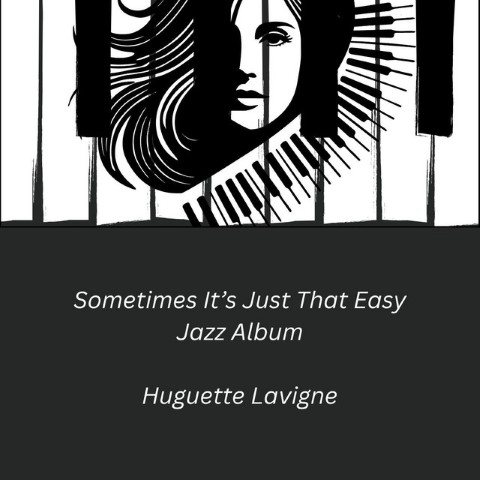
Ottawa Pianist and Composer Huguette Lavigne Finds New Audiences For Solo Jazz On “Sometimes It’s Just That Easy,” Out Now
For more than a decade, Huguette Lavigne has built a devoted audience the old-fashioned way, one improvised piano piece at a time. Her sixth album, Sometimes It’s Just That Easy, arrives at a moment when instrumental music is finding an entirely new generation of listeners, and the Ottawa based pianist and composer is proving that music built entirely on feel can speak to both a longtime jazz crowd and a much younger one discovering it for the first time.
The album’s title track captures exactly why. Lavigne describes the song as arriving almost like a gift, flowing out as a single uninterrupted improvisation that captured its exact emotion on the first try. Only minor refinements were needed to bring it to its final form, a reminder, in her words, that beauty does not always require overthinking or constant striving. That same spontaneous spirit runs through every piece on the record, with no two performances ever sounding quite the same, since each one takes on a fresh life of its own in the moment it is played.
Six of the album’s tracks are earlier jazz compositions drawn from Lavigne’s catalogue, while four are entirely new works for solo jazz piano, together tracing what she calls the evolution of her musical voice, rooted in jazz, shaped by improvisation, and open to unexpected paths. Among the new pieces is “First and Second Light Raga,” an Indo jazz composition that marks a fresh creative direction for Lavigne. Rather than following the traditional structure of Indian raga, she draws on its meditative character, its gradual unfolding, and its expressive freedom, letting jazz and Indian inspired elements meet and converse through the voice of the piano.
Lavigne’s process has always leaned on instinct over notation. She does not fully write down her compositions, instead relying on a personal shorthand to guide her recall for future performances, sketching lightweight roadmaps with just the essential checkpoints needed to keep a take’s magic alive in the studio. It is an approach that has defined her catalogue since her 2015 debut, ‘Black Tie Affair,’ through ‘Yin and Yang,’ ‘Free and Easy,’ ‘Five O’Clock Somewhere,’ and ‘Jazzed Up Dreams.’
That same wordless, feeling first quality is exactly what is drawing new ears to instrumental music right now. A generation raised on algorithm driven playlists, lo fi beats, and focus and study soundtracks has developed a genuine appetite for instrumental piano, often discovering artists through short clips and mood-based platforms rather than radio. Lavigne’s music, unhurried, improvisatory, and free of lyrics to translate or explain, fits naturally into that listening culture, offering younger audiences an entry point into jazz piano without asking them to abandon the immersive, background friendly way they already listen. At the same time, the emotional depth and structural sophistication in pieces like “First and Second Light Raga” continue to reward the close, attentive listening her longtime jazz audience has always brought to her work, meeting both audiences on their own terms rather than choosing between them.
Lavigne’s releases have consistently drawn attention from Canadian outlets including Cashbox Canada, Tinnitist, Canadian Beats, In The Cooler, and more, which have covered singles such as “Piano Retro,” “Rails,” “Pixie Dust,” and “Jazzed Up Dreams” across her recording career, each highlighting her improvisational process and the wide ranging influences, from Neo Classicism and Neo Romanticism to Minimalism, folk, and classical music from India, that continue to shape her sound.
With Sometimes It’s Just That Easy, Huguette Lavigne offers proof that music built on pure feeling never really goes out of style, it simply finds its way to whoever is ready to listen.
Huguette Lavigne’s new album proves instrumental jazz piano built on pure improvisation can speak to longtime listeners and a whole new generation discovering it through their headphones today.
Hi, Huguette! Good to see you again! Care to introduce yourself to the readers for those not familiar with your music?
Thank you for this opportunity to share my music with a wider audience. I’ve always been drawn to sitting down at the piano and simply creating—spontaneous discovery has always felt far more rewarding to me than practicing scales or mastering existing repertoire. My catalog now spans over 65 original piano works across a variety of genres.
It’s fascinating how a piece takes shape; while the initial spark behind a composition isn’t always clear, the magic happens in the moment of improvisation when a striking melodic idea or compelling pattern emerges. Ultimately, what fulfills me most is bringing these pieces to completion and sending them out into the world for others to enjoy.
You said the track “Sometimes It’s Just That Easy” arrived almost like a gift, flowing out in a single uninterrupted improvisation you barely had to retouch afterwards. What do you remember about the moment you sat down and played it? Was there something specific happening in your life right before that?
I was at my piano, wanting to create a new piece, preferably jazz. I was searching for an opening phrase or song starter, and a few notes just played in my mind as my right hand wandered across the keyboard. The left hand was cooperating nicely with great stuff. I liked it; it was going to be a slower jazz piece, and then I banked it. After that, I sat down and played the opening a few times, then continued adding to the piece. It just flowed. And I think that I recorded it again, and the piece unfolded in no time at all during an afternoon. Of course, changes are made along the way, such as chord changes or the refinement of a musical sentence, etc. And then, I obsess over it, my fingers more or less memorizing but, God help me, changing stuff every time I play it. I’m always recording every good melodic little treasure that comes along. I have a bank, so to speak. Actually, I have several banks: jazz, country, classical, minimalistic, neo-classical, Indo-classical, French songs, etc. I also try to stick to the original vision and inspiration throughout the creation of a new piece. After all said and done here, no, there was no specific drama happening in my life at that moment. God knows there’s drama, but not that afternoon!
Six tracks on this album are earlier compositions, and four are entirely new. What made you want to place older and newer work side by side instead of making this a purely new album?
I have written in several genres over a decade. So perhaps because I’m visual, I’m starting to think I can categorize them. This winter, after composing 4 new jazz songs and a country song- yes, country, because I almost went to Nashville in the spring, and this song came about: “A Simple Country Waltz.” I just decided to put my jazz catalogue, so to speak, under the umbrella of an album. And sometimes it’s just that easy; all my jazz pieces more or less flow out as the album’s title says.
You’ve built your audience over more than a decade, one improvised piece at a time. Was there a specific point where you felt the audience shift, where you noticed new, younger listeners finding you differently than your longtime jazz friends had?
The difference could be that young listeners are creating and evolving every day or looking for a fresh approach, whereas longtime jazz fans find comfort in what inspired them when they were young. You just have to attend the Montreal Jazz Festival or others to see the shift in jazz nowadays. Yes, the youth need to hear, see, and experience new visions. I may be bringing some of that to them. But make no mistake, the young are building on the foundations of the past. They are adding to those foundations every day. As a pianist and composer, I came along and broke a few rules of classical music, etc.; that could be it. I refuse to write everything down laboriously. What a joykiller, in my opinion. Besides, there’s technology for that. Streaming and social media have also exposed young people to a vast new world of artists who are redefining how they are discovered and contribute.
You’ve described your process as leaning on feeling over overthinking. In an industry that often rewards constant output and polish, was that trust in simplicity something you had to learn, or has it always been how you worked?
Have I described my process as leaning on feeling over overthinking? I don’t know why this makes me pause to think. Ha! Perhaps I did. However, I think I choose what comes naturally to me, instinctively perhaps? Everything else be damned, perhaps. The way I work is just me. Is it unique? I don’t know. Does it work for me? Yes. Why? Because it brings me joy. That’s it.
Connect with Huguette Lavigne:
Website