
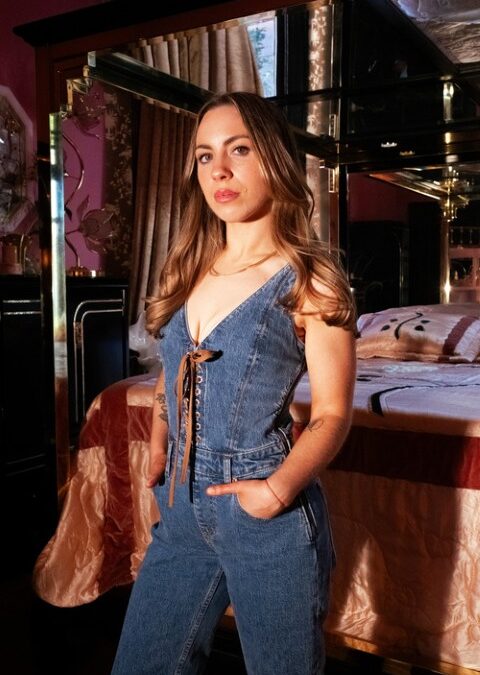
Nashville Newcomer And LGBTQIA+ Champion Abby Nissenbaum Flips The Script On Country Music’s Favourite Fantasy With New Single “Gentleman”
Abby Nissenbaum has never been shy about calling out the gap between what country radio promises and what it actually delivers, and on her outrageous, rip-roaring new single “Gentleman,” she takes direct aim at the genre’s most persistent myth: the dream cowboy. The track, released alongside her sophomore full length ‘Want To Be Wrong,’ arrives as a cheeky, big-hearted rebuttal to every love song written about a man who talks a big game and delivers the bare minimum.
Nissenbaum wrote “Gentleman” the way she’d talk to a friend whose boyfriend simply isn’t showing up for her, and then, with characteristic nerve, offered herself as the alternative. “All these boys they talk too much, act like they’re superior,” she sings, before landing the song’s central proposition with disarming warmth: “And I know you don’t need a hand, but if you’d like a soft place to land, then I can be your gentleman.” It’s a lyric that manages to be funny, tender, and quietly radical all at once, a hallmark of Nissenbaum’s writing.
The Brooklyn-born, Connecticut-raised, Nashville-based artist has spent the past five years building a catalogue that includes over a dozen singles and three EPs, earning acclaim from GLAAD, Atwood Magazine, Notion, Clash, Wonderland, and Nashville Scene, along with playlist support from Country Music Television, LGBTQ Music Chart, and The AU Review. A classically trained soprano with a lifelong relationship to music, Nissenbaum arrived in Nashville in 2021 after a previous career as a data analyst and sexual violence prevention researcher, a background that continues to inform the empathy and sharp social observation running through her songwriting.
For “Gentleman,” Nissenbaum turned to producer Martin Trevox, with additional production from Fede Catenaro, asking them to blend the sound of 80s and 90s country pop icons The Chicks, Reba McEntire, and Melissa Etheridge with a modern indie singer-songwriter sensibility. The result is a track that feels both nostalgic and entirely of the moment, honouring the genre’s melodic instincts while dismantling its more tired conventions from the inside.
Nissenbaum extended the song’s thesis into its visual companion, directed by Oceanna Colgan. Rather than lean into the tractor driving, beer drinking, football playing archetype the song is needling, the video finds Nissenbaum, barely five feet tall and unmistakably femme, on the tennis court instead, trading the expected country imagery for what she calls the most New England sport there is. It’s a visual joke with real teeth, and one that underscores Nissenbaum’s broader project of making space for queer perspectives inside a genre that hasn’t always made room for them.
That project extends well beyond her music. As an out lesbian artist, Nissenbaum uses her platform to champion LGBTQ rights and acceptance, and she remains an active advocate for sexual violence prevention, partnering with organisations including the Tennessee Coalition to End Domestic and Sexual Violence and Anthems Against Abuse on benefit programming. She has also lent her voice to video games, most recently voicing Quin Hawthorn in ‘Benevolent.’
Hi, Abigail! Good to meet you! Care to introduce yourself to the readers for those not familiar with your music?
I’m Abby, and I’m a currently Nashville-based singer-songwriter from Connecticut making music across the indie pop space. Lately, though, I’ve been creeping more and more into pop-Americana/pop-country territory, no doubt influenced by living in Nashville. I write mostly about relationships, heartbreaks, and mental health from an LGBTQ+ artist perspective, but I try to write in a way where listeners even outside my demographic can relate and hopefully derive some meaning from my music.
“Gentleman” takes direct aim at the dream cowboy myth country music has been selling for decades. Was there a specific relationship, or a specific song on the radio, that finally pushed you to write the rebuttal?
Probably the most obvious nod is to 90s Shania. “That Don’t Impress Me Much,” “Any Man of Mine,” “Whose Bed Have Your Boots Been Under,” etc. all call back to the idea that just because there’s a male love interest in a song, he isn’t necessarily the prize just by nature of being there! On the other hand, I was also obviously thinking about The Chicks’ “Cowboy Take Me Away,” where an idealistic portrait is painted of some country guy who will sweep you off your feet. I wanted to write almost the antithesis of that: Sure, you might have a whirlwind adventure, but does he treat you well long-term? And I’m totally biased because I think nobody can treat a woman better than a woman. So “Gentleman” is my counteroffer to the cowboy fantasy.
You asked your producers to blend The Chicks, Reba McEntire and Melissa Etheridge with a modern indie sensibility. What did each of those artists specifically bring to how “Gentleman” ended up sounding?
I love how irreverent The Chicks are, and they were probably the single biggest reference for the overall feeling of the song. I was looking to capture their wit and playfulness in the song, but I still wanted it to have teeth. We also used a few Reba McEntire songs as references, particularly “Consider Me Gone.” I love Reba’s theatricality and how the verses are a little more conversational, leading to a big belty chorus with a ton of emotion. And, of course, I am a longtime fan of Melissa Etheridge as she is an icon in the lesbian community. She has a signature grit to her voice that I can’t quite emulate, but she’s definitely an inspiration in terms of blending pop-rock sensibilities with folk-country elements.
You came to Nashville in 2021 after a career as a data analyst and sexual violence prevention researcher. How much of that research background shows up in how you build a lyric, even one as playful as this one?
I think it’s always present in my music, especially in a song like “Gentleman” where the lyrics flip concepts of heteronormativity and prescribed gender roles. More specifically, though, a lot of my research in grad school focused on masculinity and how cultural scripts and self-concept about gender impacted men’s bystander intervention in sexual violence scenarios. I’m fascinated by all of the scripts surrounding masculinity and how it’s performed, so I’m just always thinking about it even if it’s in a more playful way like the song “Gentleman.” But then I also have songs like “Perfect Crime,” which are more pointedly about sexual violence, who gets believed and who doesn’t, and just heavier topics in that realm.
As an out lesbian artist writing inside a genre that hasn’t always made room for queer perspectives, does a song like “Gentleman” feel like it’s rewriting the rules from inside the format, or stepping outside it entirely?
Queer country has always been around, whether people understood it as such or not. I can’t pretend I’m doing something novel when artists like k.d. lang, Lavender Country, Chely Wright, Brandi Carlile, and so many others have been holding down the rainbow fort for LGBTQ+ individuals in and around the country, Americana, and folk genres for decades. I think what makes my music interesting is that I’m appealing sonically to a growing interest in Northern/New England country music, which I’d categorize as country or folk music filtered through a different regional vocabulary and vibe. I’d say sonically, it’s less twangy and can sometimes have a maritime ballad vibe, no doubt inspired by the coastal landscape of New England. And then aesthetically, it’s less about honky tonks, ranches, and tractors, and more about charming small towns and the sense of isolation that comes in the dead of winter. I’ve been using the term “Sapphic cold weather country” to describe the type of music I want to lean further into making, and think that just about says it all!
Connect with Abby Nissenbaum:
Website
Bandcamp
Facebook
Instagram
TikTok