
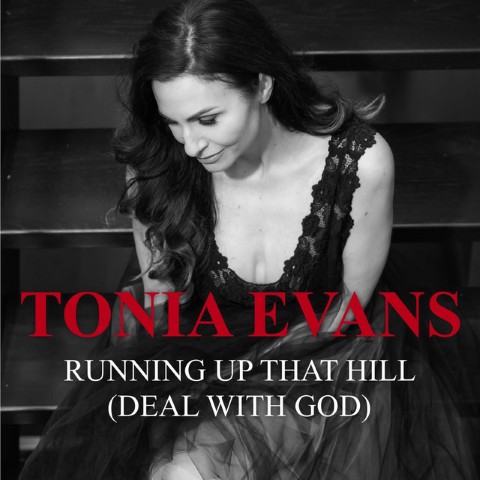
Toronto Singer Tonia Evans Sings Her Way Through Betrayal Trauma on “Running Up That Hill”
Toronto based, Newfoundland born singer-songwriter Tonia Evans (Cianciulli) releases her deeply personal cover of Kate Bush’s “Running Up That Hill,” out July 16, 2026, from her forthcoming album ‘Love Me Till I’m Me Again.’ For most artists, a cover song is a chance to reinterpret a classic. For Evans, this one is something far more significant: the only song, she says, that could carry the weight of the past year of her life.
A year ago, Evans filed for divorce after 23 years of marriage, following a discovery that unravelled a relationship she had believed in completely.
“Three years ago, the answers arrived unexpectedly through an avalanche of anonymous emails, text messages, and even a Bell payphone call containing details and photographs of a betrayal that would ultimately unravel a 27-year relationship and forever change the course of my life,” she says. “Healing through betrayal trauma has been messy, emotional, and heartbreaking as a woman, a mother, and an artist, it will never define who I am. However, it has moulded me in ways I never could have imagined, stronger, more resilient, and more unapologetic than ever before.”
“Running Up That Hill” had been on Evans’s mind for years before circumstances finally brought it to life. In January 2026, during what she describes as one of her lowest points, she received an offer with just 24 hours to choose a song, rehearse it, and prepare for a one-hour vocal session.
“I immediately knew this was the moment for Running Up That Hill,” Evans says. “I dragged myself out of bed and into the recording studio to trust the process of an opportunity that spontaneously presented itself.”
The core vocals came together in only a few takes with engineer Anthony Wright.
“Vocal coach Lorraine Lawson was present that day, and has helped me unlock a deeper, more vulnerable expression when it comes to popular music. There were goosebumps. There were tears. We got what we needed,” Evans recalls. “I truly felt like God’s hand was on my voice that day, especially as I sang the words, make a deal with God. Those lyrics no longer felt like they were directed toward another person. I was singing them to myself.”
Kate Bush herself once described the isolation that shaped her songwriting: “I had friends but I was spending a great deal of my time alone and for me that was vital because there’s an awful lot you learn about yourself when you’re alone,” a sentiment that echoes through Evans’s own reinterpretation of the song, four decades later, from an entirely different vantage point.
For Evans, the song is not a lover’s quarrel, but a conversation between who she is today and the woman she says she abandoned for years.
“It is an apology to my inner child, to the voice I ignored, dismissed, and even gaslit into silence,” she explains. “Betrayal trauma isn’t only about infidelity. Sometimes the deepest betrayal is abandoning yourself.”
That reckoning was shaped in part by her training with the Institute of HeartMath, where she learned that the heart and body often recognize danger before the mind can make sense of it, a lesson she says became deeply personal in hindsight.
The recording itself was built to favour honesty over polish.
“Sung with raw vulnerability rather than polished perfection, these performances invite listeners into the messy, beautiful process of becoming fully human,” Evans says. “I am no longer interested in hiding behind the technical excellence or carefully curated appearances of the classical music industry. I am interested in truth.”
That same philosophy carries into the accompanying music video, created with director DIMMANTI, shot in black and white as a visual metaphor for honesty. “After living through years of deception, I believe more than ever that honesty is the only path to freedom, even when it hurts,” Evans says of the video, which stages a conversation between her present self and the younger woman who, she says, always knew the truth.
The single was produced, recorded, mixed, and mastered by Dima Graziani, who also contributed piano and synth to the track, bringing the same textured, cinematic sensibility that has defined Evans’s recent releases. “Running Up That Hill” arrives alongside previously released originals “Bravery,” “Churchyard Roses,” and “Thousand Cries,” with ‘Love Me Till I’m Me Again’ rounded out by a series of emotionally resonant covers, including “Lightning Crashes,” “Runaway,” “Fix You,” and “Say My Name,” each chosen for its place in the soundtrack of Evans’s own healing.
Originally trained in church and classical music, Evans built her early reputation performing with the Cambridge Symphony Orchestra, Toronto Concert Orchestra, Southern Ontario Lyric Opera, and Casa Loma Symphony Orchestra. She has since become one of Canada’s most passionate interpreters of Newfoundland’s musical heritage, recognized by CBC for her work reviving the legacy of the province’s first international opera star through her award-winning biography, The Heart’s Obsession: An Intimate Biography of Newfoundland Songstress Georgina Stirling, co written with her grandfather, historian Calvin D. Evans. Beyond music, Evans is a Registered Psychotherapist (Q) supporting women, mothers, and adolescents through life’s transitions at A Mother’s Journey Therapy Clinic, the founder of the non-profit Wish Arts, and the author of the children’s book “Flick Your Heart-Light On, Let Your Fears Be Gone!”
With this release, Evans is also reclaiming a piece of her own identity, returning to her family name as she steps into what she calls a bold new chapter rooted in truth, healing, and the courage to become fully herself.
“Welcome back, Tonia Evans,” she says simply. “This next chapter of music is rooted in radical honesty, healing, and rediscovering who I am.”
Hi, Tonia! Good to see you again! Care to introduce yourself to the readers for those not familiar with your music?
I’m Tonia Evans—a Newfoundland-born singer-songwriter, classically trained vocalist, author of two books, therapist, mother, and, at this stage of my life, a woman learning to come home to herself.
For those who may not know my music, my work has always lived somewhere between technical excellence and emotional truth. I’ve spent years performing and developing my voice through classical training, but increasingly, I’ve found myself drawn toward music that allows me to be vulnerable, imperfect, and completely human.
My upcoming album, Love Me Till I Am Me Again, took a major detour because of life circumstances. It was born during one of the most transformative and painful chapters of my life, following the end of a 27-year relationship and the realization that much of what I believed about my marriage and my life was not what it appeared to be.
That experience changed the way I make music. I’m less interested now in hiding behind perfection or presenting a carefully curated version of myself. I want the songs to tell the truth. Sometimes that truth is beautiful, sometimes heartbreaking, and sometimes uncomfortable—but it’s mine.
Alongside my original songs, including “Bravery,” “Churchyard Roses,” and “Thousand Cries,” I’ve included several covers that have become part of the soundtrack of my life, including “Running Up That Hill,” “Lightning Crashes (Live),” AURORA’s “Runaway,” Coldplay’s “Fix You,” and Florence + The Machine’s “Say My Name.”
As an artist, I’m interested in the space where music becomes more than performance—where a song can hold grief, anger, hope, faith, healing, and even an apology to the person you used to be.
I think that’s where I am right now: rediscovering who Tonia is when she isn’t performing a version of herself for anyone else.
And perhaps that is what this next chapter of my music is really about—coming home to myself, one song at a time.
You had just 24 hours to choose a song, rehearse it, and record it. What made “Running Up That Hill” the immediate, obvious answer instead of any of the other songs that have carried you through this year?
“Running Up That Hill” was the immediate answer because, in that moment, I wasn’t really choosing a song. I was choosing a conversation with myself.
I had wanted to record Kate Bush’s “Running Up That Hill” for years, but I never imagined I would record it under these circumstances. During the production of my original album, Love Me Till I Am Me Again, the project became deeply intertwined with my healing after filing for divorce from a marriage that was not what I believed it to be.
I had spent years silencing parts of myself, questioning my instincts, and being told I was “too sensitive,” “too paranoid,” or “too dramatic.” So when I was given the opportunity to record at Toronto’s MDC Music Studios, with only 24 hours to choose a song, rehearse it, and prepare for a one-hour vocal session, there was no time to overthink it.
I knew immediately: this was the song.
The night before the session, I sat at the piano and practiced with a backing track I found on YouTube. My producer, Dima Graziani, slowed the tempo down quite a bit until it felt intimate enough for what I needed to say. I’m a big believer in really enunciating lyrics—not simply so people can understand the words, but so they can hear the emotion inside them.
I remember feeling incredibly low that night. At one point, I was sitting at the piano with my head in my hands, singing through the track, and I thought, Tonia, I’m so f-ing sorry I ignored you for so many years.
I was sorry I didn’t listen to myself. Sorry I had learned to dismiss my own instincts. Sorry I had pushed my feelings and worries down and convinced myself everything was okay.
Looking back, my body knew every time something was wrong. There were moments when I couldn’t prove what I sensed until the facts eventually came to the surface. For a long time, I’d hear the word ‘run’, on repeat in my head. But I had learned not to trust myself.
That became one of the most painful parts of my healing.
So, when Kate Bush sings about making a deal with God, I no longer hear it simply as a conversation between two people in a relationship. I hear it as a conversation between the woman I am today and the woman I abandoned for years.
Eventually, an avalanche of anonymous emails, text messages, photographs, and even a Bell payphone call brought details of a betrayal to light—details that would ultimately unravel a 27-year relationship and change the course of my life.
But by then, I had already begun to understand something profound: betrayal trauma isn’t only about what another person does to you. Sometimes the deepest betrayal is the way you abandon yourself trying to keep everything else intact.
That is why this recording feels like an apology.
I felt I desperately owed myself one.
“Running Up That Hill” became my apology to my inner child, to my intuition, and to the woman who knew something was wrong long before she had the evidence to explain it.
It became a way of saying: “Welcome back, Tonia. I hear you now.”
You’ve said the lyrics stopped feeling like they were directed at another person and started feeling like you were singing to yourself. At what point during that session did that shift happen, and did you realize it was happening in the moment or only afterward?
I think the shift actually happened before I ever walked into the studio. It happened the night before, sitting at the piano.
I was singing through the song, and suddenly the lyrics stopped feeling abstract. They became a conversation with myself.
When I sang “make a deal with God,” I wasn’t thinking about another person anymore. I was thinking about all the years I had spent overriding my own intuition, silencing my concerns, and convincing myself that everything was okay when some part of me knew it wasn’t.
And I remember thinking, Tonia, I’m so f-ing sorry.
Sorry I didn’t listen to you. Sorry I ignored you. Sorry I made you believe that your feelings were the problem.
That was the moment the song became an apology.
But I don’t think I fully understood the significance of that shift until I was in the studio. The next day, when Anthony Wright was recording the vocals, everything I had felt the night before was still there. Coach and friend Lorraine Lawson picked up on this and helped me put this perspective into words. There were goosebumps. There were tears. I didn’t have to manufacture any emotion. It was already sitting underneath the song.
So, yes, I realized it was happening in the moment—but I understood what it meant more clearly afterward.
At the time, I was simply trying to sing the song honestly. Looking back, I realize I wasn’t really singing about wanting to change places with someone else. I was grieving the years I had spent disconnected from myself.
There is a particular kind of grief that comes with realizing you didn’t trust yourself when you should have.
And I think that is ultimately what the song became for me: not a request to change the past, but a way of reconciling with myself—to forgive the woman who survived the only way she knew how and finally listen to the voice I had spent so many years silencing.
That’s why the recording feels so intimate.
I’m not performing an emotion.
I’m having a conversation with myself.
You’ve spent your career on stages built around technical excellence—symphony halls, opera. What was it like choosing to sing this one in a way that prioritizes rawness over that polish, and was that a hard instinct to trust?
It was both liberating and terrifying.
I’ve spent much of my career in environments where technical excellence is deeply valued—where you work for years on breath control, placement, diction, phrasing, intonation, and the ability to deliver a consistent performance. I’m incredibly grateful for that training because it gave me a strong foundation.
But there is a difference between singing something correctly and singing something truthfully.
With “Running Up That Hill,” I knew that if I polished away every imperfection, I would also be polishing away the story.
I wanted people to hear the breath. I wanted them to hear the emotion in the words and the notes. I wanted the moments where the voice catches or cracks to remain, because those moments tell you something about the person singing them.
That was difficult to trust because my training had conditioned me to hear those things as problems to solve. As a classical vocalist, you’re taught to control the instrument. But sometimes control can become a barrier between the singer and the listener.
This song needed me to let go of some of that control.
I wasn’t trying to sound broken. I was allowing myself not to hide the places where I was broken.
That’s very different.
My classical training is still in my voice, and I wouldn’t want to erase it. But I’m learning that technique should serve emotion, not protect you from it.
There was something deeply humbling about realizing that the voice doesn’t have to be perfect to be powerful. Sometimes the most meaningful sound is the one that happens when you’re trying not to cry, when your breath changes, or when a word carries more weight than technique can contain.
Was it hard to trust?
Absolutely.
But this chapter of my life has taught me that authenticity requires a different kind of courage than perfection does. Perfection says, “Look how well I can do this.”
Vulnerability says, “This is who I am. This is what I lived. This is what it sounds like.”
For this song, I chose the second one.
You’re returning to your family name with this chapter of music. What does reclaiming that name mean to you practically, in daily life, beyond what it represents symbolically on the album credits?
Reclaiming the name Tonia Evans means bringing my private life and my public life back into alignment.
Practically, it means waking up every day and not having to compartmentalize who I am, what I’ve lived through, or what I believe anymore.
For so many years, I became very good at performing the version of myself I thought was expected of me. Coming back to my family name is part of letting that go.
It means signing my name with peace. Introducing myself without hesitation. Making decisions from a place of truth rather than fear, obligation, or the need to maintain an image.
It also means allowing my children and the people closest to me to see me as a whole person—not just the woman who held everything together, but the woman who chose to come home to herself.
And there is another dimension to reclaiming that name for me.
Evans isn’t simply a name I’m returning to. It’s a lineage I’m reconnecting with.
I was born in St. John’s, Newfoundland, and I carry deep Welsh roots. As I’ve learned more about my family history, I’ve come to understand that identity isn’t only about where we’ve been; it’s also about what has been carried forward through generations.
That’s something I explore in my original song “For Love of a Woman,” which was inspired by the true story documented in my grandfather Calvin Evans’ book of the same name.
The song tells the story of my ancestor Edward Evans, who, in 1841, risked everything by leaving his ship on Newfoundland’s west coast for the love of Caroline, the woman who would become his wife. Their decision became the beginning of generations of Evans family history in Newfoundland.
There’s something incredibly meaningful to me about that story right now.
He chose love, courage, and a new life—and that choice shaped generations that came after him.
In some ways, I feel I’m standing at another point in that lineage where I have to make my own courageous choices about who I am and what kind of life I want to carry forward.
Reclaiming Tonia Evans isn’t about going backward.
It’s about moving forward with the wisdom of where I came from.
I want to bring together all the parts of my story that have always been there—the Newfoundland and Welsh heritage, the classical training, the songwriter, the therapist, the mother, the woman who has experienced profound heartbreak, and the woman who is still choosing hope.
I don’t want to hide behind a name, a résumé, a polished performance, or an identity that no longer feels like mine. I want the person making the music and the person living the life to be the same woman.
I want my name to feel like home again.
And perhaps that’s what I’ve been discovering through all of this: home was never just a place or a name.
It was the part of me I was always trying to find my way back to.