
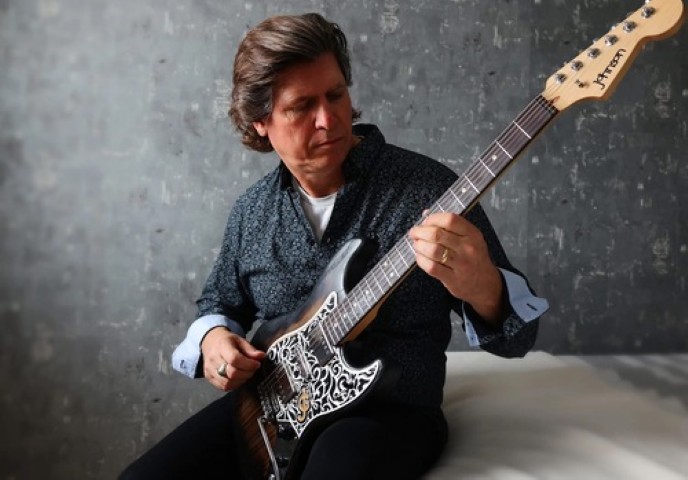
Toronto guitarist Jeremy Green reaches #1 on the Jazz Fusion chart with In Motion, featuring an all-star lineup of musicians.
Toronto-based guitarist, composer, and producer Jeremy Green is making waves with his second full-length album, In Motion, which has reached #1 on the Roots Music Report Jazz Fusion chart and #3 on its overall Jazz chart.
Featuring an impressive lineup of musicians, including Mike Stern, Will Lee, Keith Carlock, Oz Noy, Tim Lefebvre, and Jimmy Haslip, the eight-track instrumental album blends contemporary jazz fusion with personal storytelling, exploring themes of memory, family, friendship, and the experiences that shape our lives.
Led by the single “The 55,” In Motion marks Green’s return to composing following a period away from writing. The album embraces improvisation, energetic grooves, and spontaneous musical collaboration, creating a collection that feels both deeply personal and musically adventurous.
The album’s success follows Green’s acclaimed 2021 debut, Standing Eight, which also reached #1 on the Roots Music Report Fusion Albums chart. The record earned international radio airplay and recognition from publications including Guitar Player and Sea of Tranquility.
Jeremy Green In Motion – The Stories Behind the Album
Throughout In Motion, Green draws inspiration from meaningful places and personal experiences.
“The 55” pays tribute to New York City’s legendary 55 Bar, where Green spent time absorbing performances by musicians including Mike Stern and Tim Lefebvre. Both artists appear on the track, creating a musical connection to the iconic Greenwich Village venue.
Elsewhere, “Where the Sun Shines the Brightest” offers a heartfelt tribute to Green’s three children, while “Queen West” captures the vibrant energy of one of Toronto’s best-known streets.
The album closes with “Sir Robin,” an emotional tribute to Green’s lifelong friend Rob White, featuring a moving saxophone outro from Chase Baird.
Produced by Green and mixed and mastered by Nashville’s Jerry Guidroz, In Motion showcases the guitarist’s ability to balance technical musicianship with emotional expression.
Fans will have the opportunity to experience the music live when Jeremy Green performs at Toronto’s Jazz Bistro on November 14, 2026.
Jeremy Green – Interview
We caught up with Jeremy Green to discuss the inspiration behind In Motion, collaborating with some of the world’s most respected musicians, the personal stories woven throughout the album, and what audiences can expect from his upcoming Toronto performance.
Hi, Jeremy! Good to meet you! Care to introduce yourself to the readers for those not familiar with your music?
I’m a Canadian guitarist from Toronto, and I’ve been performing and recording in and around the city since the mid-1980s. My early years were spent playing in tribute bands, before I moved toward original projects and fusion music in the 1990s. Much of my career has centred on studio work. With three children, family became my primary focus, and the demands of touring and late-night gigs became harder to balance. I therefore gravitated toward music projects I could pursue while still being present for family life.
Your new album ‘In Motion’ brings together an extraordinary lineup of musicians, including Mike Stern, Will Lee, Keith Carlock and Oz Noy. When you’re writing for players of that calibre, how much of the music do you plan in advance, and how much do you leave open for their personalities and improvisation?
I usually start by creating the song structure as a solo guitar piece. Players of this caliber are incredible when you give them room to let loose, so I generally try to get out of their way. The bass players get the basic harmonic structure, but they’re free to change it if they hear another direction that serves the composition. I also give each player a solo section where they can really go for it.
I think of musicians a bit like tools in a toolbox: we all have things we do particularly well. When I write something that suits a specific player’s style, that’s the person I want to hear on it. More often than not, they bring exactly what the music needs.
Keith Carlock is the exception in one sense: I literally love everything he does! We work really well together, and it’s always a pleasure.
“The 55” pays tribute to New York’s legendary 55 Bar, where you watched musicians like Mike Stern and Tim Lefebvre perform, and now they’re playing on your own tribute to that venue. What did that room teach you about music, and what was it like bringing those influences full circle?
As much as I loved going to 55 Bar, the piece is also a tribute to the small, intimate venues like it that exist around the world. Sadly, these places are becoming harder to sustain. Inner-city real estate is expensive, and those little hole-in-the-wall venues have to work incredibly hard just to stay open.
That’s a real loss, because these rooms are breeding grounds for musicians. They’re places where players can experiment, develop their sound and learn from one another in front of an audience. If we lose them, we lose some of the fertile ground that the music community desperately needs. Having musicians who helped make that scene so special play on a piece inspired by it felt like a wonderful way to bring things full circle.
Several tracks on ‘In Motion’ are deeply personal, from “Where the Sun Shines the Brightest,” inspired by your daughter’s drawing, to “Sir Robin,” written in memory of your lifelong friend Rob White. How do you translate experiences like love, family and loss into instrumental music without relying on lyrics to tell the story?
More than anything, I’m trying to capture a feeling. “Sir Robin” was written the day after my old friend Rob passed away. That was where my head and heart were at the time, and the music simply came out of that place.
Sometimes I use musical parameters to help express an idea. For “Where the Sun Shines the Brightest,” for example, I used a 3/4 time signature to represent my three children. Setting up those kinds of limitations can help bring the vision into focus.
For me, the instruments and the way they interact usually create the emotional landscape of a piece. Lyrics can add a powerful layer when they connect with that feeling, but the emotion can be just as present without a vocal. I like the abstraction of instrumental music because it lets listeners bring their own experiences and emotions to it. Lyrics can sometimes tell us how to feel, whereas an instrumental piece can mean something different to every person who hears it. I love that openness.
You’ve now had two consecutive #1 jazz fusion albums and worked with some of the world’s most respected musicians, yet you’re still introducing yourself to many listeners here in Canada. What do you think people misunderstand about jazz fusion, and what do you hope audiences experience when they see you perform ‘In Motion’ live at Toronto’s Jazz Bistro on November 14?
I think jazz fusion is best experienced live. Music like this is meant to be felt in the room, where you can witness the communication between the musicians onstage. That interaction is part of the art, and it doesn’t always come across as strongly on a recording.
I encourage people to come out and experience it for themselves. Improvised music is a one-of-a-kind work of art that will never be repeated in exactly the same way. Every visit to a jazz club can offer something unique. With AI and so much else shaping our world, there seem to be fewer truly one-off experiences left. Live music is one of them, and I believe we need it to thrive now more than ever.
Connect with Jeremy Green:
Website | Bandcamp | Facebook | Instagram | TikTok