
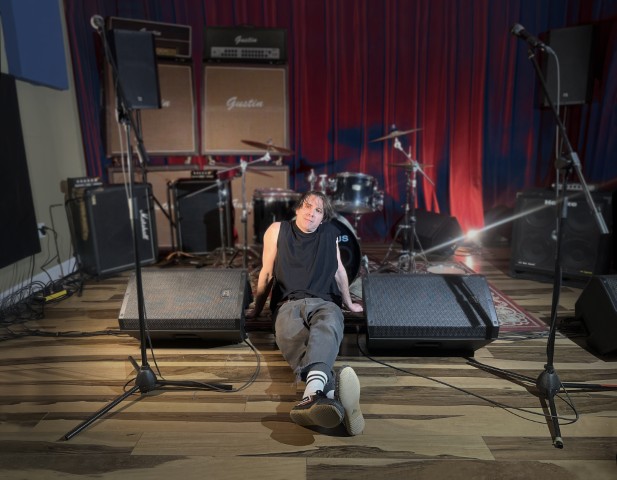
Finding freedom between indie rock, electronic experimentation, and the unknown.
Montreal artist Hey Gorgeous has spent the past several years quietly building toward International Breakthroughs, a debut album that blends indie rock, electronic experimentation, and deeply personal reflections on movement, identity, and creative freedom.
Led by multidisciplinary artist Peet Massé, the project explores both physical and psychological journeys, embracing uncertainty, contradiction, and the search for connection beyond familiar boundaries.
With the release of the new single and video “Rocker on a Club Run” — a restless anthem navigating the space between alternative rock and house music culture — we caught up with Massé to discuss artistic convergence, creative evolution, and the road to International Breakthroughs.
You’ve been releasing music as Hey Gorgeous for several years now. What made this feel like the right moment to finally release a full-length debut album?
I was actually just waiting to finish the Master’s degree in Fine Arts that I had been pursuing full-time over the past two years before fully returning to music. I completed the final mastering of the album right before starting the program. During that period, releasing a few singles seemed like the right thing to do.
What I really wanted, however, was the opportunity to dedicate myself entirely to the project before releasing the full album. Now that the degree is finished, the timing feels perfect.
The title International Breakthroughs is intriguing because it suggests both travel and transformation. What does the title mean to you?
Travel, in this album, is explored in two dimensions: the geographical one (the discovery of new territories, cultures, languages, etc.) and the introspective one that stems from it (going through life-changing experiences with amazing people around the world; how travel leads to personal growth, wisdom, and open-mindedness; how it helps you set and achieve goals; and how it allows you to build or rebuild yourself in the best possible way).
That is the premise behind the album’s theme, and it is partly how I arrived at the title International Breakthroughs. However, I need to elaborate on some important details because those details are at the very heart of the project and are based on real-life experiences.
I always wanted to release music, but I developed professionally first as a multidisciplinary visual artist whose practice revolves around sculpture. For whatever reason, in my twenties I focused more on visual art so I could devote the necessary time and energy to eventually make a living from it.
Back then, I had the somewhat naive ambition of becoming both a musician and a visual artist. Then life showed me how difficult it was to succeed in just one discipline, so I chose to concentrate on visual art for a while, believing I was better at it at the time. It was a pragmatic decision.
I had been playing guitar and writing music for as long as I can remember, but I simply wasn’t releasing anything. Finding the money to produce music, buy equipment, and maintain a studio that wasn’t really adapted for recording, while already working sixty hours a week as a visual artist mostly just to pay the rent, made it difficult for a second artistic practice to flourish.
Over the years, however, I began earning a bit more money through public art projects, better-paid exhibitions, and a couple of significant art grants. Around 2019, I was finally planning to take some much-needed time off and travel somewhere far from home—Asia, perhaps—and enjoy the rewards of all that hard work.
Then the pandemic hit.
Suddenly, I was stuck at home, isolated, unable to travel, yet for the first time in my life I had some financial stability. I decided to take it as a sign from the universe and turn an unfortunate situation into an opportunity. I began recording an album.
While writing the songs, a recurring feeling kept returning. I had reached a stage in my life where I felt tremendous gratitude for what I had achieved, both professionally and personally. That gratitude compelled me to take a step back and reflect on the previous decade—a period that was deeply intertwined with my professional rise as an artist.
That rise was long and demanding, and like many artists trying to establish themselves, it placed me in a kind of parallel world. It was a genuine journey. The challenges you face are not shared by many people. It is its own unique experience, and it is difficult.
Yet it can also be profoundly inspiring, offering countless opportunities for personal growth if you are willing to develop the resilient, soldier-like mindset the profession often requires.
I also see that journey as a form of travel, albeit a more philosophical and introspective one. To embark on such a path, you need a certain disposition because it is undeniably challenging. At the same time, you can learn to build yourself into the kind of person who can thrive within it, and I find that process deeply inspiring.
I wish everyone could have the opportunity to experience this kind of cathartic yet enriching voyage, at least in the way that I did. It can be profoundly transformative.
The title International Breakthroughs reflects this idea. The plural “breakthroughs” refers to a series of personal and professional achievements, each of which felt like a breakthrough in its own right. Adding “International” places those breakthroughs within the broader theme of travel while also playfully borrowing from the language of the music industry.
Your latest single “Rocker on a Club Run” is described as the “party song” of the album. What role does it play within the larger narrative of the record?
I tend to write songs that are emotionally charged and introspective. That’s just my default state of mind. But every now and then, under the right circumstances (and sometimes the wrong ones), I turn into this weird clown, something of a Dr. Jekyll and Mr. Hyde situation.
I see that clown as a psychological mechanism that emerges whenever emotions, depth, and introspection become too heavy and need to be counterbalanced. It’s an inner voice that tells me to shake things up a bit, have a beer, and stop taking everything so seriously. It’s my way of restoring balance.
The deeper and longer I dive into introspection and emotional exploration, the more hard core that clown comes back. I use that side of my personality to expose some of my own failures and to address psychological and political issues through the lens of an antihero rather than through virtue. I find that portraying an asshole and illustrating flawed behavior through real-life mistakes is richer artistic material than moralizing. At this point, I’m pretty much done with virtue talk (unless it’s coming from Propagandhi, my favorite band, or a handful of particularly credible people). Social media and superhero movies killed it for me. We’re living in an era where everybody is virtue signaling, and it’s become a real pain in the ass. Put your integrity to the test in front of everyone. Throw yourself under the bus once in a while. Make yourself vulnerable. Create situations that force transparency upon you. It’s a very effective way to: 1) improve faster in every aspect of your life, and 2) connect with other people’s imperfections and their own attempts to become better.
I try to approach both visual art and music in that spirit. Virtue talk can be intimidating when trying to raise awareness about important issues, and it can ultimately become counterproductive. Some do it just well. But I’m trying something else. I’ve also noticed that a lot of virtue talk comes from the people who should be doing it the least. So there you have it: I have a clown avatar that helps me get this dirty job done.
Rocker on a Club Run, while not portraying the absolute worst version of myself, shines a spotlight on a raw, unfiltered, and self-critical side of my personality. Nut-Free—another even dirtier song on the album—draws from that same mechanism.
With that in mind, Rocker on a Club Run may not come across as what most people would consider a traditional party song, but it’s probably the closest I’ll ever get to partying in my music.
“Rocker on a Club Run” explores the tension between alternative rock and house music culture. Have you always felt pulled between those worlds, or is that something you’ve become more aware of over time?
I’ve observed that most people need to feel like they belong to a group. And that’s okay, it’s just human nature. But I’ve never really felt that way. I spend time with people from all walks of life, and my social circle is quite heterogeneous.
The art world is very cliquey, and that can be frustrating. People in the art world often dress similarly, speak similarly, share similar values and principles, and can sometimes exclude anyone who threatens the ecosystem they feel they need to belong to. I feel the music scene is similar. Punks dress alike, metalheads dress alike, rappers dress alike, talk alike, and so on. Every scene has its own codes and conventions—some more rigid than others—and the punk scene, the one I have the deepest history with, is no exception.
One of my goals as an artist is to step back, observe these codes, identify them, and either dismantle them or use them as artistic material by examining their very nature.
As someone who comes from the punk scene, I tend to experience other genres through a punk lens, drawing parallels between punk and whatever else I’m observing. A few years ago, I got deeply into deep house music. That’s pretty far removed from punk. It’s emotional while remaining uplifting, and it allows me to mentally escape. It also feels closer to the idea of travel than rock or punk does, at least to me. It’s a breath of fresh air to me and I’ve become quite attached to it.
None of my punk friends really understand that it seems. At the same time, I’ve made friends within the deep house scene, and guess what? None of them are into punk either. Even though it’s common these days to see a headline DJ wearing a Ramones T-shirt or referencing bands that contrast with their scene, which is another topic entirely, I wish I saw punk rockers wearing shirts from deep house artists too, but they don’t. That’s another topic as well.
As a result, I’m left alone in my tastes, and that leads me to social experiences that can only happen by creating bridges between different groups. Those bridges have become one of the most interesting aspects of my social life. The feeling of transcending one condition and experiencing things that might never have occurred naturally is incredibly stimulating.
Sometimes I meet people on those bridges, and those are often the people who remain in my life. Most of the lyrics I write come from standing on one of those bridges, occasionally making meaningful human connections there, and then getting philosophical about the experience.
Once I’ve crossed a bridge, however, and become immersed in a particular group, it’s fun for a while. But before long, I start feeling bored, and it doesn’t take much time before I’m looking for a way out.
That said, this way of comparing genres and contrasting cultural or social groups could easily be seen as a juvenile or superficial way of understanding the world. But I’ve decided to make it an existential question and have some fun with it. Rocker on a Club Run is the result of that decision, both lyrically and sonically.
The “Rocker on a Club Run” video features several iconic Montreal cultural spaces. What role has Montreal played in shaping both your artistic identity and the sound of Hey Gorgeous?
Montreal is my Gotham City. It’s dirty and filthy. At times, it feels as though it’s collapsing under the weight of its own inability to function as a city. Yet it remains beautiful, vibrant, and overflowing with raw talent. It’s one of the coolest and most punk cities in Canada, and it deserves to be saved. It needs its Batman. I feel I’m Robin, so not quite the ultimate savior, but doing my part, trying to give the city a hand via the arts.
More broadly, I’m fascinated by artists’ relationships with their hometowns. I’d love to see more Canadian cities and landscapes represented in the arts. Every place in the world has its own character, its own story. I enjoy it when artists share pieces of their immediate surroundings and adopt a slightly documentary approach. Our hometowns are part of the artistic material we draw from, and I believe there is real value in sharing them with others.
That’s what I’m trying to do with Montreal, which I now affectionately refer to as Montréal–Tiohtià–Mooniyang, in recognition of the Indigenous peoples who first inhabited this land.
As someone who works across multiple creative disciplines, do you find that music serves a different purpose in your life than your visual art and other projects?
Yes. Visual art serves as a platform through which I can address political topics much more directly. My work focuses primarily on environmental issues, endangered species, and biodiversity. I made that my specialization. When creating visual art, I tend to work with external data and broader societal concerns. I often step back and let the work speak for itself. I rarely talk about myself directly and usually position myself as an absent narrator.
Over the last couple of years, however, I’ve started to incorporate more subjectivity into my work. My Master’s degree certainly played a role in that shift. I’ve come to realize that it’s nearly impossible to discuss politics or science without including yourself in the equation. Everything we do has political implications, even when we consciously try to step away from politics. There is simply no way around it. At the same time, subjectivity lies at the very heart of artistic practice. At some point, everything becomes intertwined with the self. That’s a fundamental epistemological reality.
As a whole, visual art feels much more cerebral and intellectual to me. It can certainly be playful, but it’s difficult for it to reach the same emotional depth that music can. Music allows me to tap directly into raw emotion, simplify the subjects I explore, and connect with universal experiences that most people can relate to through a more accessible language.
I’ve always produced my best visual art when I was doing well mentally. When I go through darker periods, my instinct is usually to focus on getting better so that I can create art. Music is different. Music can genuinely be therapeutic. I believe some of my best songs could emerge from difficult moments, I know they could. Even though International Breakthroughs was written during a particularly positive period of my life, music has always felt like a tool capable of transforming hardship into something meaningful.
I wish everyone had access to a tool like that in their life. I feel privileged to have music. It has the power to bring light and poetry into even the darkest moments. That’s something incredibly powerful.
What did you learn about yourself while making International Breakthroughs that you didn’t know when you started?
Writing music was easy for me. More than that, it was necessary. Producing it, however, was much harder. The learning curve was steep. I did almost everything on this album myself, except for the live drums, which were performed by Mario Telaro and recorded by Peter Van Uytfanck, and the final mastering, which was done by Ryan Morey.
One thing that struck me throughout the process was just how much free and accessible knowledge exists within the music world. Sound engineers, musicians, people working in music stores, everyone seems to know so much. But the most beautiful part is how generously that knowledge is shared. I’ve learned an incredible amount simply by talking with people in music stores, sometimes for hours, occasionally without even buying anything. Musicians just love geeking out about music. It’s pure passion. It’s awesome.
I’ve never really experienced anything comparable in the visual arts world. Going into an art store often feels just, meh. And when you’re involved in contemporary art, as I am, with a highly multidisciplinary practice, you’re often shopping for materials at hardware stores and industrial suppliers rather than art stores anyway. It’s a very different experience.
Stepping into a music store, on the other hand, feels special. It’s pure joy. A huge shout-out to Montreal’s music stores: Steve’s Music, Moog Audio, and Long & McQuade. A shout-out as well to all the sound engineers, musicians, and educators online who freely share their knowledge through videos about recording, mixing, gear, and navigating the music industry. The information is all out there, available to anyone willing to learn. The least we can do is support them back—leave a thumbs-up, subscribe to their channels, and spread the word.
We need to celebrate that generosity. In difficult times, there are two things that have consistently helped humanity remain hopeful: science and the arts. When the world becomes divided, science and art build bridges through collaboration and sharing. It has always been that way. A small but meaningful manifestation of that spirit can be felt the moment you walk into a music store, or a rehearsal space, and start talking with people. I’ve come to see these places as sanctuaries. They are precious. In today’s darker geopolitical climate and anxiety-driven media landscape, this is exactly the kind of energy we need more of. Without that ecosystem, International Breakthroughs simply would not exist. I am so grateful.
I never imagined that searching for the right guitar tone, while recording and mixing, could become the journey of a lifetime. I also discovered that I’d rather spend an evening watching guitar pedal demos on YouTube than watching Netflix. I guess that makes me a geek. I just didn’t know it before I made an album.