Creating New Possibilities: Kayee on Growth, Collaboration, and Women in the Studio
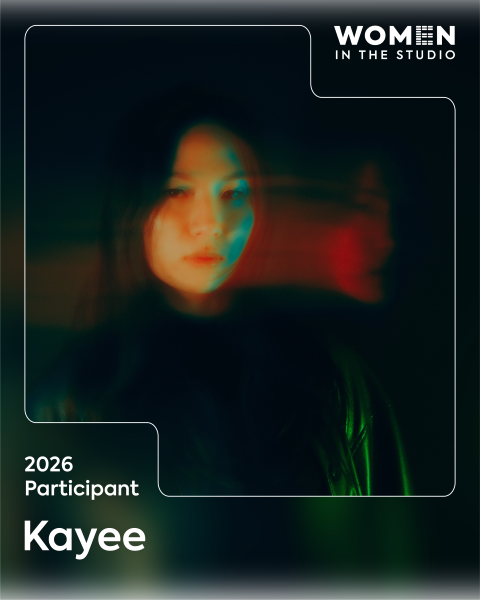
Selected as one of six creators for Music Publishers Canada’s 2026 Women in the Studio National Accelerator, Toronto-based artist and producer Kayee is joining a program designed to support women and gender-diverse creators through mentorship, creative collaboration, and industry access. Running from June through October and featuring an in-person Toronto residency, the Accelerator continues to help create opportunities in an area where women remain significantly underrepresented. We caught up with Kayee via email to discuss being selected for this year’s cohort, what she hopes to gain from the experience, and where her creative journey is headed next.
Hi Kayee. First off, care to introduce yourself to our readers?
Hi, I’m Kayee! I’m a film/media composer, producer, songwriter and multi-instrumentalist from Toronto. I grew up within Toronto’s performing arts communities, super involved in dance, theatre, and choir from a young age, and studied classical piano and opera. I always knew I liked making music more than performing it, which is why I find myself today working with artists to develop their sound and composing for film & multimedia.
What does being selected for the Music Publishers Canada Women in the Studio National Accelerator mean to you at this stage in your career?
It honestly feels like perfect timing. I applied twice before (once in 2022 and again in 2023) and didn’t end up being selected. Looking back on it, I’m grateful to be a part of this cohort, not only because I admire the other women this year so much, but because this is the year that I’ve truly focused on honing my production skills. Compared to just a few years ago, I’ve gained a new level of confidence because of the amount of practice I put in, and I started to take the role seriously. Now I’m really beginning to have fun with production. This is also the first year I’ve reconnected with composing, after feeling for a while it wasn’t relevant or my focus. From scoring a short film & composing for trailers, to creating orchestral versions for artists I’m working with, I’m realizing that all these musical experiences accumulate and the skills just cross-pollinate between genres. I’m very grateful to MPC for the opportunity to continue down this path with momentum and excited to connect with the other women and mentors. Shout out to the recruitment team for knowing when the timing is right!
Can you walk us through what your creative process looks like when you’re producing or developing a track from scratch?
I like to start with 2 to 3 reference points – usually a new song I heard recently, an old song I know and love, and/or a reference from the artist I’m working with. I’m constantly listening to music and trying to expand my internal library; to me, it’s the easiest way to get inspired. I analyze the arrangements, textures, and genres these songs pull from and try to place what it is I like about them. From there, I’ll just pull in instruments or sounds that live in that world and create a soundscape to play with. My rule of thumb is to start with parts that are a little experimental, then round them out later in the process if needed. I’m always aiming for the track to have some kind of production hook and personality, and it’s way easier to start crazy then make it palatable than the other way around. These days I’m also putting a fair amount of consideration into the BPM of a song, because a lot of the time it ends up determining or limiting the groove, and by extension the genre. When I’m in the thick of making the track, I always come back to “is this something I can envision myself writing to?” I started out as a songwriter so I try to use my intuition about that to create tracks and chord progressions that are inspiring and actually usable for an artist.
The program emphasizes mentorship and collaboration—what kinds of gaps or challenges are you hoping this experience helps you address?
For one – building a team. I’m fully independent, and sometimes it feels like it’s out of necessity and not by choice, but the program helps us identify and assess what we need to progress at this stage of our careers. That might be a social revamp, professional headshots/content, a manager, or collaborators, etc…whatever it might be, they are helping us be intentional in what we need, and helping put us in touch with those resources and people. The music industry can be daunting, but WITS has been vital in bridging the gap of not knowing where to go or who to ask.
Another challenge I’ve experienced is having a consistent studio space to work from that suits my needs. I feel blessed that I’ve learnt to do a lot of producing “in the box”, which means I can do it from anywhere. However, I’m reaching the point where I would love a more expanded space dedicated to creating, with a more tangible workflow. A portion of the program will be geared towards mixing, engineering and in-person collaboration, which I already have some experience with. From that I’m hoping to get a better sense of what I want in a studio space and how to start building towards my dream studio.
What has been the most valuable piece of feedback or guidance you’ve received so far in your development as a creator?
It sounds so corny, but be yourself. The feedback I get most frequently from my closest collaborators is “put more of you into it”, which always leaves me wondering what it is they think I sound like. But I think the takeaway from that is to not shy away from the things you naturally veer towards as an artist and musician, because that’s going to be what defines your sound. Just because something is easy or obvious to you doesn’t mean it is to everyone else, and showing up authentically is the way to do justice to collaboration. For me, that looks kind of like old school melodies (I grew up on Disney music), going a little wild on piano, vocal and string arrangements, and being okay with not fitting into one genre.
What kind of sound or message are you hoping to refine or push forward during the Accelerator program?
I’m still trying to figure out where I live sonically, as a producer. I want to discover what kind of music I love making the most, which artists I might click with, and where on the artist – producer/songwriter spectrum I sit. That’s definitely something I’ll be exploring during my time at WITS. As for a message I want to convey, I’m hoping to show those who love music and are pursuing it that there isn’t just one path to a music career. I’ve made music in some capacity my entire life, but only now am I starting to get an idea of what I want a career in it to look like. Producing was definitely not on my radar 5 years ago, but here we are. Everything I picked up along the way feels so valuable and a pillar of my musical identity, so don’t be afraid of the twists and turns.
The program includes a virtual component and an in-person residency in Toronto—how important is that in-person collaboration for your growth?
I think having in-person collaboration is crucial. There’s a kind of momentum and energy exchange in the room when you’re collaborating IRL that’s hard to achieve virtually. Someone throws out an idea, then you’re spitballing together, and all of a sudden an idea becomes real and concrete. Many times while writing with someone, we have started to sing the same melody at the same time like voodoo. A lot of musicians are a little superstitious or spiritual, and I think this is why – we experience moments of telepathy all the time. You just kind of miss out on that when you don’t get to be physically present in the same room. When people are present, you’re being challenged – there’s a constant open feedback loop that you don’t have working alone. On a less serious note, it’s also just way more fun; art is all about connection. So far our virtual sessions have been great and informative, but I know the program will start to feel real and exciting when we all meet in July.