
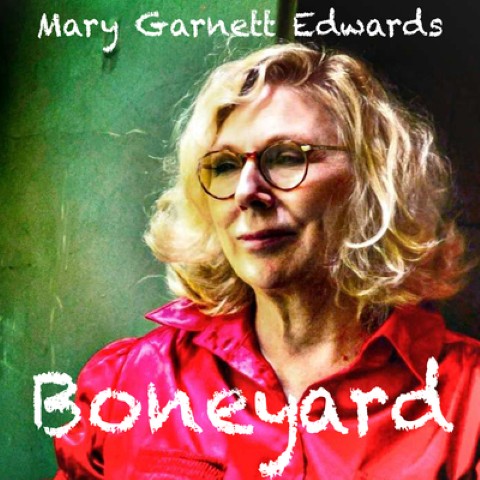
Mary Garnett Edwards, Vancouver-Based Country and Bluegrass Storyteller, Releases New Single “Boneyard”
Mary Garnett Edwards has spent more than five decades turning her own life into song, and her raw, raspy new single “Boneyard” stands as one of her most haunting works yet. Out now, the track pulls listeners into a money scarce, small town world of poverty, broken trust, and a rage filled ending that closes with a hanging, with Edwards crying out lines like “I walk the road as the moon shines bright, I hear the spirits in the forest night, I feel my knees they are a quiver.” It is a performance built on grit, and one that finds Edwards, born in Edmonton and now based in North Vancouver, working at the height of her storytelling powers.
“Boneyard” was produced by Andreas Schuld, one of the most recorded guitarists in Canada, whose credits include work with Long John Baldry and his own project Schuld & Stamer. He is joined on the track by a formidable lineup of Canadian musicians: Pat Steward, known for his work with Bryan Adams and The Odds, on kick drum; Stu MacDonald, whose credits include Crawfish Fiesta and Sue Leonard, on acoustic bass; Gord Maxwell, who has played with Chilliwack and One Horse Blue, on background vocals; and Nashville’s Chas Williams, who has recorded with David Gates and Nanci Griffith, on dobro. The track was recorded at Studio Downe Under in Abbotsford and Coa’s Hideaway in Maple Ridge, with Soren Lonnqvist and Schuld behind the board, and serves as the latest single from Edwards’s upcoming eight song album ‘Madhouse.’
Edwards’s musical story began at the age of ten, when she started singing, playing guitar, and writing her first songs. By twelve, her mother brought her to the Barricade Coffee House in Edmonton, where she performed her original material, a start that carried her through open mic nights at Vancouver venues including the Classical Joint, Soft Rock Cafe, and Kits House after her move to the coast. In the early seventies, she recorded with songwriter and lead guitarist Doug Mix at Psi Chord Studio, and was part of the original rock band Breeze, where Mix paired her with vocalist Tasi Sharpe to create a sound built on hard hitting vocals and tight harmonies.
Those early sessions with producer Robin Spurgin, founder of Psi Chord Studio, would go on to shape the rest of Edwards’s career in an unexpected way. After her husband Doug Edwards, known for his work with Skylark and Chilliwack, passed away from cancer in 2016, Mary rediscovered the original tracks Spurgin had recorded years earlier and decided it was time to sing them again. That rediscovery led to 2019’s ‘White Lightning,’ a thirteen-song album produced by Andreas Schuld and recorded with Soren Lonnqvist, featuring “Robin’s Song,” written for her longtime friend, along with three songs by Vancouver songwriter John Holbrook. The album’s track “I Had a Dream” was later featured in the award-winning documentary The Circle of Eagles.
Across a discography that includes ‘Street Spirits,’ recorded with Dan Morrow, and ‘Garnett Edwards First Stone,’ recorded with Doug Edwards in 1997, Edwards has built a body of work defined by honesty and hard-won experience. “Boneyard” continues that tradition, pairing her weathered voice with a story of desperation and consequence that feels pulled straight from the small towns she sings about.
With ‘Madhouse’ now taking shape and more singles on the way, Mary Garnett Edwards shows no signs of setting down her pen. She has spent a lifetime turning grief, hardship, and hard truths into song, and “Boneyard” proves that well runs as deep as ever. For Edwards, music has always been where the darkest stories get told, and where she keeps finding the next one worth singing.
Hi, Mary! Good to meet you! Care to introduce yourself to the readers for those not familiar with your music?
Hi, my name is Mary Garnett Edwards. My new single is called “Boneyard.”
You’ve been writing songs for more than 50 years. When you look back, do you see your catalogue as a diary of your life, or does each song become its own character once it’s out in the world?
Every song I write has a huge piece of my life in it. I write a little bit of everything. I write songs with deep engrained pain that comes to me in stories. Some of the stories have a bit of fiction, but a lot of it has things in it that are from my life some of them are love songs. I have a lot of love in me to give and so I like to write the odd love song my next song coming out titled you were meant for me, is a love song. It’s a song with tender moments. It’s about things that fit together in this next album. I have a lot of story songs boneyard as a story song. It’s eerie it has a lot of sadness and there’s a lot of parts of me in it. The parts of that money, scarce world and learning to live with it and learning to function until you’re old enough to get up on your own 2 feet and grow up and leave that world and venture out there. That’s not an easy place. If you haven’t had much education, I only got the first part of grade 7 at the most three months if I can remember correctly, I think you miss a lot if you don’t go to school as school teaches you how to deal with people and how to use arithmetic and spelling to do normal things. I feel in a sense I was fortunate because I think I had really a lot of good coping skills coming from a big loud dysfunctional family. I think a lot of that comes out in my writing. It definitely came out and boneyard. When I was a kid, I used to daydream that I was gonna be this that and the other and in your heart really, you’re just wishing for a better place.
“Boneyard” is filled with poverty, violence, and desperation, yet it never feels sensationalized. What draws you to stories that live in life’s darkest corners?
As a child, I did see a lot of poverty and violence and desperation that all comes from starvation just trying to survive when your parents are not able to make money or make ends meet. We had seven kids in our family. I wore all the hand me downs. I saw a lot of violence. I saw things that are no kid is supposed to see, but like I said before there was a real hint of good in me. There was something that was forgiving and kind and I would fall back many times on humor. Humour is a good place to fall back on, but I do get touched emotionally. If I see suffering still to this day, I do burst into tears when I see suffering because I do know what that’s like. I know hard how hard it is to suffer. Suffering is not a good place to come from also, when you’re too little to know the difference and you become a victim to somebody that’s perpetuating a crime on you and that gets buried and hidden under a carpet you have to raise your head up and realize that even though you don’t feel the same as everybody else and that you think everybody else’s lives are perfect they really aren’t because they even though they had furniture and beautiful clothes and lots of toys they were getting sometimes worse. I was fortunate in the fact that my mom and dad had given up drinking. They decided they weren’t going to drink alcohol anymore and that was a good thing for our family
Your voice carries so much experience. Do you think you could have sung “Boneyard” the same way 30 years ago, or did life have to leave its mark on your voice before this song could exist?
My voice has experience I’ve been singing since I was a little kid. We had a whole bunch of dead old cars in our backyard. The kind that had the antennas that you could pull up and bend and I would stand on the car and bend that antenna, like it was a microphone and sing and stand on top of the car loud, I was a bit of an obnoxious kid. I like to sing all the time if I was told to shut up, I just kept singing my mother enjoyed that I could sing. She knew there was something different about my little husky voice. I think I was allowed obnoxious kid I used to run around screaming and hollering. I had a younger brother and sometimes we’d have fights. It was normal sibling rivalry he was cute, but he was like a baby Huey. He was a great big kid when he was born. He was 13 pounds. He was a lot to handle. He was about four years younger than me I was a good climber. I could climb way high up in a tree. I get up really really high up in the tree in our backyard in Edmonton and I’d sing and people would wonder where the heck that voice was coming from.
Well, that voice was coming from me, I would sing a little bit of Gordon Lightfoot anything folk I also sang country tunes anything with a yodel or a holler in that that’s where the yodel in boneyard comes from it comes from those days when I would do yodeling yodelling was fun to do.
I used to entertain myself doing yodelling. I liked guys like Hank Williams, and I would repeat over and over again the Hank Williams yodel that he would do in his songs. I thought they were way cool I used to climb up on top of my house at one point we lived in a house that had a flat roof, and I used to climb up there. One time I found out my victimizer was moving into our basement of our house, so I tried to catch the side of my house on fire. My little brother told on me I got a wooping for that. My dad‘s friend gave me a guitar. He showed me a couple of chords and that put me into my own world. I immediately started writing songs. I wrote songs about the Vietnam war I wrote songs about this that and the other I would jump around the back alley with my guitar, and I would strum it loud. I learned how to finger Pak from that minute on after getting that guitar I was hooked I learned a few cover tunes, but my forte was writing. I was happiest when I could express myself it took me out a moment where I think I would’ve been a depressed person. Had I have not been a writer. We all know what it’s like to get stuck in the winter in a house housebound so the only way I could express myself was writing. I liked writing it put me somewhere else in my head away from bad things that would happen to me physically I was not being beaten by my family in anyway, but I had a victimizer that took advantage of me and my immaturity as a really, really little girl that kept on for years and years and years I think in someway, I was very afraid of men, but because I had such a good, wonderful father, he was a truck driver and he really was not around very much. I had some wonderful bonding experiences with my dad. He was a true gentleman, and I knew from that moment on as I grew up with my dad that not all men jumped on little girls and that I did have a safe space and that were safe. That comes out in my writing a lot.. because of being victimized I like my space to myself. I spend really a lot of time by myself. It’s where I feel me the most.
You can feel my pain in the way I sing boneyard you can hear anger at times in my voice. You can hear things that really rise up psychically and can be really quite frightening. You can see what people do to each other and how evil they are in that song. I think I saw that a lot as a child. My voice does portray that, yet I hear that little kid still in my voice I always had a gritty voice when I was a teenager. I sing a little bit of metal rock type songs. But then I went back into country and folk and Americana and bluegrass style just simply because of the words that I could express in those songs when I write like that.
Your career is a continuation. What keeps you chasing the next song after more than five decades, instead of simply looking back at everything you’ve already accomplished?
I think right now I am writing. I’m writing a lot more because when I look at my life, I know I have less time coming up in February. I will be 70 years old. I have a lot to say I have a lot to express. I have a lot to feel, and I have a heck of a lot to heal. Everything is starting to make sense to me now because I’m able to look back and recognize things I can walk into a room full of people and read them so easily, I know which ones are narcissistic I know which ones feel pain. I see immediately the people pleasers I’m glad I’m this age. I’m glad that I’m getting close to the end of my life, but I hope I can leave a whole bunch of work behind. I have nine more songs coming up and I am working on some really cute little ditties that are coming up but also some songs that are absolutely going to shock people they’ll know when the song comes out, they’ll know that it’s the most shocking thing to say but I don’t care. I wanna say it. I have something to say. I might be old, but I have something to say. And maybe just maybe that’s gonna make my heart feel a little bit lighter because I don’t think I’m gonna be able to cry anymore. I hope everyone listens to boneyard. I hope they listen to the words. It is a story of sadness and poverty and scarceness; I wish the whole world was equal. I wish everybody had enough food. I wish the world was a happy place but sometimes it just isn’t, all I can say right now is thank you and good night.
Connect with Mary Garnett Edwards:
Website
Bandcamp
Facebook
Instagram
TikTok