
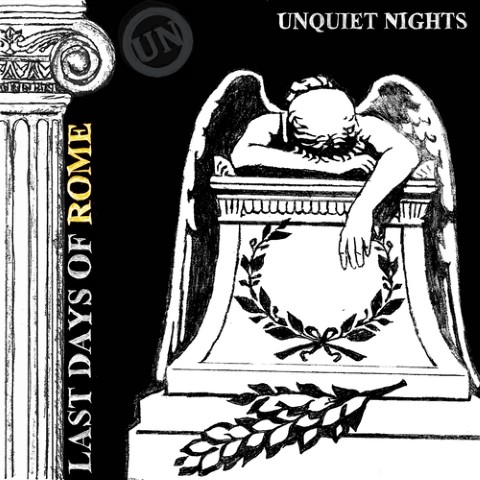
Belfast-formed rock band Unquiet Nights return with “Last Days of Rome,” a deeply personal single inspired by six years spent living in Italy and a song that took 15 years to complete.
For Unquiet Nights, some songs need time to find their meaning. Their latest release, “Last Days of Rome,” is one of them. Led by vocalist and guitarist Luke Mathers alongside drummer Rodger Firmin, the band transforms memories of Rome into a reflection on love, permanence, and the passing of time.
The song draws inspiration from the Eternal City’s historic streets, marble steps, and artistic landmarks, including William Wetmore Story’s Angel of Grief sculpture in Rome’s Non-Catholic Cemetery. Through its imagery and emotionally charged lyrics, “Last Days of Rome” explores the tension between relationships that feel everlasting and the reality that everything eventually changes.
Unquiet Nights Last Days of Rome: The Inspiration Behind the Single
The story behind the single stretches back to 2011, when Mathers and Firmin first began developing its guitar riff. Although the band initially hoped to finish the track ahead of a London performance supporting Bloc Party guitarist Russell Lissack, the song remained unfinished for years.
It wasn’t until Mathers returned to the familiar surroundings of Rome that the remaining pieces finally fell into place.
Recorded at the band’s Credential Sound studio in Northern Ireland, “Last Days of Rome” features Mathers on vocals, guitar, mellotron, bass, and production, with Firmin handling drums and percussion. Neal Calderwood completed the mixing and mastering at Manor Park Studio.
Unquiet Nights Build on 15 Years of Rock Music
Formed above Belfast’s Limelight club in 2010, Unquiet Nights have spent more than a decade developing their sound and building an international audience.
Canadian Beats previously introduced readers to the band in February 2024 through our Canadian Beats Passport feature on Unquiet Nights and “Diamond and the Missing Son”. The feature offers another look at the band’s music and creative journey.
Their years living in Italy helped shape the band’s identity, leading to performances across nine countries, national television appearances, and a lasting connection with Italian music fans.
Their 2024 album, Seasons in Exile, introduced a stronger progressive rock influence, drawing inspiration from classic acts such as Genesis. The release earned positive attention from several music publications, while the single “This Is My Oxygen” received airplay on Kerrang! Radio and TotalRock.
Now, with “Last Days of Rome” marking the beginning of a planned series of singles, Unquiet Nights are looking ahead while revisiting the experiences that helped define their musical journey.
Unquiet Nights Last Days of Rome – Interview
We caught up with Unquiet Nights to discuss the inspiration behind “Last Days of Rome,” the band’s connection to Italy, and what comes next.
Hi, Luke! Good to see you again! Care to introduce yourself to the readers for those not familiar with your music?
Great to be back on Canadian Beats. I’m Luke – the guitar guy who started releasing songs as Unquiet Nights about 2006 in Belfast.
“Last Days of Rome” was inspired by the six years you spent living in Italy, particularly those moments sitting on marble steps and ancient walls, thinking about how art can outlive the people who create it. Was there a particular moment in Rome when your understanding of time, mortality or what really matters in life began to change? And how did that experience influence the way you approach songwriting today?
One exact moment doesn’t stick out. It’s more of a gradual thing where spending time in a culture that prioritises history and beauty so much soaks into your skin. I have countless memories there, but one is that after The Rolling Stones at Circo Massimo we thought it was too late to bother trying to get a hotel, so we lay on stone benches all night several feet from the Colosseum. I sat for hours looking up at it against the skyline. Stuff like that will make your mind wander.
One of the most striking images in the song comes from the Angel of Grief sculpture in Rome’s Non-Catholic Cemetery, where you imagine someone asking whether the statue would be grieving if the person buried beneath it were them. That’s an incredibly powerful way to explore love and loss. What drew you to that sculpture in the first place? And when you wrote that lyric, were you thinking about a particular relationship, or something more universal about our fear of losing the people we love?
In the song it’s the female character asking the male character if he would be equally as distraught as the Angel of Grief appears to be if it were herself under the statue instead of the sculptor’s wife. She says it with the facade of a joke, but you get the impression she will be offended if he wouldn’t be grief stricken enough to try and create something as beautiful in her honour. To me that scenario is funny and poignant at the same time.
3You and Rodger first started working on the guitar riff for “Last Days of Rome” back in 2010, and it took 15 years for the song to finally come together. What was missing from those early versions that you couldn’t quite figure out? Do you think the song needed you to become a different person before you could finish it? And when you finally found the missing piece sitting on that marble step near the Foro Italico, did you immediately know the wait had been worth it?
What was missing was the lyric. We used play the song where it sounded like a hillbilly thing and called it just “Clip of a Thing” without pressing very hard to finish it. If I can negotiate with Rodger for the release of some video on socials, there’s one of us playing it before new year 2010 that’s particularly ridiculous. Anyway “Clip of a Thing” continued to be played in our rehearsals for years. It was more like a stress reliever, or something we’d break into without planning to. Some people close to the band kept asking when “Clip of a Thing” was going to be finished, so eventually I focused on it and finished the lyric. Yes I do think it required more life experience to write it than when the music first appeared years before.
4Unquiet Nights have been making music for more than 15 years, moving between Belfast and Italy, touring across nine countries and gradually expanding your sound into more progressive rock territory with ‘Seasons in Exile.’ When you look back on everything you’ve experienced together, how has your definition of success changed? And with “Last Days of Rome” beginning a new chapter for the band, what are you still trying to accomplish creatively that you couldn’t have imagined when you first started playing together above Belfast’s Limelight club in 2010?
I think I started wanting to make records as a kid because if you do it right, there’s a chance someone will consider it art. In that sense I don’t think my definition of success has changed at all. The other measures of success aren’t legitimate in music, because they can be rigged. Like I’m exploring in the song, songs are the same as statues in that they can be permanent and timeless in the best case. It’s important to keep searching for that.
To answer the second part, creatively there are two particular things we’re trying to do. Developing stories over longer form is something we like doing, because with the third album “Seasons In Exile”, all ten songs are sequential as one story. Out of that you get moments that wouldn’t have happened otherwise. For example the song “High Conviction Play” from that album was written as a link and turned out to be one of the songs I’m most proud of. It crept up by itself. I wouldn’t have taken these kind of risks if we hadn’t already achieved recognition with the more direct songs in terms of getting on the radio stations first. So the second thing we’re trying to accomplish creatively is just to make a single which surpasses what we’ve already done. Whether it happens or not I don’t know, but the important part is to have that goal and keep targeting it.
Connect with Unquiet Nights:
Website | Bandcamp | Facebook | Instagram | TikTok