
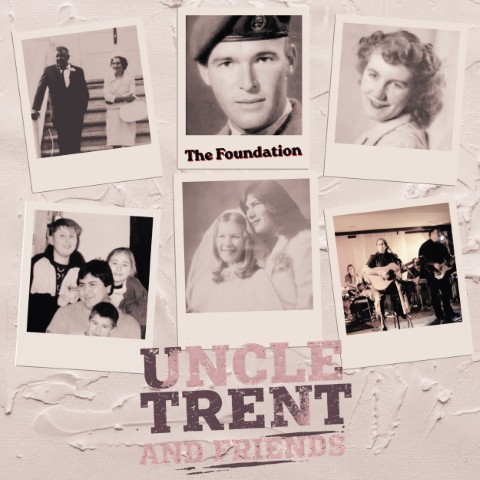
Cowessess First Nation Artist (Uncle) Trent Agecoutay Releases Moving New Single “The Foundation”
Cowessess First Nation singer-songwriter (Uncle) Trent Agecoutay releases his deeply personal new single “The Foundation,” out now. Written with his late father Jim Agecoutay in the days following the funeral of their Kokum Agnes, it is the first song Trent ever co-wrote with his dad – making it one of the most intimate and significant recordings of his career. “The Foundation” serves as the lead single from Uncle Trent and Friends – Legacy Deluxe edition, the acclaimed project Trent created alongside his brother Bryce to honour their father’s musical gifts after his passing.
The song carries the full emotional weight of its origins. Born in grief and shaped by gratitude, it opens with a scene of devastating tenderness: “Kokum started her journey on a rainy day in May / I’ve never felt so helpless, don’t like to feel that way / A wave of lonely, it tore me up inside / I kissed her on the cheek, I held her one last time.” From that place of loss, the song builds toward something enduring – a chorus that names the thing that holds us when everything else gives way: “The Foundation of who I am, it runs strong and deep / Generations surround me while my soul weeps / They light the path when darkness follows me / The Foundation of who I am – it’s my family.”
“Family is the Foundation of who we are as musicians, and men,” Trent reflects. “The gift of music our father gave us, along with the strong influence of our Aunts, Uncles, Cousins and Grandparents, truly shaped us into the men we are today. The song will connect to any listener – people with a strong bond with family, and those longing for that family connection.”
It is a song built for both.
The legacy that gives this project its name stretches back to a kitchen table in Western Canada, where a young Trent and Bryce would slip into the next room to listen as their father Jim composed songs – always with a pot of coffee, a lit cigarette, and an old tape recorder close at hand. All the songs on Legacy were written or co-written by Jim Agecoutay, and the album, funded by the Alberta Foundation for the Arts and Calgary Arts Development, stands as a testament to everything he left behind.
Legacy has already made a significant mark since its April 2025 release – earning a number-one single on the Indigenous Music Countdown with “Burn a Smudge,” placing “You’re the Reason” in full rotation on Sirius XM Indigiverse for much of 2025, and charting in the top ten of the Earshot National Folk, Roots and Blues chart. “The Foundation” opens the album’s next chapter with the song that perhaps best captures its entire purpose.
Since joining his father’s band in 1993 and performing in Alberta honky-tonks across Western Canada, Trent has grown into a respected artist and community voice. His previous albums – I Don’t Regret a Thing, Now…And Then, and A Place to Call Home – established a sound that is deeply personal yet broadly resonant, earning him a Native American Music Award nomination for Best Blues Recording. Alongside Curt and Chelsie Young, he co-created Do You Hear Me Now…Amplifying Indigenous Voices, and his podcast The Deadly Uncle Podcast continues to provide a culturally grounded space for Indigenous men and boys to connect and heal.
Hi, guys! Good to see you again! Care to introduce yourselves to the readers for those not familiar with your music?
Hey everybody, we’re Bryce and Trent Agecoutay — brothers from Cowessess First Nation in Treaty 4 territory who grew up in Red Deer, Alberta. Our dad, Jim, was a nightclub singer, so we had music and musicians in and around the house our entire lives. Both Bryce and I played with our dad — Bryce on drums and myself on bass.
The Legacy project has allowed us to make music together again, and we both love recording, so it gave us an opportunity to produce a project together. Initially, it was tough because Bryce was in Vancouver while I was living in Calgary, but recently I relocated to Surrey and we’ve been putting a lot of work into wrapping up Legacy Deluxe.
It’s been a really good feeling being in a room together working on songs. Coincidentally, our cousin Beaver Thomas has also been back in the Lower Mainland area, and we’ve been rehearsing with him on guitar. We’re going to do a couple of shows in June back in Alberta. It always feels best when we’re playing music with family.
“The Foundation” was written in the days after your Kokum’s passing. What do you remember most vividly about that moment of writing with your father?
Back then, I wasn’t confident with my writing, and co-writing was not something I thought I would ever do with Dad. I felt like he was light years ahead of me, and I put unrealistic expectations on myself. I never thought any of my songs were good enough to take to him.
When I first started songwriting, I didn’t understand the power of editing. This co-write for “The Foundation” came about more like a coaching session. I played him the song and asked if he had any suggestions. I think he knew how fragile I was as a young writer, so the suggestions started gently. He said, “I understand what you’re saying here, but is there a better way to say it?”
That opened me up to asking what he meant and what ideas he had. We slowly went through and edited the song, and when I became a little more comfortable with the process, he challenged me to find better melodic choices — things I may never have thought about doing myself.
That’s what I remember most vividly: connecting with my dad during a time of family grief and being able to do that in honour of a very special woman in both our lives. It showed me just how healing music truly is.
This was the first song you ever co-wrote with your dad. How did that experience shape the way you see songwriting now?
That experience taught me the power of co-writing. Before that, I only wrote songs alone. I thought that was the way to do it — you get an idea, work it out on your own in a room, and if it’s a good song, it will eventually come out the way it’s meant to.
If I’m honest, the reason I always wrote alone was mostly about trust and insecurity. Once I experienced how much the song elevated by allowing in another perspective — especially after my dad encouraged me to edit and rework the melody — I knew I had to leave that mentality behind.
I realized I needed to be brave and open the door to collaboration, as long as it serves the song.
Your music often feels both deeply personal and widely relatable. What do you think allows listeners to see themselves in your experiences?
Firstly, it’s amazing if people can take a personal song and relate it to their own life experiences and really connect with it. I think when you start writing a song, that should be your north star. If you can write something that resonates with people across different age groups and cultural backgrounds, you’ve done your job.
If that has happened with any of my songs, I think it’s because I’ve been authentically myself. If I’ve been brave, vulnerable, and honest in the lyrics, that authenticity resonates. When you stay true to yourself in the lyrical content and keep a simple, singable melody, people tend to embrace it.
There is a strong sense of healing in your work. What role does music play in processing grief for you personally?
Music seeps into every aspect of our lives in our family, but for me personally, it has always been an essential part of processing grief. Writing songs has always been an outlet to process my feelings. It’s very cathartic to sit with your own thoughts, write them down raw, sit uncomfortably with those feelings and words, and try to rearrange them in a way that helps the world understand you.
I think we all want to be heard and feel like we belong — to feel like people understand us. When I create something that other people embrace, it helps me realize that even though we often feel disconnected from each other in this crazy world, we are not alone. We actually have far more in common with each other than we do differences.
If we can refocus our thoughts around the things we share in common, the world becomes a much less lonely place.
Connect with (Uncle) Trent Agecoutay:
Website
Facebook
Instagram