
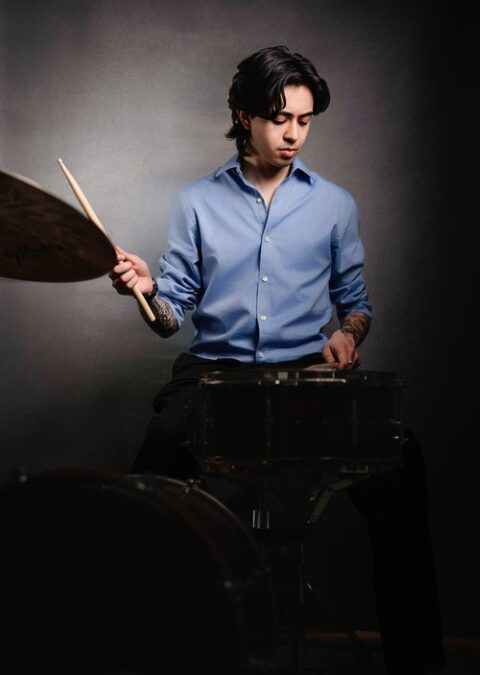
Winnipeg Drummer, Composer And Producer ESTEBAN SEUNARINE Rebuilds From Scratch On New Album, The Expanding Whatever, Led By Single “Arts & Crafts for Robots”
Winnipeg based drummer, composer and producer Esteban Seunarine releases his third album, The Expanding Whatever, on September 16 through his own label, Rice and Beans, led by the single “Arts & Crafts for Robots.” The record exists because an entirely different one fell apart first.
Earlier in 2026, Seunarine and longtime collaborator Ben Kensok were deep into a much bigger, more maximalist project, dense with jazz improvisation, programmed and live instruments, strings, spoken word and layered vocal harmonies, when honest feedback from their own team, friends and family convinced them to scrap it.
“It was the first time in my writing life that I felt like I’d genuinely failed,” Seunarine says.
Out of that anger, he stripped everything back to harmony, basslines and groove, and wrote an entire album in a week, sometimes finishing two songs in a single day.
The Expanding Whatever is a record about noticing, built around the idea that meaning doesn’t announce itself so much as sit quietly inside ordinary things, a garden, a guy in a hat on a street corner, a dog, until someone finally pays attention. Where most albums chase something big, Seunarine set out to find what was worth saying inside the monotonous, repetitive texture of everyday life.
“I write jazz music for people who don’t like jazz,” he says, “and I should stop trying to fight that instinct.”
The band tracked the whole record in two days at No Fun Club in Winnipeg with engineers Riley Hill and Nika Atefi, recording live off the floor in one room with no headphones, essentially capturing a rehearsal in real time. Guitarist Adam Ciric pushed the band to cut three or four takes of every song regardless of how the first one felt, a call that paid off once it came time to choose takes for the final record. The sessions produced 11 finished songs, trimmed to 10 during mixing two weeks later, not because the cut track was weak but because it hadn’t reached the level of the rest. The album was mastered by Jon Kaspy in Montreal.
Seunarine assembled a new lineup for the record under the name Esteban Seunarine and The Kind Ghosts. Ben Kensok stays on tenor saxophone as Seunarine’s closest creative partner of the past few years, joined by upright bassist Aria Rempel, whom Seunarine overlapped with during his jazz performance studies at Brandon University without ever actually playing together at the time, and pianist Alanna Fast, a fellow Brandon University alum he met through Kensok. Guitarist Adam Ciric, whom Seunarine had only met once before the sessions, brought a wider musical palette from his own background in metal and recording engineering, and Seunarine credits him with keeping the whole record from sounding bland.
Two tracks deliberately break from the album’s live off the floor approach. “One for Lav” is a solo drum piece Seunarine wrote in tribute to his dog, who passed away shortly before the sessions, later layered with electronic textures by Hill and Atefi to pull it slightly out of the record’s otherwise acoustic world. “Varanda” features guitarist Emmanuel Bach, who came into the studio for about 45 minutes, cut a handful of completely unrehearsed solos, and left, a burst of pressure Seunarine says comes through clearly in the finished track.
Compositionally, the album marks a deliberate return to simple tools, triads and pentatonic ideas Seunarine had been drifting away from in pursuit of harmonic complexity. The band spent full rehearsals talking through how to use that simplicity to tell a story through soloing rather than simply navigate changes, a sharp turn from the raw density of his previous record, ‘What Blossoms from Bloodshed?’ While writing and recording, Seunarine found himself pulled between Aaron Parks’ ‘Little Big,’ a desert island record for him, and Styx’s ‘The Mission,’ with Todd Sucherman’s drumming leaving a few quiet homages tucked into the new songs.
Seunarine built this sound from a childhood shaped by Caribbean and Latin American rhythms and a musical education on the Canadian prairies, studying jazz performance at Brandon University under Eric Platz, Marika Galea and Greg Gatien. He has since shared stages with Grammy and JUNO winning artists including Sara Gazarek, Jason Palmer and Luis Deniz, and is the recipient of the 2026 SABIAN Dom Famularo SEN Mentorship Award. With ‘The Expanding Whatever,’ Seunarine lets his influences coexist rather than compete, jazz fusion and prairie folk, the grand and the mundane, in his most personal record yet.
Hi, Esteban! Good to meet you! Care to introduce yourself to the readers for those not familiar with your music?
Of course! Nice to meet you, and thanks for having me. My name is Esteban Seunarine, and I’m a drummer, composer and producer from Winnipeg. I make primarily, instrumental, more “modern” jazz music, which ends up being an amalgamation of rock, folk, Afro-Cuban, and other styles as well. My new one sentence description for the type of music I make is: I make jazz music for people who don’t like jazz.
You made the unusual decision to throw away an album that was essentially finished and start over from nothing. That’s terrifying for any artist. Looking back now, was that moment actually a failure, or was it the first honest decision you made in making this record?
Great question. I think it was both, and I think it can be both. I think there is nothing wrong with failure, especially in the world of art. Failure is a critical part of growth, so I think those that don’t experience that will always stunt their own development. It excites me to try and stretch myself and reach for things so beyond my grasp that I end up falling flat on my face. Because then, I learn a little bit more about the process, what worked, what didn’t, as well as identify what could’ve changed from an execution standpoint, and lastly, I learn a little bit more about myself. Conceptually, what was I really aiming for. The thing that made this specific failure unique was that it was one of the first “failures” I had experienced that had quite a lot of money and time associated with it. So, watching the hours and dollars essentially go to waste (which of course, it wasn’t a waste, just that I perceived it as a waste at the time) was a newer experience for me. I think in retrospect though, scrapping that project was definitely the first honest decision. At the time, I didn’t even really know it would be the catalyst for this record, but I don’t think this record exists without having to scrap the prior one.
This album is called The Expanding Whatever, and you’ve said it’s about finding meaning in ordinary things instead of chasing big moments. Do you think we’ve become so conditioned to look for extraordinary experiences that we forget how much life is actually happening in the quiet moments?
I really do think so. I think it’s hard to not become conditioned to look for extraordinary experiences, or crave them even. Social media and being online so much really doesn’t help. I’ve noticed, at least in myself, that the comparison culture of social media, breeds this addiction of craving the next big extraordinary thing. I find myself not being able to live and breathe in the quiet moments, instead I have to constantly chase and I crave the dopamine hit of accomplishing or doing something extraordinary. That’s so unrealistic and not healthy at all. And I think was a large driving force of the record we scrapped. I think we went so maximalist in its approach, because we fell victim to this comparison culture syndrome. Music social media can be very cool but also very disheartening. It’s a weird contrast of extremes. This was one of the learnings that came out of scrapping that project. Learning to be okay with the “in-between”. Not everything in life is going to be extremely good or extremely bad. Sometimes, it’s just, kind of, ordinary.
You say you write “jazz for people who don’t like jazz,” and I love that because it sounds less like a genre statement than a philosophy. What is it about jazz that you wanted to preserve, and what parts did you feel needed to be left behind for people to truly connect with your music?
This is a phenomenal question. I remember chatting with a mentor of mine, Elise Roller, who is a very experienced music manager, as well as the CEO of Misfit Music Management and Odd Doll Records. Elise, was actually the one who first came up with that marketing tagline. I sat with it for a couple of days and I think I felt deep down in my gut, that that’s always been the kind of music I wanted to make, I just needed a little bit of validation that making that type of music, was okay. And Elise provided that. I really do see the statement as a philosophy as well. This is what I’ll say about jazz music. I’ll preface by saying that I can only describe my first-hand experiences with it. I think there are a lot smarter, more talented musicians in the genre that speak about the music and the history so adequately. So, by no means are my thoughts, the be all end all. Jazz was not my first love. I didn’t grow up with it; my parents don’t particularly enjoy it. I only started to learn about jazz in high school, through my band program. Ever since then though, Jazz became an art form that I love. I did my undergrad in Brandon University where I studied jazz drum performance with some incredibly talented teachers. Eric Platz, Marika Galea, Greg Gatien, Luis Deniz, Leanne Zacharias, etc. These are people that played with Bob Brookmeyer, Bill Frisell, Danilo Perez, Tommy Crane, Jason Palmer, etc. Heavy names. So I absorbed as much as I could from these mentors. During my 4 years there, I sort of started to figure out what I liked about the music, and what I didn’t like. The main things I always enjoyed were how honest and raw it was. I believe improvisation is the most genuine window into one’s personality and/or soul. I also loved how it expanded my concept of groove. There are so many mixtures of cultures and rhythms, and so many ways you can analyze groove from a macro or micro perspective. Jazz also showed me the extremes of what intent looks like in a musical sense. How intent can look like from a sonic or tonal perspective, a density perspective, or a narrative perspective. These were the parts I wanted to incorporate into my own music making. I didn’t necessarily want to leave other parts behind; I simply didn’t connect with other parts as strongly. I can only react to what genuinely moves me or speaks to me, and I need to be honest with myself about that. It’s also important to note, that I do firmly believe in knowing the rules, or studying the rule book, before breaking any rules. I don’t dig people who break the rules without taking the time to understand why they are wanting to break them in the first place.
The entire record was tracked live, off the floor, in just two days with musicians listening to each other instead of relying on edits and overdubs. In a world where almost anything can be fixed later, what did committing to those imperfect moments teach you about trust, both in the music and in the people making it?
It was such a privilege to record in this manner. I have to shoutout our engineers Riley Hill and Nika Atefi. They got us super dialed in for our sessions at No Fun Club. In all honesty, this is how I’ve performed and played most music in my life. Coming from a jazz background, everything has been live, off the floor, just the musicians listening and interacting with one another. I think conceptually it was scarier for me this time only because like what you are saying, we live in a world of overdubbing and tracking separately. So, it was another learning thing for me, I needed to muster up the confidence and courage to know that this was my vision, and that it’s totally okay if it doesn’t completely follow the norms. I spoke about validation earlier, and I think Riley and Nika also gave me that validation from an engineer/sound perspective. Additionally, I had full trust and faith in my band. The record would sound horrendous without them. Being able to let go and fully trust their creative output was such a blessing, and I can’t imagine these songs without them. Lots of love to my band, Ben Kensok, Aria Rempel. Adam Ciric and Alanna Fast.