
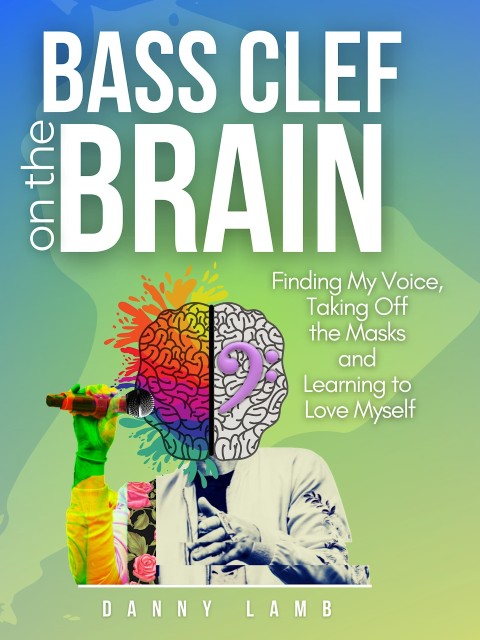
Canadian singer-songwriter, music philanthropist, and entrepreneur Danny Lamb has released his memoir, Bass Clef On The Brain: Finding My Voice, Taking Off The Masks, And Learning to Love Myself, sharing a deeply personal journey of resilience, self-discovery, and finding his voice through music.
The book opens with a question Lamb has spent much of his life answering: What do you do when the life you’re given isn’t the one you expected?
Diagnosed with hydrocephalus at just three years old, Lamb grew up with parents who encouraged him to embrace possibilities rather than limitations. However, his determination would be tested throughout his childhood and teenage years, ultimately shaping the musician, advocate, and entrepreneur he would become.
Danny Lamb Bass Clef On The Brain: A Story of Resilience and Self-Discovery
At 14, a shunt failure led to brain surgery, leaving Lamb with a new scar and a two-year battle with depression. The experience also meant letting go of his dreams of playing soccer, a sport that had provided him with community, purpose, and identity.
Two years later, a Rotary Exchange offered an opportunity for a fresh start. Initially rejected by France because of his disability, Lamb eventually found an open door in Brazil, where a transformative year changed the direction of his life.
Bass Clef On The Brain follows Lamb’s journey from that pivotal experience in Brazil to touring internationally as a musician, founding a music school, and becoming an advocate for hydrocephalus and spina bifida awareness.
Rather than presenting resilience simply as overcoming obstacles, Lamb challenges the limitations others place on people living with disabilities.
The memoir carries a message for anyone who has ever been told they cannot achieve something.
“Yes, you can,” Lamb says.
Writing Bass Clef On The Brain Becomes a Journey of Self-Discovery
The idea for the memoir had been developing for six or seven years before Lamb finally began bringing it to life.
A cordial breakup ultimately became the catalyst for looking inward and examining his experiences, relationships, and personal growth.
“I have come to learn that when faced with adversity, I have a habit of wanting to dive deeper into the question of why,” Lamb explains, “and the writing of Bass Clef On The Brain was no different.”
Writing the memoir allowed him to reflect on his role in the relationship’s ending while also recognizing which burdens were never his responsibility to carry.
Written from his home in Niagara Falls, the book draws on 38 years of experiences, including three brain surgeries, a childhood learning disability diagnosis, international travel, and the difficult decision to walk away from soccer.
Through these stories, Lamb explores the importance of finding his own identity and using his experiences to encourage others.
“The adversity that pushed me to discover my own voice in music and life has also continued to teach me how to use my voice, stories and abilities to create spaces that people feel comfortable and confident to find their own,” he says.
Danny Lamb Connects Music, Advocacy, and Community
Beyond his work as a recording artist, Lamb has dedicated much of his career to creating opportunities for others through music.
He founded the Danny Lamb School of Music and co-founded A Song, A City, a music movement focused on connecting, celebrating, and amplifying the voices, stories, and abilities of people living with spina bifida and hydrocephalus.
Canadian Beats previously featured Danny Lamb in June 2024 with the release of his single “Champion”. The earlier release offers readers another opportunity to explore his music alongside the personal experiences shared in his memoir.
Throughout his musical career, Lamb has shared stages with Canadian acts including Marianas Trench, Mother Mother, Fefe Dobson, Hollerado, Faber Drive, Honeymoon Suite, and David Wilcox.
His work has also attracted media attention from the BBC, Global TV, CTV, CHCH, and Canadian Musician Magazine.
One particularly notable achievement came through A Song, A City’s crowdfunded tour across the UK and Europe. The campaign was later featured as a case study in the second edition of a college Business Communications textbook, demonstrating how the ambitious project came together.
Danny Lamb Encourages Readers to Find Their Own Voice
With Bass Clef On The Brain, Lamb brings together the experiences that have shaped his life, from childhood challenges and personal relationships to music, advocacy, and international adventures.
Edited by Bev Hotchkiss, founder of Backhouse Press & Collective, the memoir offers readers a look at the experiences behind Lamb’s determination to create spaces where others can discover their own voices.
At its heart, Bass Clef On The Brain: Finding My Voice, Taking Off The Masks, And Learning to Love Myself is a story about identity, acceptance, and learning to embrace life’s possibilities.
Get the book: Amazon
Hi, Danny! Good to see you again! Care to introduce yourself to the readers for those not familiar with your music?
Hi! My name is Danny Lamb. I’m a Singer-Songwriter, Author, and Entrepreneur from Niagara Falls, ON. The Founder of Danny Lamb School Of Music and Co-Founder of a musical vehicle for change called ‘A Song, A City’ that toured across the UK & Europe for the first time in 2013 as a tool to connect, celebrate, and amplify the voices, stories, and abilities across our Spina Bifida & Hydrocephalus Community locally & globally.
You were diagnosed with hydrocephalus at just three years old, and at 14, a shunt failure led to brain surgery, depression and the loss of your soccer dreams. When you look back at that teenager, what do you wish someone had told him about the life that was still waiting for him?
Be patient. With yourself, and the world around you. Good things take time, and great things happen all at once. Keep finding ways to turn obstacles into opportunity, finding your voice, and discovering how you can use your abilities to have an impact beyond your own need and want to prove yourself to yourself.
At 16, you were rejected from a student exchange to France because of your disability, but Brazil eventually welcomed you. Can you take us back to that rejection, and explain how the experience of living in Brazil changed the way you saw yourself and what you believed was possible?
Brasil, and my host family in Brasil, embraced me from the very beginning like I always belonged. It was a familiar feeling, as growing up in my house in Canada felt similar, always embraced for everything we were, and empowered to dream. It was in Brasil, one day walking down a road known as Avenida Visconde De Jequitinhonha that I walked past a gentleman playing his guitar. He was singing in Portuguese, and I didn’t speak the language yet, but I loved how, through the music, I felt connected to him. A complete stranger. Not only did this start to really open my mind to the universality of music, and the power it has to break barriers, transcend borders and reach people in some of the most fundamentally human ways. It was in Brasil that not only did I start to find my own voice, but wake up to the power & responsibility to use such a gift to re-define the way in which I dreamed, wanting to create a more inclusive, accessible world that everyone can see themselves inside of that dream.
You’ve spent years using music to help other people find their voices, but your memoir explores the masks you’ve worn and the struggle to love yourself. Was there something you discovered while writing this book that you hadn’t been willing to admit to yourself before?
I need help. I’m a proud person. I can be stubbornly independent, and I love some of these things about myself. I think some of these qualities have played a role in getting me this far. That said, I think sometimes ‘we preach what we need to hear’. I heard Bono say that on stage once, and I couldn’t help but agree. As I was back and forth with my editor, going through draft after drafter of edits and additions, I finally came up with the Subtitle of the book. ‘Finding My Voice, Taking off the Masks, and Learning to Love Myself’. Reading the Memoir, even though it’s my story, I couldn’t help reflect on some of the same strengths that I’ve had throughout the years, like being proud and stubborn, have been some of the same weaknesses that have often led to me climbing some of these hypothetical mountains on my own when there are people around me who want to help. I got to a point in my career where I started to reflect on the need for help. Not because I can’t do it on my own, but because independence & asking for help are both deeply intertwined & knowing when to ask for help, instead of taking it on all on your own, is an essential part of growth and creating a larger impact.
You’ve undergone three brain surgeries, toured internationally, founded a music school and become an advocate for people living with hydrocephalus and spina bifida. When people hear your story, they might call you inspirational, but does that label ever feel limiting? What do you wish people understood about living with a disability that often gets lost in stories about resilience?
I love, and so much appreciate, this question. So much. Not just for me, but because I know many friends across our Disability Community feel a certain way about this question as well, the impact that this label often creates, and the way it continues to perpetuate a societal narrative that too often looks down on our Disability Community.
Too often people are labelled as ‘Inspirational’ for simply existing.
Doing simple, human, things that are not necessarily extraordinary.
For me, when I hear the word ‘Inspiration’ I would love somebody to know that instead of looking to me like I’ve done some extraordinary thing, while I so much love and appreciate being recognized for the things that I’ve been able to accomplish and overcome, and calling it something like ‘inspirational’, I simply hope that it drives more action in people.
To listen, learn, get involved, ask the tough questions.
Words, and understanding the root of the Impact, for better or worse, of a word is so important, but so is action.
If you see me, and see me in a certain way, I absolutely love that, and I’m so incredibly grateful that I can do that for somebody else.
I just hope that it empowers somebody else to not just see me in a certain way but to take me, as an example even, and do whatever they can do in their own life, community and the world to spread that positive impact forward.