
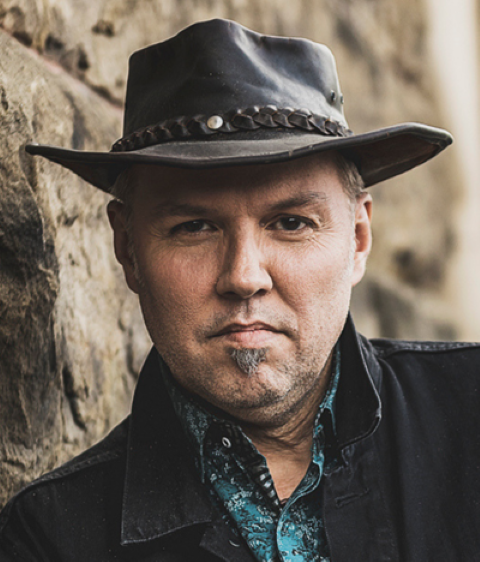
Ottawa-based folk singer-songwriter Christophe Elie challenges political power, corporate influence, and economic inequality on his latest protest single.
Ottawa-based folk singer-songwriter Christophe Elie is taking aim at political power on both sides of the Canada-U.S. border with his latest single, “Up On The Hill.” The sharp-tongued protest anthem tackles corporate influence, rising living costs, and the growing divide between politicians and the people they represent.
The single marks the second release from Elie’s upcoming third studio album, UnAmerica, expected in early 2027. Born in Cleveland and now living in Ottawa, Elie draws on his Canadian-American identity to challenge political systems on both sides of the border.
Christophe Elie Challenges Political Power on “Up On The Hill”
Built around stomping rhythms and pointed social commentary, “Up On The Hill” takes listeners from Parliament Hill to Capitol Hill, questioning a political landscape where corporate interests often take priority over everyday struggles.
“I’m Canadian and American, so I’m an equal opportunity critic,” Elie explains. “‘Up On The Hill’ points the finger at Capitol Hill and Parliament Hill at the same time.”
The song began taking shape in November 2024, with its lyrics evolving alongside political headlines. From rising grocery prices to billionaires and corporate influence, Elie incorporates current events into a larger conversation about inequality.
At the centre of the song is a childhood memory of playing king of the hill, transformed into a metaphor for political power and the ongoing struggle to maintain it.
Christophe Elie Brings Protest Music to Life With an Accomplished Team
Recorded at La La Studios, “Up On The Hill” was co-produced by Elie and JUNO-nominated producer Gareth Auden Hole of Jack Pine.
The recording features JUNO-winning drummer Matt Sobb of MonkeyJunk, guitarist Blair Michael Hogan, keyboardist Clayton O’Connell, bassist Ryan Clare, and harmony vocalist Susan Murphy.
The track was mastered by legendary engineer Rob Fraboni, whose credits include Bob Dylan, The Band, The Rolling Stones, and Eric Clapton. Fraboni previously worked with Elie on his 2024 single, “Columbia.”
Drawing inspiration from protest music pioneers including Bob Dylan, Phil Ochs, Neil Young, and Marvin Gaye, Elie continues a tradition of using songwriting to confront social injustice.
Christophe Elie Looks Ahead to His New Album UnAmerica
For Elie, music and activism have always been closely connected. His experiences growing up with a Haitian father and an American mother involved in the civil rights movement continue to shape his songwriting.
Beyond recording, Elie hosts Songs for the Revolution on Ottawa’s CKCU radio, organizes the monthly Writers’ Bloc songwriters’ circle, and founded The People’s Music Festival, celebrating socially conscious music.
His upcoming album, UnAmerica, follows Deepest Shade of Blue (2007) and Bridging Borders (2016), continuing his exploration of identity, social justice, and political accountability. Canadian Beats previously featured Elie’s 2024 single, “A Soldier’s Face,” another example of his commitment to using music to explore meaningful social issues.
Christophe Elie Interview – Five Questions About “Up On The Hill” and UnAmerica
We caught up with Christophe Elie to discuss his latest single, “Up On The Hill,” the inspiration behind his politically charged songwriting, and what listeners can expect from UnAmerica.
Hi, Christophe! Good to see you again! Care to introduce yourself to the readers for those not familiar with your music?
Hey Rebels !! Great to have the chance to speak to the readers of Canadian Beats, lovers of music! Thank you for inviting me Canadian Beats. I’m a Political Folk singer based here in the Capital of Canada!
My introductions to the scene, came working as a roadie for a band at 17, joining my 1st band, a British Invasion troupe ‘The Source’ at 18, playing the clubs in this town, from Barrymore’s to the Chaudière, and touring this area right up in to small towns in Quebec.
I recorded my first Album ‘Deepest Shade of Blue’ over a few years, a little at a time, at 3 studios in the City, Including ‘Distortion’ and ‘Raven Street’, with local producer Ross Murray and help on the songs from Nashville songwriter Rick Beresford.
From that first album, I felt the songs that were connecting, the songs most meaningful to me were the socially conscious tracks.
My activism was emerging through my other artistic directions at the time which included film-making. I produced the film ‘Occupy Ottawa – Prelude to Passion’. This was a short film that took the audience inside the planning of and emergence of the Occupy Movement and was presented at the Digi-60 Film Festival here in Ottawa.
I’ve just completed my third album with Juno nominated Producer Gareth Auden Hole and many of the most talented musicians in the city including Juno winning drummer Matt Sobb of Monkeyjunk! The album was Mastered by Rob Fraboni (Musical Director The Last Waltz).
This new album is titled ’UnAmerica’ and explores this new America where, might is right, cruelty and corruption are the status quo and the Statue of Liberty’s flame is flickering.
Christophe, your mother was arrested during the civil rights movement in the 1960s, and your father came from Haiti, where you witnessed both poverty and extraordinary resilience as a child. When you grow up with those experiences so close to home, I imagine injustice becomes something very personal rather than something you simply read about. How did your parents shape your understanding of what it means to stand up for something? And do you remember the first time you realized that music could become your own way of carrying on that tradition?
Growing up, it was just how we were brought up, these topics didn’t necessarily come up, I guess it’s personal,because it’s just normal, we were taught to be grateful for what you have and think of those who may be struggling. My Mom would give me books to read like ‘The Autobiography of Malcolm X’. I remember my Mom would watch the evening news each night with Walter Cronkite. But I remember there was a moment a couple years after I began writing songs when I bought a journal and remember writing out on the opening page a list of topics to write about, that included, Human Rights, Peace, Poverty, Homelessness among another 20 or so topics. I feel like that was the moment, a choice to be more deliberate as a songwriter.
There’s a brilliant image at the heart of “Up On The Hill,” where you compare politicians fighting for power to children playing king of the hill. You’ve lived on both sides of the border, and you’re watching similar struggles unfold in Canada and the United States. When you started writing the song, was there a particular moment when frustration turned into something you needed to sing about? And when you look at the political climate today, do you still believe music can genuinely change people’s minds, or is its greatest power in making people feel less alone in what they’re experiencing?
The idea for the song first emerged just after Covid, people struggling to get back on their feet, pay their bills. I saw the differences between Canadian and US policy that had an impact on peoples lives, we also saw during Covid how certain Countries got vaccines before others, that’s where the idea for the song’s bridge began, a world with two tiers. And the lobbyists and politicians playing.. is a longstanding frustration, that we the people have much less access, than the lobbyist.
I do believe music can be a force that can make people think. Sometimes a song catches your ear and after hearing it a few times the lyrics begin to sink in and even if it doesn’t change your mind, it at least provides you another point of view, presented to you musically.
And songs can absolutely remind us that we’re in one boat here on earth, that we’re not alone, that often we’re facing similar struggles and it’s better if we can face them together.
You’re following in the footsteps of artists like Woody Guthrie, Phil Ochs, Bob Dylan and Neil Young, musicians who understood that a song could become part of a much bigger conversation. But you’re writing in an age when political opinions can divide audiences almost instantly. Have you ever worried that speaking so directly might cost you listeners or opportunities? And how do you balance the responsibility you feel to speak out with the challenge of writing something that reaches people who might disagree with you?
This is an excellent question. It is true our world does seem more polarized than it used to be, I think we need to spend more time together. I don’t worry though that what I write, might cost me listeners or opportunities. If I did, it would have too big an influence on what I say. I have to write from my heart and express how I feel about a particular issue and not worry that it might, turn one person off or appease another. But as far as trying to reach people who might disagree with me, I do always try and consider both sides of an issue and try and think about the viewpoint that may not be my own. It is on my mind to be able to reach those people with my music and a message that, even if they don’t agree, that at least they may feel heard, that their view is considered.
One thing that stands out about you is that your activism doesn’t end when you leave the stage. You’re hosting “Songs for the Revolution,” bringing writers together through “Writers’ Bloc,” organizing The People’s Music Festival and even singing for people protecting a local forest. What have those experiences taught you about the difference between singing about change and actually helping create it? And when you think about your upcoming album, UnAmerica, what would you most like someone to feel or do after hearing these songs, especially someone who has started believing their individual voice doesn’t make a difference?
First, the various roles, each bring their own unique perspective. My radio show is an opportunity for me to do the research, understanding certain bills passing through Parliament, particularbenvironmental issues, local homelessness, it’s an opportunity to understand these issues more deeply, which I believe is important as both an activist and an artist. Working on the front lines for change can be a wake up call, we lost 1000’s of 100 foot pine trees our neighbourhood forest, the forces we are up against are powerful and they don’t care, they will simply go against the community because they can, in this case it was Ottawa’s Airport Authority. What you learn is you need to work hard but you also need to be strategic, you need to be creative and you need to know you won’t always win and you need to be prepared to brush yourself off and get back to work.
Art and Activism are complementary to each other. Each has a part to play in creating change. Music can really open people’s heart and provides that opportunity for people to be open to discuss matters they may not otherwise be open to. Being an artist can also open doors into many different areas of activism. I interact with environmental activists with human rights activists with activists associated with very specific issues. And there’s an important role in connecting these various groups and In helping people understand that these issues are connected, and an artist can play the role of connecting.
Lastly, hosting Writers’ Bloc a local songwriters group ensures you’re connected to your community and provides a multiplier effect in terms of the songs and energy needed for this work. These people are my musical community, I support their work and they support mine. And our songs are that much stronger when we have a supportive space to share our work and get honest, constructive feedback!
With the Encore of the People’s Music Festival coming up and my new album UnAmerica coming out.. I hope you attend the PeoplesMusicFestival.com December 4th to December 7th and I hope you’ll give my album a listen, I hope the songs inspire conversation. Lastly I encourage you to get involved, we all have a little time to contribute, find something you’re passionate about and get involved. And join our Movement for Positive Change at www.chriselie.com.
I hope that people will be inspired to get involved somehow. This is our world, and it’s important for us all to shape it in a positive way.
Connect With Christophe Elie:
Website | Facebook | Instagram | TikTok