
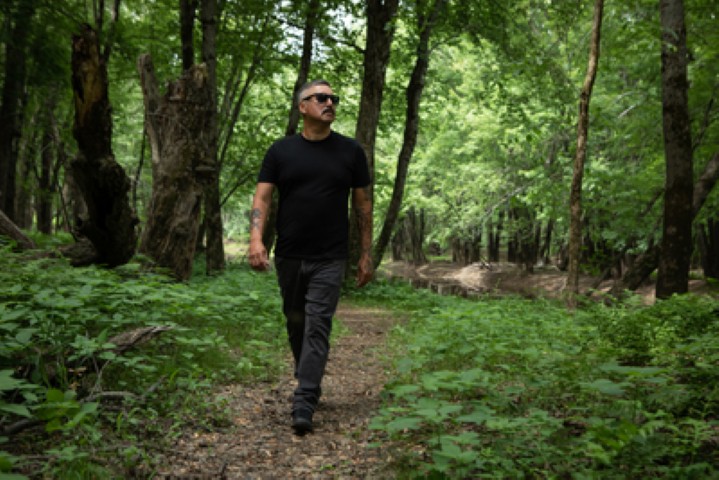
Mike Bern Celebrates Wolastoqey Storytelling, Healing and Indigenous Identity on New Album, Little People
Where did all the little people go? That question opens Mike Bern’s new album, and it echoes far beyond the title track.
The folk-rock singer-songwriter from Neqotkuk (Tobique First Nation), New Brunswick, has released Little People, a seven-song album exploring healing, family, and Indigenous identity, alongside its title track as his latest single.
The song “Little People” is built on the Kiwolatomuhsisok, also remembered by some as the Geow-lud-mo-sis-eg, the mysterious small beings of Wolastoqey folklore whose stories have travelled through generations of families.
Both are out now, arriving as the album’s earlier single, “The Belt,” sits inside the Top 15 on the Indigenous Music Countdown.
The Stories Behind Mike Bern’s “Little People”
“This song isn’t really about proving whether the Little People exist,” says Bern. “It’s about remembering the stories our people carried and asking ourselves what we lose when we stop telling them. I grew up hearing about these things, and I don’t want those stories to disappear.”
The Little People mean different things depending on who’s telling the story. To some, seeing one is an omen, good or bad. To others, they’re tricksters, spoken of with caution and respect.
The title track holds on to the playful side too: tricks played on grandparents, and horses found in the morning with their tails mysteriously braided.
In the song, the Little People slip away into the water, the forest and beneath the roots of the old trees as the singing fades and the language grows quieter.
For Bern, their disappearance stands for something every community can recognize: old songs that go unsung, ancestral languages spoken less often, and stories that once passed easily from grandparent to grandchild growing harder to hear.
The song doesn’t end in loss. Bern leaves open the possibility that the Little People never left at all.
“Maybe the Little People are still here,” he says. “Maybe we’re the ones who stopped listening.”
Exploring Healing and Heritage Through Music
That spirit of memory runs through the whole album. “The Belt” looks at how war reshaped one man’s fatherhood through a child’s eyes, and an old belt hanging by the door becomes a symbol of the pain families carry without ever speaking about it.
Songs like “pecihpun” and “mehtaqte,” named in Wolastoqey and featuring Jean-Philippe Hébert on guitars and lap steel, carry the language itself into the music.
Throughout, Bern writes about the struggles people carry, the people they love and the strength it takes to keep moving forward.
Mathieu LeGuerrier produced and mixed Little People, and Jean-Philippe Villemure mastered it.
Mike Bern’s Musical Journey
The album builds on a run of personal, history-rooted releases that have made Bern one of Canada’s most consistent Indigenous folk-rock voices.
Several of his earlier singles reached the top of the Indigenous Music Countdown, including “First Mother,” “Echoes,” “We Are the Stars” and “Into The River.” His albums Waponahkew and Ancestors and his catalogue of singles have earned him three Native American Music Award nominations.
Bern grew up along the Tobique and Wolastoq rivers, where music filled family gatherings and his late uncle’s guitar first caught his ear. He found his calling as a songwriter during a stay in rehab, when a counsellor recognized the poetry in his writing.
Before going solo, he fronted Kickin’ Krotch and District Avenue, opening for The Trews, Seaway, One Bad Son and The Motorleague. A District Avenue music video picked up two awards and was featured at the 2018 PyeongChang Winter Olympics.
Little People ends the way it begins, with a question and an invitation to listen. Somewhere in the forest, by the water and under the old roots, the stories are still waiting to be heard.
Listen to “Little People” below and learn more about Mike Bern in our interview.
Mike Bern Interview: Little People, Storytelling and Indigenous Identity
Hi, Mike! Good to see you again! Care to introduce yourself to the readers for those not familiar with your music?
It’s great to be back, and thank you for having me again. I’m Mike Bern, a Wolastoqey singer-songwriter from Neqotkuk (Tobique First Nation) in New Brunswick, Canada. My music is a blend of folk, roots and rock, with a strong connection to my Indigenous culture and upbringing.
I’ve always been drawn to music that tells a story. A lot of what I write comes from personal experiences, conversations with our Elders, our history and the things we sometimes struggle to talk about. As I’ve grown as an artist, I’ve realized that music is more than just entertainment for me. It’s a way of preserving who we are, where we come from and what we’ve experienced as Indigenous people.
Your new single “Little People” draws from the Wolastoqey stories of the Kiwolatomuhsisok. What do you remember hearing about these mysterious beings growing up, and why was now the right time to bring their stories into your music?
Growing up in Neqotkuk, the stories of the little people were part of our culture. The Kiwolatomuhsisok were mysterious beings connected to the natural world. These stories carried lessons about respecting the land, being mindful of our surroundings and understanding that there’s more to this world than what we can see.
As I got older, I started noticing that we weren’t hearing these stories as often anymore. We’re losing our Elders, and with them, we’re losing generations of knowledge that was passed down orally.
That’s really where the question, “Where did all the little people go?” came from. It’s not necessarily about the little people disappearing. It’s about us no longer talking about them. Have they disappeared, or have we simply stopped listening?
I felt it was important to bring these stories back into the conversation and hopefully inspire younger generations to become curious about their own culture.
You’ve said the song is about what happens when communities stop telling their stories. How important is music in keeping Wolastoqey language, culture and traditions alive for future generations?
I think music is one of the most powerful tools we have for cultural preservation. Our people have always been storytellers. Long before our stories were written down, our history, teachings and traditions were carried through our voices.
When we stop telling those stories, we risk losing a part of ourselves. Colonization, residential schools and generations of assimilation have already taken so much from our people. We’re still trying to reclaim many of the things that were taken from us.
For me, incorporating Wolastoqey language, traditional stories and cultural teachings into contemporary music is a way of building a bridge between our Elders and our youth.
If one of my songs encourages a young person to sit down with their grandparents, ask about an old story or learn a word in our language, then I’ve accomplished something far more meaningful than getting a song on the radio.
“The Belt” explores how trauma can be passed from one generation to the next. How has songwriting helped you confront difficult family experiences and find healing?
Songwriting has allowed me to have conversations that I didn’t always know how to have in person. Growing up, there were things I didn’t understand about my family, about the way people dealt with their emotions and why certain behaviours were repeated from one generation to the next.
As I got older, I began to understand that everyone carries a history. Sometimes the people who hurt us are carrying pain that they’ve never had the opportunity to deal with themselves. That doesn’t excuse their actions, but it can help us understand where those actions came from.
With “The Belt,” I didn’t want to point fingers or place blame. I wanted to look at the bigger picture of generational trauma, including the experiences of Indigenous veterans who returned home carrying the emotional weight of war.
Writing these songs has helped me develop a greater sense of empathy and understanding. Healing isn’t about forgetting what happened. It’s about acknowledging it, learning from it and making a conscious effort not to pass that same pain on to the next generation.
You discovered your gift for songwriting during a stay in rehab, and you’ve since earned three Native American Music Award nominations. Looking back on that journey, what has music given you, and what do you hope listeners take away from your new album, ‘Little People’?
Music gave me a sense of purpose at a time in my life when I was searching for one. During my time in rehab, I had a counsellor who helped me recognize that songwriting was something I could use to express myself and work through my experiences. I never imagined that it would eventually lead me to where I am today.
Receiving three Native American Music Award nominations, hearing my songs on the radio and having people connect with my music are things I’m incredibly grateful for. But some of the most meaningful moments are when someone tells me that a song helped them understand something about their own life.
With Little People, I wanted to create an album that was bigger than myself. It’s about cultural identity, generational trauma, healing, remembrance and reconnecting with the things we’ve lost along the way.
I hope Indigenous listeners hear a little bit of themselves in these songs, and I hope non-Indigenous listeners walk away with a better understanding of who we are as people.
Most importantly, I hope this album starts conversations around kitchen tables, encourages people to listen to their Elders and reminds us that our stories are worth carrying forward.
Because if we don’t tell our stories, who will?
Woliwon.
Connect With Mike Bern:
Website | Facebook | Instagram | TikTok