
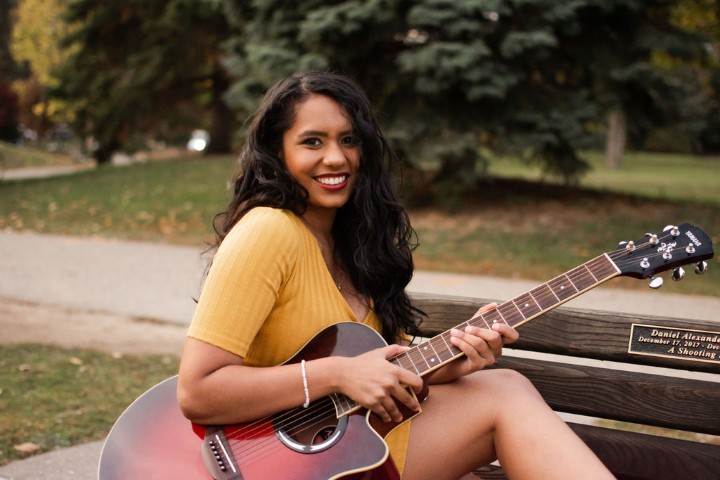
Guelph, Ontario Singer-Songwriter Trina Chakrabarti Trades Metaphor For Directness On New Single “Take A Stance”
Guelph, Ontario singer-songwriter Trina Chakrabarti releases “Take A Stance,” out now, a deliberately stripped-down protest song built to let its lyrics carry the whole weight of the record. Where her debut EP, Underworld, processed personal trauma through myth and metaphor, “Take A Stance” drops the allegory entirely.
“I wanted this song to be more stripped down, and really have the lyrics shine,” Chakrabarti says. “Just like I want to embrace the anger of my personal experiences, I believe in embracing the anger from world issues.”
The song grew out of two specific moments of frustration. Chakrabarti, who works as a registered music therapist, says she wrote the first verse after watching colleagues in her field grow more concerned with the professionalism of language than with the human cost of the events being described, and wrote the second after watching public reaction to escalating conflict involving Iran. From there, the song widens into a broader argument about complicity and silence, delivered without a single metaphor standing between the listener and the message.
“This track has no metaphors,” she says. “It is calling out the hypocrisy so directly, because with this topic, metaphors just are not enough.”
The chorus builds around a call to collective responsibility, “there’s power in the people when we choose to take a stance,” while the song’s extended outro becomes a chant naming a long list of regions experiencing occupation, Chakrabarti says deserve more global attention than they receive, Palestine, Congo, Sudan, Hawaiʻi, Kashmir, Iran, Venezuela, Cuba, Haiti, Lebanon, Syria, Myanmar and Ukraine among them, closing each time on “free them all.” Throughout the song, she returns to the phrase “none of us are free till all of us are free,” a sentiment she traces to Black activists including Maya Angelou, Malcolm X and Opal Lee.
“We owe each other everything,” she says, “because that is what it means to be in community.”
For Chakrabarti, the song is personal as much as political. Her family history includes the impacts of colonization and partition, and she says continuing to speak out feels like a responsibility rather than a choice. A portion of the proceeds from “Take A Stance” are being donated directly to a friend’s family in Palestine.
“You don’t need a giant platform to take action,” she says. “Using your voice is more and more important every day, and it is never too late to speak out.”
“Take A Stance” was produced, mixed and mastered by Ruthie Santiago, with Chakrabarti handling lyrics, melody, vocals and ukulele herself. It follows her 2024 debut EP, Underworld, a concept project that reimagined the myth of Hades and Persephone as a vehicle for exploring personal trauma, anger, grief and chronic illness, built in collaboration with producer Wonder Truly and a community of musicians Chakrabarti met through music streaming on Twitch.
Chakrabarti holds a graduate diploma and master’s degree in Music Therapy from Concordia University, along with training from the Royal Conservatory of Music, and continues to work part time as a registered music therapist alongside her recording career. She identifies as a member of the Desi, Queer and Disabled communities, and describes her work as a genre bending exploration of personal experience examined through a social justice lens.
“Art has the ability to create meaningful change,” she says, “and if there is one piece of advice I can put forward, it is to make your human made creations, even if no one sees it.”
Chakrabarti says her next single, “Something Like Hope,” is planned as the introduction to her next full-length project, continuing a catalogue built on turning difficult experience, personal and global, into songs meant to be felt directly.
Hi, Trina! Good to meet you! Care to introduce yourself to the readers for those not familiar with your music?
So excited to be having this conversation! My name is Trina Chakrabarti, and I am a Registered Music Therapist and singer/songwriter here in Ontario. My journey to releasing music really began when I started streaming on Twitch 2021. I was able to find a community that encouraged me to start putting my original art out there, which resulted in my debut single “Calling” produced by Alanna Matty being released in 2023. Fast forward to now and things just kept growing, whether it was Charity collabs with other streamers, or my Greek Mythology EP produced by Wonder Truly, or my most recent protest song “Take A Stance” produced by Ruthie Santiago. I like to describe my music as a genre bending exploration of personal trauma, that examines the world we live in through a social justice lens. Everything I create is deeply personal, but there is always a message behind it that goes beyond the individual. I love blending musical styles and often bring my classical training for vocal quality, into songs that instrumentally and melodically might lean more towards alt pop, dark wave, folk, or even theatrical.
“Take A Stance” is a deliberate break from the myth and metaphor of your debut EP. What made you decide this particular song needed to be stripped down and direct instead?
The most honest answer I can give to this is exhaustion. Don’t get me wrong, I genuinely believe metaphor, and mirroring the real world through fantasy is a powerful tool, however with Take A Stance, the direct nature felt more like a need instead of a choice. It seems that many people can read about tyrannical forces in a fantasy novel and side with those being oppressed, but when it is real life, for some it goes out the window. I think a lot of people can relate to the feeling of fatigue from our current news cycle, and one of the things that lead to my specific fatigue was headlines that didn’t tell the full story, and excuses being made to defend powerful people. An example would be headlines that would say something along the lines of “15 dead in bombing in Gaza.” There’s no accountability in a headline like that. Who bombed them? The passivity and dehumanizing language such as “Dead” over “killed” or “murdered” felt infuriating. Music and art has always been political, and it was essential to me that my message was clear, and there was no way to misconstrue it.
As a registered music therapist, you work in a field built around language and how we talk about pain. Did writing this song feel like a departure from that professional instinct, or an extension of it?
This song was absolutely an extension of professional instinct. Therapy has always been, and will always be political. The current landscape of therapy is evolving away from the idea of a “blank slate” therapist, at least in the spaces I occupy. Not every therapist or music therapist will agree with me, and that is their prerogative because at the end of the day not every therapist will be the right match for every client. I believe that in order to move towards decolonizing the field of therapy, we must learn from marginalized therapists themselves, and the traditional practises that have been used for decades by Racialized, Queer, and Disabled therapists. What I know, and what has been shown time and time again in my therapeutic practise is that showing up with my values clearly stated is what indicates to clients that they can be brave with me. If those values don’t align with yours, I’m not the therapist for you and that is ok. Traumatic world events do show up in the therapy space, and if you are in this field you HAVE to be prepared for that. Does this mean share every part of myself with my clients? Of course not, that would be unethical and is saved for my own therapist! But I am still me. Similar to showing authenticity as a therapist, I want to display my values in my music, and help listeners know they are seen. Those who have an issue with my words, can just move along. Whether in my role as a music therapist or musician, I arrive as myself, and writing this song has been an extension of that.
Your family history includes the impacts of colonization and partition. How much did that personal history shape the urgency behind this song, even in a track that’s largely about global issues beyond your own story?
History repeats itself, and patterns I have seen in my own family history, I am now noticing in places such as Palestine, Congo, and Sudan. I still don’t know the entirety of my family’s history, and that is incredibly painful. One side of my family is originally from what is now Bangladesh, but at the time was part of India, and they were forced to migrate to what is now India. I have never visited that original land. There was a Bengali genocide that killed 3 million people that not even I knew about until far too recently. These horrors have forced manufactured religious divide, and mentioning Kashmir in this song was incredibly purposeful as it is my duty to speak out when my own people are participating in the occupation that their ancestors suffered. I think what it comes down to is that I don’t necessarily believe these global issues are beyond my own story, rather they are direct example that all our struggles are connected.
You’ve talked about identifying as part of the Desi, Queer, and Disabled communities, and about art’s ability to create meaningful change. How do those identities show up in how you approach protest songwriting specifically?
It is impossible to separate my identities from any of my music. Often I am not even consciously incorporating it, but it just happens. Whether that is a melodic run that is unconsciously drawn from the Bengali music I grew up listening to, or a lyric about coming into your true self that mirrors my experiences being Queer, or the immediate image I had in my head holding my cane and wearing my medical mask that became the cover art of “Take A Stance” a photo by Sidney Elizabeth Photography in my backyard beautifully brought to life by Emily Plus Everything in a protest backdrop. When it comes to writing protest music, similarly to the contrast of metaphor in my EP versus direct in my latest single, I think to myself, “What do I want to hear more of?” or “What do I wish I heard as a child?.” For me the power of writing protest songs is their ability to empower both the writer, and the listeners into action. We do have voices, and we have a responsibility to use them, whether it be by supporting a Disabled owned business, or joining local grassroots organizations, or writing a song. I chose to donate the proceeds of “Take A Stance” to my friend’s family in Palestine. I don’t have a huge platform, but that doesn’t mean I can’t utilize what I do have.
Connect with Trina Chakrabarti:
Website
Bandcamp
Facebook
Instagram
TikTok