
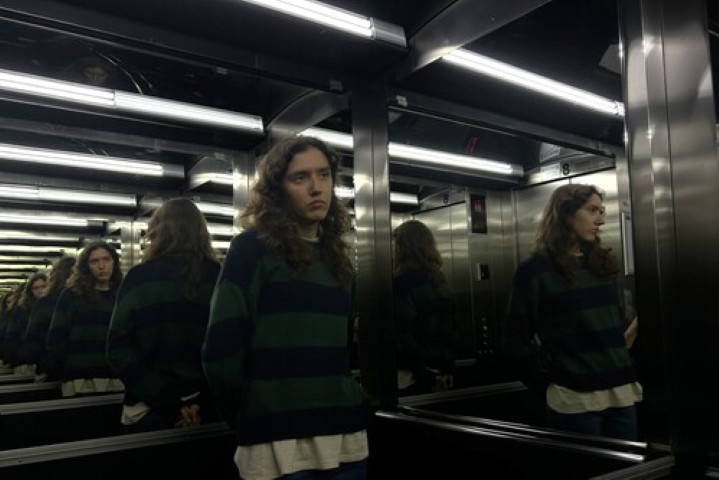
Cape Town’s ESSPI Turns 2 A.M. Spirals Into Strength On New Album, FAUXstalgia, Led By Single “Retrograde”
Cape Town, South Africa artist Esspi, the project of singer-songwriter Sarah Pearson, releases her new album, FAUXstalgia, led by focus track “Retrograde,” both out now. The album takes its title from a word Esspi coined herself while studying the meaning of nostalgia in college, sitting in her mother’s office one afternoon doing homework.
“I went, wow, that’s an emotion I experience every day, but I didn’t know it existed,” she says. “I knew the word was too iconic not to use.” FAUXstalgia, as she defines it, is the feeling of mourning a time you never lived, or deeply understanding an emotion you never personally felt.
Musically, the album is a love letter to the production values of the 1970s and 80s, with Esspi trying to inhabit the mindset of artists like Kate Bush, Depeche Mode, The Eagles, Linda Ronstadt and Queen while tracking the record.
“I tried to picture what those bands and artists were thinking while making their songs in that time period,” she says, channeling that era’s sound through her own folk-pop, alt-pop and indie-country lens, a style that sits somewhere between the acoustic warmth of America and the confident pop sensibility of Wham!, carrying the emotional honesty of artists like Phoebe Bridgers and Lizzy McAlpine.
FAUXstalgia represents six years of work that began when Esspi was just 13. The first song written for the album, “What Am I Supposed To Do,” came from watching a close friend’s parents go through a divorce, written from the child’s perspective.
“I wanted to try to imagine what she was feeling and thinking, and how the children always get overlooked in the situation,” Esspi says.
The rest of the album came together gradually, pieced together from voice memos that Esspi had to transfer every time she got a new phone.
“That was absolutely terrifying,” she says. “Some songs took ten minutes to write; others took six years.”
Esspi recorded the album during school holidays in a home studio with producer David Jones, an environment built for total creative freedom.
“We had the time and freedom to be experimental, try random things, and see if they worked,” she says.
When saxophonist Dave Bettesworth came in to record his parts, the sessions became known, inevitably, as being run by “Double Daves.” For “All I Hear Is Rain,” Esspi and Jones stood in front of a microphone clapping at different volumes and hand shapes for what felt like 500 takes, a sound that ended up buried under the saxophone solo but stayed one of her favourite memories from the sessions. Pro Tools crashed often enough to force repeated re-recording, and Esspi says a lot of the album’s random sound effects made it onto the final mix purely out of studio delirium, the two of them throwing digital sounds at the wall until something sounded right.
FAUXstalgia marks a real shift from Esspi previous release, “Tainted Heart,” which came from a period of isolation.
“That whole song was literally a two a.m. spiral,” she says, “the kind you get when you’re completely alone at night and the whole world feels like it’s pressing down on you.”
With this album, she wanted to reframe those same spirals as a source of strength rather than something to hide.
“So many people have those two a.m. moments,” she says. “I took a bunch of those spiral thoughts and used them as a strength instead.”
That reframing sits at the centre of “Retrograde,” the album’s focus track and, in Esspi’s words, “my baby.” The song moves through the exhausting weight of trying to be the strong one while quietly spiraling backward, born out of the disappointment of running with the wrong crowd. “I don’t like the person I’ve become, I don’t know how I’ve changed or what it’s from, yeah I just retrograde instead of run,” she sings, later admitting, “I’m tired of living a lie, they say smile, you’ll be fine, I can’t move on with my life if I’m always wrong.” Looking back on the song now, Esspi says she still thinks about the version of herself who wrote it.
“I will always remember the girl writing that song in her two a.m. spiral,” she says. “Looking at it now, I know I have incredible experience, I’ve learned so much, and I have so much more knowledge going out into the world.”
Elsewhere on the album, “Darkness at the Disco” turns heartbreak into something bittersweet, the realization that loving someone fiercely sometimes means letting them go, while “What Am I Supposed To Do” remains one of the album’s most tender character studies. Esspi is deliberately open ended about what the rest of the record means.
“I could tell you every scenario I had for the rest of the songs,” she says, “but I want you to interpret it in the way that most resonates with you.”
With FAUXstalgia, Esspi turns six years of voice memos, late night studio delirium and private battles into a record built to be shared, an album about the emotions we all recognize the moment someone finally names them.
Hi, Esspi! Good to meet you! Care to introduce yourself to the readers for those not familiar with your music?
Hi. I’m Esspi, I make alternative pop music for people who feel completely alone in the thoughts and feelings they have.
You coined the word “FAUXstalgia” to describe mourning a time you never lived. Why do you think we can feel so emotionally connected to eras, places or experiences that were never actually ours?
I often find that when I see a place, or hear a sound, or smell something from a previous time, I feel this overwhelming sense of “I’ve been here before” or “I’ve experienced this in my life,” but I can’t tell you why or when or how. So I did a lot of research to try to figure out why that feeling feels like that. I watched tons of videos and everything I could find — I was so obsessed with it. And I basically came to the conclusion that as humans, we’ve been the same throughout our ages. I’m not going to go back very far, but if you look at people in the sixties and seventies, they were the same. We’re the same people, and I think we all have the same emotional register for things. So when things happen to other people, we can imagine what that would be like for us. I think it’s actually about our unity as humanity — it’s really beautiful when you think about how connected we are, yet we’ve probably never met each other at all. I love it.
You started writing this album at 13 and finished it six years later. When you listen back now, can you hear the different versions of yourself growing up across the record?
Yes, I can, and it’s really strange because I’ve condensed them all into one album. But it’s actually really cool to see it finished, because even parts of the songs — like a verse or a prechorus or a chorus — were actually from another song I was working on but ended up not liking as a whole. So I’d take a verse or prechorus from that song and put it into another one. So even when I break down and listen to one song, I can hear so many different parts of my life in it, which is really cool. Like, “Darkness at the Disco” is literally five different songs I had that I just couldn’t finish, so I put them together and created one song out of them. It’s a surreal experience sometimes, but it also feels normal in a weird way.
Because these songs were developed over years of voice memos and home-studio experimentation, how much of the finished album came from careful planning and how much came from accidents you decided were better than the original idea?
The interesting thing is, when I went into the studio for the first time to record this album, I only went in with maybe two finished songs. Literally all the other songs were just a verse or a chorus or something, and I had to come up with the rest while making the album. So a lot of it was coming up with things in the moment — there was no real idea beforehand, which is interesting. With “What Am I Supposed To Do,” we actually had a completely different verse in the beginning. We recorded it and everything, but it just didn’t sound as good compared to the rest of the song — I was really disappointed. The rest of the song was really cool, but we had to rerecord a whole bunch of the sound ideas to match the new verse. At the same time, while we were putting the other songs together, a lot of it just happened out of experimenting with the sounds I wanted based on the emotions or feelings I had. So a lot of the songs came together through, “Okay, we like that sound, keep that,” and then, “Now I need to make my verse match that sound.” It was quite interesting.
You deliberately leave many of these songs open to interpretation instead of explaining exactly who or what they are about. Once a song is released, do you feel its meaning still belongs to you, or does the listener become part of writing its story?
I have my interpretation of the story, and that’s important to me — that will stay with me. But I actually find it even more interesting to see how everybody else interprets it, because there’s nothing more exciting than seeing somebody else’s creative interpretation of something and how their brain interprets it. It’s really, really cool. To me, that’s one of the most exciting parts about being a musician — seeing how your song impacted someone else, not just your own feelings about it. I really enjoy that part.