
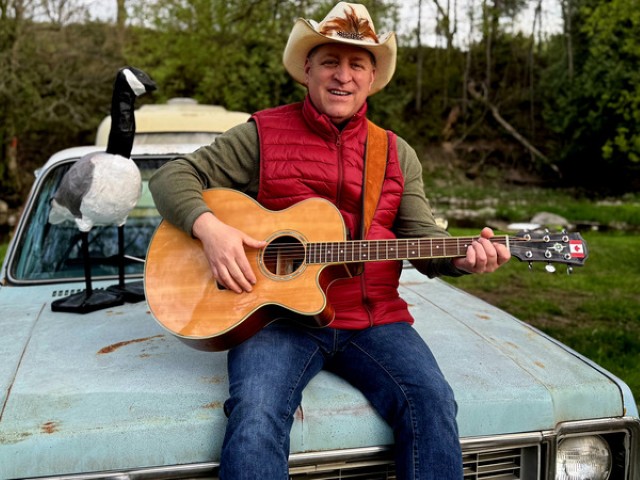
Kitchener’s Kevin Westphal, Known As THE CANUCK, Skewers Grocery Prices On New Single “The Food Inflation Blues”
Kitchener, Ontario singer-songwriter Kevin Westphal, better known to Canadian audiences as The Canuck, releases “The Food Inflation Blues,” a country comedy track born out of a conversation that stuck with him longer than he expected. Standing in the checkout line, Westphal asked a store manager why prices kept climbing, and later that same night watched the news report record grocery store profits.
“I picked up my guitar and ‘The Food Inflation Blues’ just came out,” he says.
The song plays out almost like a short story set to a shuffle beat. Westphal walks the aisles cataloguing sticker shock, “I almost started crying when I saw the price of meat, and the price of the fruits and vegetables, it knocked me off of my feet,” before landing on the chorus that carries the whole joke: “There is something funny going on at the grocery store, every week the price of food goes up a little more, what in God’s creation is making grocery prices soar.” A fictional store manager offers up the usual list of culprits, diesel fuel, tariffs, climate change, rising wages, before the song’s punchline arrives care of the evening news, the same stores pleading poverty are posting record profits. “It’s the same old story,” Westphal sings, “it’s the food inflation blues.”
That instinct, using a joke to say something serious, puts Westphal in good company. Comedy has always had a particular power in protest songwriting precisely because it slips past the defenses a straightforwardly angry song runs into. Where outrage tends to preach to people who already agree, a funny lyric invites listeners to laugh first and catch what they’re laughing at second, the same trick songwriters like Randy Newman, Tom Lehrer, The Kinks’ Ray Davies, Warren Zevon, John Prine and Arlo Guthrie have leaned on for decades to make difficult subjects land without ever feeling preachy.
It is also a tradition Westphal came by honestly. His breakout song, “The Gas Song,” turned pump price frustration into a hit that spread across Canadian radio regardless of format in the early 2000s. Years later, a friend who played lead guitar for Stompin’ Tom Connors brought “The Gas Song” out on tour when gas prices spiked again, a connection that led to a real friendship between Westphal and the country legend from 2005 to 2012, and cemented Westphal’s own reputation as one of the genre’s most reliable chroniclers of everyday Canadian frustration.
“The Food Inflation Blues” continues a catalogue that has, for close to 15 years, turned ordinary Canadian gripes into songs people instantly recognize, from “Here’s to Our Farmers” to “A Typical Day on the 401,” “The Barbershop Song” and “The Marijuana Song,” each one earning Westphal television, radio and online coverage across the country, including CTV News and London’s Country 104.
Westphal wrote and produced “The Food Inflation Blues” himself, recording at Fred Smith Studio in Kitchener with Fred Smith on lead guitar, Doug Dietrich on pedal steel, Don McDougall on drums and Paul Stouffer on keyboards, with Westphal himself on bass. The accompanying video was directed by Danny Bailey, assisted by Riley Harrison and filmed and edited by Inflorescence Bloom, with Grant Heywood on drums, Pete Harrison on upright bass and Paul Schultz playing the grocery manager opposite Westphal as The Canuck.
With “The Food Inflation Blues,” Westphal adds another chapter to a career built on turning what everybody is already grumbling about into something worth singing along to, proof that the funniest way to say something serious is often the one that sticks.
Hi, Kevin! Good to meet you! Care to introduce yourself to the readers for those not familiar with your music?
My name is Kevin Westphal, although most people know me as The Canuck. I’m a singer-songwriter from Kitchener, Ontario, who’s spent years turning everyday Canadian experiences into songs that make people laugh while also making them think. The turning point came with The Gas Song. I was on stage complaining about rising gas prices, and the audience immediately connected with it. They weren’t just laughing—they were relating to it. That’s when I realized there was a real appetite for songs that gave a voice to the everyday frustrations people were already talking about around the kitchen table. Since then I’ve written songs about farmers, Highway 401, Tim Hortons, marijuana, Canadian life, and now grocery prices. My latest release, The Food Inflation Blues, continues that tradition by taking a serious issue that’s affecting families across the country and presenting it with humour. My goal has always been to entertain first, but if people leave smiling and thinking about the message, then I’ve done my job.
You’ve said this song came out of you the same night after standing in a checkout line asking a store manager why prices kept climbing, then watching the news report record grocery profits. Walk me through that night. What did it actually feel like picking up the guitar with that specific anger still fresh?
It really was one of those moments where everything just came together. I was standing in the checkout line looking at what groceries were costing, and I ended up asking the store manager, “Why does this stuff just keep going up?” He gave me all the reasons you hear—fuel costs, wages, tariffs, climate change—and I understood what he was saying. But then later that night I’m watching the news and hearing about grocery companies making record profits, and I thought, hang on a second… there’s something funny going on here. I was frustrated, but for me frustration often turns into humour. I picked up the guitar while it was still fresh in my head, and the song started coming out. I wasn’t sitting there thinking I was going to write some big protest song. I was basically saying musically what I think a lot of people were already saying at the checkout: How can everything cost this much when somebody at the other end seems to be doing pretty damn well? That’s really where The Food Inflation Blues came from.
You’ve built a career on using comedy to say something serious, going back to “The Gas Song” over two decades ago. What did you learn writing that first one about how far you can push a joke before it stops working as protest and just becomes a punchline?
I learned that what I was doing was actually pretty original, and for whatever reason, people seemed to look up to what I was doing because they felt like I was standing up for them. I wasn’t really trying to create some kind of formula. I was just being myself and speaking my mind about a sensitive topic that was upsetting people, and I was trying to make a serious situation a little lighter. I think that’s where the humour works best. You can make people laugh, but underneath the joke there still has to be something real that people recognize in their own lives.
You’ve got close to 15 years of songs turning ordinary Canadian gripes into something people recognize instantly—farmers, the 401, the Timmy Tune, marijuana, and now groceries. How do you know when a frustration people are grumbling about is actually a song, versus just something people complain about at the dinner table?
I don’t know if there’s really a formula for it. The people usually tell you. They’ll give you ideas through everyday conversation, or you’ll hear a catchphrase from somebody who’s upset about something, and sometimes that translates into a good song. If I hear people talking about the same thing over and over again and I can find some humour in it, that’s usually when I start thinking there might be a song there. That’s how things like The Timmy Tune, The 401 Song, the marijuana song and now The Food Inflation Blues happen. They’re really just everyday conversations and frustrations that I turn into music.
Comedy protest songwriters like Randy Newman, Tom Lehrer, John Prine and Arlo Guthrie all used humour to get a serious point past people’s defenses. Do you think of yourself as working in that specific tradition, or did you arrive at this style completely on your own, just trying to make Kitchener laugh?
I have a lot of respect for those songwriters, but I’d say I arrived at this style pretty naturally on my own. I wasn’t thinking about writing protest songs or trying to follow anybody else’s style. I was just being myself and trying to relate to the audience in the heat of the moment. It really started when I was on stage bitching about gas prices and the audience immediately engaged with it. That reaction showed me there was something there. Over the years, I realized humour can be a great way of talking about serious or sensitive subjects. If you can make people laugh about something they’re already frustrated with, they connect with it. So if that puts me in that tradition, I’m proud to be part of it, but I really got there just by being myself and trying to make people laugh.