
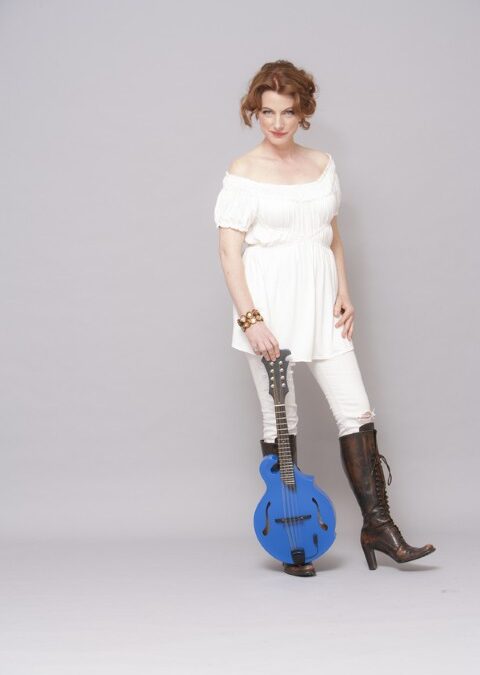
Irish Singer-Songwriter and Multi-Instrumentalist Maria Butterly Releases Transatlantic Single “The Last Ship to Shore”
Irish singer-songwriter and multi-instrumentalist Maria Butterly joins forces with celebrated Quebec guitarist and producer Martin Larose for “The Last Ship to Shore,” a luminous, cinematic new single co-written with arranger Frank Corneau that bridges two of the world’s great folk traditions across one extraordinary piece of music. It is a song about longing to belong, about setting out across deep open waters in search of a place to finally call home, and it arrives as one of the most emotionally resonant collaborations of either artist’s already remarkable career.
The song’s origins are as organic as its sound. Butterly and Larose met in Dublin during a visit to the legendary Windmill Lane Recording Studios, where U2, The Cranberries, The Rolling Stones, and The Chieftains recorded some of their earliest work. The connection was immediate, rooted in a shared recognition that Irish and Canadian folk music draw from the same deep well of migration, exile, and longing for home.
“I knew I could add something to it that would bring the two cultures together harmoniously in music,” Butterly has said of the collaboration.
The lyric delivers on that promise with sweeping, imagistic beauty:
“Emerald streams / Emerald dreams / As the lighthouse guides the last ship to shore.”
Butterly, a Meath native who has performed at Nashville’s Bluebird Café, the House of Blues in Los Angeles, and New York’s Mercury Lounge, is a winner of Best Celtic Sound at the New York International Film and Music Festival and multiple Songwriter of the Year awards at the Leinster Entertainment Awards. She holds a Master’s degree in Scoring for Film, TV, and Interactive Media, and her music has appeared on RTE, TG4, Virgin Media One, and Sky. Larose, from the Saguenay-Lac-Saint-Jean region of Quebec, is a Guitar World-featured virtuoso, founder of Studio Septentrio, producer and host of the television series Studio Boréal, and the artist behind eight solo albums. Together with Corneau, a master arranger whose work spans orchestral strings, brass, and layered harmony, the three have created something genuinely timeless.
Hi, Maria! Good to meet you! Care to introduce yourself to the readers for those not familiar with your music?
Hi, I am a multi award winning Irish Singer Songwriter Musician & Composer for Film TV Games. I am Vocalist and self taught multi-instrumentalist on Guitar, Mandolin, Piano, Whistles. I have released 4 albums to date and working on a 5th album to be released in early 2027. Blue Mandolin album of original songs is my finest artistic creation so far blending Folk, Traditional and Country. It has won many awards, produced by well known Irish guitarist and producer Bill Shanley. I toured in US and resided in NY, LA and Nashville for nearly two decades where I got to experiment with Country, Bluegrass and Folk genre blending with Celtic instruments giving a Celtic fusion sound to my music which can be heard on ‘Blue Mandolin’. While touring in the US I performed along side the likes of late Hal Ketchum, Damien Rice, The Pogues, Hot House Flowers, the late Raul Malo (Mavericks) and many others. Played venues in New Yorks Mercury Lounge, LA’s House of Blues. Performed and wrote a song titled ‘Quiet Man’ for Hollywood star ‘Maureen O’Hara. Lyrics have always helped me connect with people through stories, emotion, and honesty. Growing up in a difficult home shaped music into both an escape and a source of strength. My songs often reflect important moments and relationships in my life. “You Are My Heaven” explores love and connection, while “Kieran” honours a close friend who passed away. “Demons” draws on old banshee folklore with a dark, mystical atmosphere. I like to combine elements of various genres I have experienced throughout my travels. I love changing a tempo for a rhythmic section when you least expect it in a melody.
“The Last Ship to Shore” is ultimately a song about searching for home. What does the idea of “home” mean to you today, and has that definition changed throughout your career?
For me leaving Ireland in 1994 for the US and coming back to Ireland nearly 20 years later, was not a case of ‘coming home’ for location and family reasons, but the idea of ‘home’ today reflects where I am in my musical journey and personal life. As leaving for the US was a decision based on finding my fame and fortune with my musical career. Home today means being ‘happy’, content, feeling grounded, at peace where I am at in my personal life and career, no matter what country I am in. But for now that country is Ireland, but I always have an itch to travel and to see how I can incorporate different cultures and their genres of music to blend them with Celtic instrumentation and melodys, and this time all the signs point towards Canada as a connection has been established in Canada with another like minded music creator.
You and Martin Larose come from opposite sides of the Atlantic, yet the song feels incredibly unified. What similarities between Irish and Canadian folk traditions surprised you most during this collaboration?
The song is about longing to belong, about setting out across deep open waters in search of a place to finally call home. There is a connection between Ireland and Canada, rooted in a shared recognition that Irish and Canadian folk music draw from the same deep well of migration, exile, and longing for home. Irish and Canadian folk music often explore similar themes, e.g. working class life, rural identity, the sea, political struggle, nostalgia for home. And I think that’s why the connection was immediate with Martin when I heard the song. I knew I could add something to it that would bring the two cultures together harmoniously in music. There’s a modern crossover and influence. Many Canadian artists openly draw from Irish traditions e.g. Loreena McKennitt ( who has inspired me) combines Celtic and world influences, Spirit of the West incorporated Irish folk sounds, The Pogues influenced Canadian folk-punk scenes. Irish artists also tour extensively in Canada because there’s a large audience for traditional and contemporary Celtic music. That’s why Irish folk audiences often connect strongly with Canadian folk artists, and vice versa. It’s not so much of a surprise, but more of an exciting opportunity that a window has opened for me to connect with a talent like Martin in Canada.
The imagery in the song is vivid and cinematic. How did your background in film and television scoring influence the way you approached writing and arranging this track?
I always had an interest in orchestral sounds anI always had an interest in orchestral sounds and loved watching movies with the amazing scores from composers such as John Williams, using just a solo Violin to pull at the hardened of heart strings to make the audience ‘feel’ what the visual is portraying e.g. Schindlers List (1993). Once the melody is solid, then adding instrumentation around the melody is the key and skill set. I had no formal training in orchestral scoring, self taught musician, so I went to college and recently completed my MA (Masters) in Scoring for Film TV and Interactive Media so I could dive deeper . I am a diversified composer in a wide array of genres, but I have a passion for Celtic music with a classical ear and this gives my music a modern Celtic sound with a Classic cinematic appeal. So when Martin sent the song to me, I immediately connected with the melody, and lyrics which were so visual and personal, I knew my voice was going to capture that emotion and strength that it needed.
As a multi-instrumentalist, do songs usually begin for you with a lyric, a melody, or an instrument in your hands?
Most times they begin with an instrument, playing a few notes on the piano, strumming the guitar, and then the melody comes from that, the lyrics come after which sometimes is the hardest way to write a song, but that’s what works for me.
How did this particular song first reveal itself?
It revealed itself in the intro, the tempo/groove, it just had this slightly haunting feel, the production was so tight ,Martins’ guitar melody had this lovely arpeggios which was the hook in the melody and their was a slow build to the chorus which I loved and then the chorus just completely opened up, and this is where I knew I could power out this chorus with my vocals and layered it with harmonies. I also related to the story itself which made it personable. It had all the elements to allow me to do what I do best, so I just went for it, I loved singing it, and truly love the song, and that’s a good sign LOL.