
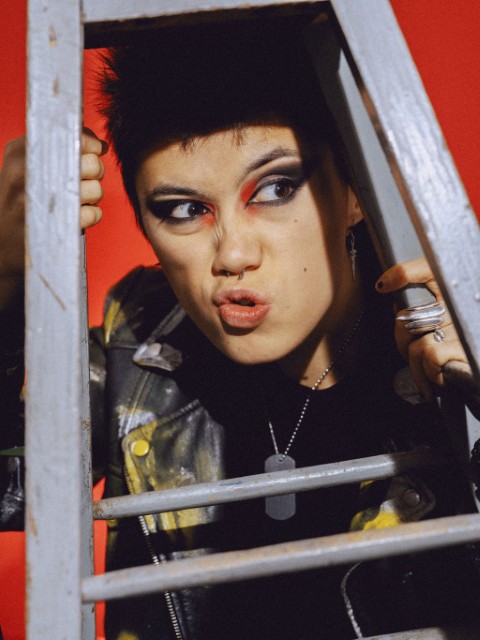
Feura Unleashes “Lose Your Head,” a Bold Debut from a Queer BIPOC Rock Artist Done Asking Permission
Feura takes a stand. The Toronto-based queer, BIPOC, East Asian rock artist releases her debut single “Lose Your Head” today, a sharp, unrelenting rock anthem that calls out every system, every person, and every institution that has ever had a problem with her existing. Funded by the Canada Council for the Arts and the Toronto Arts Council, written by Korol Pikulik, Alexandra Jelilyan, and Marc Koecher, and produced by Illegal Audio (Marc Koecher and Lexie Jay), “Lose Your Head” is the opening statement of an album that has been a lifetime in the making.
Feura grew up as one of the only people of colour in a small rural Ontario town, excluded early and excluded often. For years she tried to shrink herself to fit in, and it was never enough. At some point, she stopped trying. “Lose Your Head” is what came out of that decision: not a grievance, but a verdict.
“‘Lose Your Head’ came from this feeling that no matter what I do, people will find a reason to react to me just existing,” Feura says. “I’m queer, BIPOC, East Asian, and a type 1 diabetic, and whether I want to define myself by those labels or not, they’ve always shaped how people treat me. So, at a certain point it became: Screw it. If people are going to lose their minds over me anyway, I’m going to be fully myself. This record comes from that switch.”
The song is funny, furious, and precise. “You get mad that I got tattoos, chipped nail polish, studded shoulders” lands in the first verse with the kind of specificity that makes satire sting. The chorus, “You can’t help but lose your head every time I take a breath,” is not a complaint. It is a diagnosis. And the bridge delivers the thesis without apology: “All you want is my freedom.” Three words that say everything about power, control, and why certain people cannot stand watching someone refuse to be diminished.
Feura is clear-eyed about what she represents and what she is up against.
“Even existing as a queer East Asian artist in rock music feels radical, and it shouldn’t,” she says. “There’s so much pressure now to assimilate, to be digestible, and this record pushes back against that. At its core, it’s for anyone who’s ever felt like they had to ‘edit’ themselves to be accepted. It’s about being unapologetically yourself, even if it makes people uncomfortable, because that discomfort usually says more about them than it does about you.”
That is not a press release talking point. That is someone who has lived it.
Produced by Illegal Audio and mastered by Kristian Montano, “Lose Your Head” hits with the full weight of a rock record that knows exactly what it wants to say and refuses to turn it down. The production gives Feura’s voice room to be both biting and anthemic, and the result is a song built for arenas and for anyone who has ever needed to hear someone say the quiet part loud.
Feura’s summer run includes London Pride, Kempenfest at the OLG Main Stage in Barrie, a featured performance at Honey Jam at TD Music Hall in Toronto, and more dates through September. Every show is all ages. “Lose Your Head” is available now on all major platforms. The album follows.
Hi, Feura! Good to meet you! Care to introduce yourself to the readers for those not familiar with your music?
My name’s Feura, and I’m from Toronto, Ontario! I usually describe my sound as if P!nk and YUNGBLUD shoved forks into an electrical socket at the same time and fused into one person. That’s basically me.
I’ve also been described as a “fierce little Tasmanian devil,” which honestly feels pretty accurate. My music brings together the anger and chaos of punk rock with the camp, humour, and freedom of queer culture. It’s loud, emotional, fun, and a little unhinged in the best way.
At the core of everything I make is the message I wish I had growing up: you only get one life, so don’t waste it trying to dull yourself down for other people.
You describe “Lose Your Head” as the moment you stopped trying to shrink yourself for other people. Was there one specific experience that pushed you to that breaking point?
I’ve always been the kind of person who genuinely didn’t understand why self-expression was supposed to be embarrassing. Even as a little kid, I was fiercely creative and completely unapologetic about it. I wore what I wanted, said what I wanted, obsessed over weird niche things, and honestly just existed very loudly. It definitely got me into trouble sometimes.
Growing up, I think people saw me as “the weird kid” long before I saw myself that way. I came out at 14, which is actually insanely young when I think about it now, but weirdly the bigger turning point for me was makeup.
Up until then, I’d mostly been boxed into being “the tomboy girl,” and that felt easier for people to understand. But I remember getting to high school and deciding to show up with huge black winged eyeliner for the first time. It looked terrible, by the way. My mom only let me use these holistic makeup products that basically melted down my face by lunchtime, so I looked like a sad raccoon every day. But honestly, that eyeliner was the beginning of everything.
It was the first time I consciously chose self-expression over being accepted. I knew people were going to make fun of me, and I did it anyway. That feeling eventually became the heart of “Lose Your Head.” It’s about reaching a point where you stop shrinking yourself just to make other people comfortable. I still wear that eyeliner today too.
I think so many people are creative, emotional, weird, interesting human beings, but they build walls around themselves because they’re afraid of how they’ll be perceived. I want my music to feel like permission to let that go a little.
You say simply existing as a queer East Asian artist in rock music feels radical. Why do you think rock still struggles with representation in 2026?
Rock music has a really interesting history because it comes from Black music cultures, but when most people picture “rock” now, they picture something very white and male-dominated. That image became the standard for what people think a rock artist is supposed to look like, sound like, or act like.
So when you’re queer, East Asian, female, or honestly just visibly different in any way, you become very aware of yourself in those spaces. I’ve been to so many rock shows where I’m looking around realizing I’m one of maybe three people of colour in the room. That can feel intimidating, especially because a lot of rock culture still comes from small-town environments and older mindsets. I grew up in a rural area myself, so I understand that world very well.
Even on a professional level, you still feel it sometimes. I’m the leader of my band. I run the tech setup, I talk with the engineers, I know exactly what’s going on, but there are still moments where people will direct questions to the nearest guy instead of me. That’s a very real thing women in rock still experience all the time.
At the same time, I don’t want to frame rock as this hopelessly toxic space because I genuinely love rock music. I grew up on classic rock. I love the artists and communities that built this genre, and there are so many people within rock actively pushing for it to become more inclusive. I think we’re actually in a really exciting moment right now where the genre is opening up in a huge way.
For me, simply existing in this space feels radical because people still react strongly to anything that challenges what they’re used to seeing. A big theme in “Lose Your Head” is ego and insecurity. There’s a line in the song, “If it were up to me, I would beat up your ego,” and I think that really connects to this conversation. A lot of exclusion comes from insecurity and fear of difference.
But I also think people are craving connection and authenticity right now. That’s why I believe rock is changing. More people are finally allowing themselves to exist loudly and honestly inside the genre, and I’m really proud to be part of that shift.
Your music has this huge, arena-ready energy. What kind of live experience do you want people walking away with after a Feura show?
First of all, thank you for saying “arena-ready.” That’s incredibly flattering.
I’m a theatre kid through and through. If COVID hadn’t happened, I’d probably still be working in theatre right now. Music actually became my outlet because live performance spaces disappeared overnight, and I suddenly had nowhere to put all that energy.
Because of that, I’ve always approached music from a “live first, songs second” mindset. Even when I’m in the studio, I’m constantly thinking, “Okay, but how are we going to perform this live?” My music and live shows are completely tied together.
And my live shows are chaos in the best possible way. I don’t believe in standing on stage acting like the audience is there to worship me. I see myself more as the person leading the party.
At my album release show for Lose Your Head, we had a dancing horse onstage, performers running through the crowd, pool floaties flying around, someone fake-strangling me with a whip during a song, and me sprinting across tables and through the audience like a complete Tasmanian devil.
I want people to leave sweaty, overwhelmed, laughing, emotionally exhausted, and going, “That was the most fun I’ve had in a long time.”
More than anything though, I want the atmosphere to feel welcoming. I’m very intentional about creating a space where people can show up exactly as they are without feeling judged. If you’re at my show because you want to prove your music taste is cooler than everyone else’s, you’re probably at the wrong concert.
A huge inspiration for me is artists who create unforgettable live moments. People like Lady Gaga, YUNGBLUD, Michael Jackson, or Wendy O. Williams from The Plasmatics. I love artists who treat live performance like an event instead of just a recital. That’s what I want a Feura show to feel like too: total immersive chaos, but with heart behind it.
“Lose Your Head” feels like both a personal release and a broader statement. What conversations are you hoping this song starts for listeners who may never have thought about these experiences before?
I think because of who I am, people sometimes immediately assume my music is only “for” queer people, or only “for” people of colour, or only for people who already relate to those experiences. But honestly, “Lose Your Head” is for everybody.
At its core, the song is about what happens when you stop policing yourself for the comfort of other people. That could apply to something huge like identity, or something as small as wearing nail polish, dressing differently, listening to music people think is weird, or expressing yourself in a way that feels vulnerable. I want the song to hit that moment where somebody asks themselves, “Why am I so afraid to just be honest about who I am?”
I also hope it opens conversations from both sides. For the people who feel like they have to hide parts of themselves to fit in, I want the song to feel freeing. But I also hope it makes people question why difference makes them uncomfortable in the first place.
A big theme throughout the album is insecurity, ego, and conformity. I think we’re living in a time where people are lonelier than ever, but instead of connecting with each other honestly, there’s this pressure to fit into increasingly rigid identities, aesthetics, or belief systems. A lot of people are terrified of standing out right now.
And honestly, I think that fear creates anger. It creates division. It creates this instinct to attack people who are different instead of trying to understand them.
So the conversation I really want “Lose Your Head” to start is: what would happen if we stopped treating authenticity like a threat?
Because I genuinely believe people would feel less alone if we gave each other more permission to exist openly and imperfectly.