
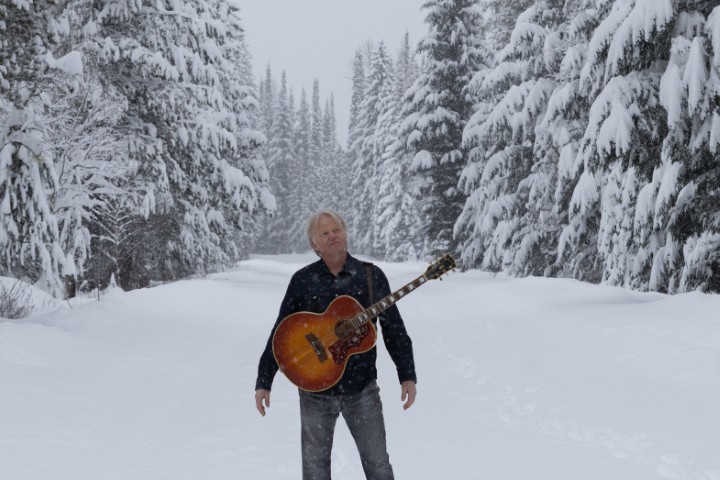
Where music and memory meet.
As anyone who knows their way around a camera understands, an aperture controls the amount of light exposed on film. Adjusting the aperture can radically alter the difference between what the naked eye sees and what is captured in a photograph.
John Schwirtlich has been a professional photographer for the past 25 years, based in Kamloops, British Columbia, shooting everything from his twin passions for skiing and live music to working on film sets and architectural projects. Still, John never gave up on his dream to make music, dating back to his youth in Kitchener, Ontario during the late 1980s, when a scene blossomed around emerging singer-songwriters such as Danny Michel, Paul MacLeod, and Shannon Lyon.
With the harmonica as his instrument of choice, John became a member of Lyon’s band Strange Days, which went on to play across Canada, crossing paths with bands like Blue Rodeo, The Tragically Hip, and Skydiggers, all of whom were helping establish a national touring circuit.
Now, John’s musical aspirations have come to fruition with his debut album, Apertures, a roots rock feast that sounds like it comes from someone who has truly lived the songwriting life. Produced by Craig Smith of the band ONTARIANS, the 10 full-band songs on Apertures reflect the album’s title—exposing different layers of personal experience, with John’s rough-edged voice perfectly suited to tell his story.
Not surprisingly, much of the subject matter on Apertures explores the complexities of love and relationships that come with experience. There’s the good—as heard on “Night Like This” and the album’s first focus track “Kimberley”—as well as the more bittersweet moments found in tracks like “7 Days” and “What You Want.”
Then there are the fun, straight-ahead rockers like “Idaho Rain,” “Ain’t No Joke,” and “Somebody,” which showcase the strong creative chemistry between John and Smith.
If Apertures had been made in the 1970s, it might have resembled a ragged-but-right solo album by artists like Rick Danko or Ronnie Lane. Instead, Smith’s stellar production keeps each track sounding bright, tight, and filled with unexpected sonic touches.
As John says,
“I think anything you do that involves a creative process—whether it’s photography, music, woodworking, sculpting, whatever—it can all be inspiring in different ways. I would say that music inspires my photography, not the other way around. I also produce mountain scenery video projects, and music plays a big role in how I see images and edit them together. Working with Craig on this album was truly inspirational. We’ve been friends for a long time, and he’s always been one of the best songwriters I’ve ever known.”
For many of us, achieving goals takes longer than we expect. But with the release of Apertures, John Schwirtlich can not only appreciate what he’s accomplished—he can also take pride in having created one of the strongest Canadian roots rock albums of the year.
First off, care to introduce yourself to our readers?
Hello, my name is John Schwirtlich. I’m a singer/ songwriter / photographer living in Kamloops BC.
Apertures feels like a deeply lived-in record—did taking the long road to your debut actually strengthen the songwriting?
Yes, I felt the timing was right for this. I was inspired to produce the record and felt like the songs were strong enough to record and release.
You worked with Craig Smith on this project—what made him the right person to help bring Apertures to life?
I knew Craig would support me and wouldn’t sugarcoat any of my songwriting. If it wasn’t strong enough for the record, we wouldn’t record it so I had a lot of faith in him being honest with me. I just felt really comfortable working with him. I’ve known Craig for a long time so there was history there and they helped me be open with the songs.
How did that long-standing friendship influence the creative process in the studio?
I really couldn’t have made this record with anyone else. Craig’s support for the songs was just the right amount. He doesn’t try to pump up your tires too much and he has an innate knack for finding the perfect balance of truth, support and direction.
You’ve said music inspires your photography more than the other way around—can you explain how that shows up in your work?
I love listening to music while I’m working with my cameras. Whether it’s still photos or video production work. Music provides inspiration for everything that I do. One of the challenges with video editing is finding music that works. If you find the right sound, it changes everything when it comes to editing.
Has releasing your debut changed the way you think about your future in musIc?
Yes, My original goals were just to record a couple tracks and that morphed into a full album and then with the support of Craig making the decision to release it. It’s all been much more rewarding than I ever could’ve imagined.
Looking back, do you think your path—taking decades to release this album—was exactly how it needed to unfold?
Well, it took decades to release it, but it wasn’t planned process. I just decided one day that it was the right time and I felt like I had the songs. I had been writing a lot more in a short amount of time and that was really what inspired me to connect with Craig and record them.