
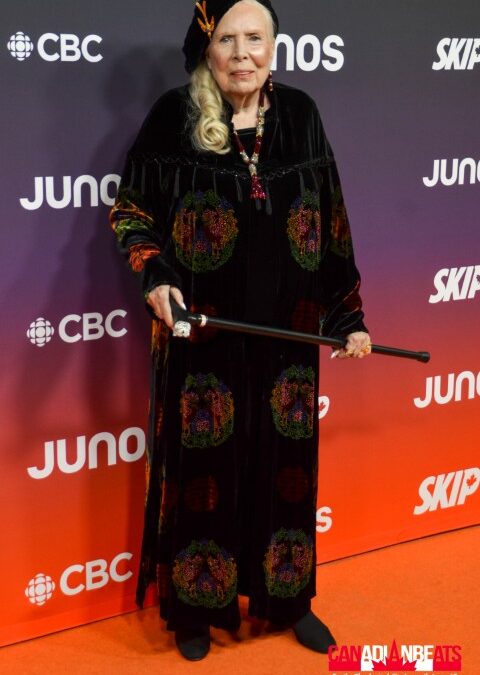
Joni Mitchell Celebrated with Lifetime Achievement Honour at the 2026 JUNOS
Photo by Emily Plunkett & Writeup by Maddie Maitland
There tends to be a predictable kind of reverence that washes over awards ceremonies when they honour a legend. Lifetime achievements are often presented with a tone that feels over-polished, a little bit distant, and slightly too self-aware, but Sunday’s Juno Awards did not feel that way. When Joni Mitchell walked onto the stage in her black velvet dress and signature beret, that distance collapsed into something far more intimate. Celebrating the legacy of Joni Mitchell’s music felt less like a ceremony and more like collective recognition.
Prime Minister Mark Carney surprised us all when he arrived to present Joni with the honour and in any other context, this might feel like a strange pairing. Like politics handing flowers to poetry. But Carney didn’t try to flatten her into a national symbol, instead, he spoke about her the way people actually experience Joni Mitchell: as a voice that meets you differently every time you return to it. Carney spoke to that idea calling Joni’s later recording of Both Sides Now one of his favourite covers of all time. By 2000, “that wistful levity of youth had been replaced by the raw vulnerability of a woman who had lived.” The early version is all lightness and illusion, the later one heavier, wiser, a little bruised. “Something’s lost but something’s gained in living every day,” Carney continues, “Canada has gained from Joni Mitchell living every one of her days”. Which is maybe the point of a lifetime achievement at all. Not perfection, but the evidence of a life lived deeply enough to change the work along the way.
We like to claim her here, of course. Joni Mitchell was born in Fort Macleod, Alberta, and raised in Saskatoon. Her beginnings are distinctly Canadian, but her work was never going to remain exclusively Canadian. Mitchell came up through the 1960s folk scene, but didn’t stay there for long, moving through genres with a refusal to stay still. Over decades, her work expanded from stripped-back acoustic songwriting into more complex, jazz-influenced compositions, never settling into one category for long. Along the way, she collaborated with artists like Herbie Hancock, Neil Young, The Band, and Bob Dylan and became one of the most covered songwriters of her generation.
When Joni spoke, she didn’t really linger in mythology or legacy. Instead, she talked about her aneurysm, her years of recovery, about how something so catastrophic had “altered her life in unexpected ways”. She even joked that it took a coma to finally get her to quit smoking. All of it a reminder that she has lived fully, painfully, and now joyfully, through everything she has ever written about.
The tribute that followed moved through A Case of You and Both Sides Now, led by Sarah McLachlan and Allison Russell. Joni’s entrance was brief and gentle, but unmistakably her, with a quiet joy to it. It didn’t feel like a comeback or a spectacle, just the natural continuation of someone still fully inside her own story and smiling as she went.
There’s something profoundly disarming about witnessing that kind of presence, especially from an artist whose influence has been so thoroughly absorbed into the culture that it’s almost invisible. Joni Mitchell didn’t just inspire musicians, she changed the permission structure of art itself. She made it possible to be intellectually sharp and emotionally exposed at the same time. To write songs that didn’t resolve neatly and to exist inside contradiction without apology.
Maybe that’s why her impact feels so difficult to articulate in traditional terms. It isn’t just historical or even cultural – it’s personal and almost privately so. People don’t just admire Joni Mitchell, they locate themselves within her work. They grow up with her, circle back to her and understand her differently each time.
Joni Mitchell lives in the way people write now, in the risks they take and in the honesty they allow themselves. And somehow, impossibly, she’s still here, still singing, still changing and still showing us both sides now.