
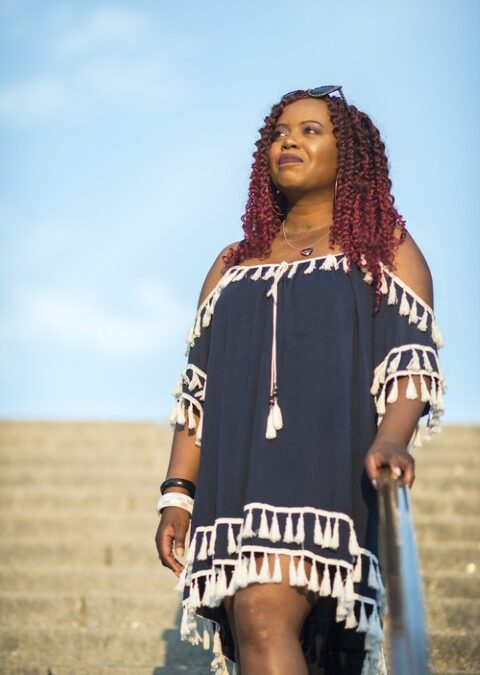
Montreal singer Hagiel blends blues, rock, and gospel on her debut EP, I Am Enough of a Woman, an inspiring collection of songs about survival, faith, and finding freedom.
For Hagiel, music has always been more than a passion. Her earliest memory is of dancing in her mother’s arms, swaying around the living room to music playing on the radio or record player. That childhood moment sparked a lifelong connection to music, one that now finds its fullest expression on her debut EP, I Am Enough of a Woman.
Born in a small French village near Quebec City and now based in Montreal, Hagiel, also known as Analoga, brings together blues, rock, gospel, Caribbean and African influences, and French-Canadian flair.
Across six deeply personal songs, she explores survival, faith, heartbreak, resilience, and freedom, drawing on both her life experiences and years performing with one of Montreal’s celebrated gospel choirs.
Leading the release is the powerful single “Fight for Your Life,” co-written and produced by award-winning songwriter Mark Zubek.
Hagiel I Am Enough of a Woman EP Explores Survival and Strength
The EP’s lead single, “Fight for Your Life,” emerged from one of the most difficult periods of Hagiel’s life, shaped by illness, hospital stays, and experiences of violence.
“The single Fight for your life was written after I was exhausted by all the hospital stays and literally Fighting for the life I wanted and the truth after having a physical sickness, violence and always being considered a mental case also,” Hagiel explains. “I just wanted my freedom and to heal. I have been forced to stop all my projects many times, like music, video, film and acting so many times. I just found it unfair.”
Rather than allowing those experiences to define her future, Hagiel transforms them into a powerful message of determination. The song acknowledges life’s struggles while reminding listeners that dreams can be delayed without being abandoned.
The EP’s title track, meanwhile, dates back to the end of a toxic relationship in 2003.
“I wrote I Am Enough Of A Woman following the end of a toxic relationship in 2003. I don’t want any more violence in my life,” she shares. “As I looked ahead as usual, I wrote down at different hours of day, different places even in hostels, many lyrics through thick and thin saying what was left of me. Trying to get my life back.”
Originally titled What’s Left of Me, the project took on its current name following encouragement from songwriting teacher Marc Bélanger, who recognized the strength of the phrase “I Am Enough of a Woman” within her lyrics.
His encouragement helped Hagiel recognize the power of her own songwriting and ultimately shaped the identity of the release.
Hagiel Finds Her Musical Direction With Mark Zubek
Bélanger also encouraged Hagiel to seek feedback from someone experienced in English-language songwriting.
That advice eventually connected her with producer Mark Zubek, whose credits include work with Grammy-winning artist Betty Carter and Crash Test Dummies.
“He said I should find someone that writes in English to judge my songwriting,” Hagiel recalls. “I posted an ad on craigslist looking for someone to review my grant application. Mark Zubek replied to my ad and offered his services as a producer. I sent him my material, and he thought I had potential. I got refused a few times for grants. Then eventually I got chosen with Mark Zubek’s help and guidance.”
Finding musicians who understood her artistic vision proved to be another important step.
Through an advertisement on the now-inactive NetBlues website, Hagiel connected with Pascal Gaudreau, who helped develop the songs “I Am Enough of a Woman” and “Survivors.”
Gaudreau arranged both tracks and contributed guitar and bass, while Mike Deschambeault played drums.
“Survivors” has a particularly long history. An early demo earned third place in Montreal’s YES Artistic Project Plan Contest in 2010, reflecting the song’s enduring message of perseverance.
Hagiel Brings Faith and Gospel Influences to Her Debut EP
Faith is another defining element of I Am Enough of a Woman, particularly on the gospel-inspired track “Praise Your Way Out.”
Written during a hospital stay, the song was inspired by Hagiel’s repeated listening to a testimony from Dr. Juanita Bynum.
“I wrote ‘Praise Your Way Out’ when I was in the hospital after listening to Dr. Juanita Bynum’s testimony before the song, I don’t mind waiting on YouTube many times,” she explains. “I could relate…”
Featuring backing vocals from Hagiel, Robert Peace, and Zubek, the song reached the semi-finals of the 2024 Unsigned Only competition in the Christian category.
It also earned semi-finalist recognition in the 2020 International Songwriting Competition alongside “Turned Around Me,” a groove-driven love song that later reached the semi-finals of the 2023 Music in Motion Canada Awards.
Rounding out the six-track EP is “Born to Rock Like No Morrison,” co-written with composer Vincent Xavier St-Laurent and inspired by a childhood photograph of Montreal rocker Jonas listening to music through his earphones.
Together, these songs reflect Hagiel’s ability to move between deeply emotional storytelling, uplifting gospel influences, and blues-infused rock.
Hagiel Reflects on Her Musical Journey and Gospel Choir Experience
Performing professionally since 2009, Hagiel credits her time with the People’s Gospel Choir of Montreal as a transformative chapter in her musical development.
Her experience has included contributing backing vocals to Nadja’s Christmas album, singing at Montreal’s Bell Centre for a performance involving Joey McIntyre of New Kids on the Block, and being selected by Gregory Charles for several Mondial Loto-Québec performances in 2014.
In 2012, she was also among 140 singers selected from more than 5,000 hopefuls for the blind auditions of La Voix.
“I am concentrating on music because it has always been natural, less harsh as a process. I often sing instinctively. It is a visceral need,” Hagiel explains.
Her passion for music continues to guide her, even after the challenges she has faced.
Inspired by the words “You are the artist of your own life” from the film Mademoiselle C, Hagiel approaches her debut EP as both a personal achievement and a testament to perseverance.
From dancing in her mother’s arms as a child to sharing her own songs with listeners, her journey has come full circle.
“My father has always said that my life is traced to my mother,” she says. “So not to worry!”
Five Questions With Hagiel
Hi, Hagiel! Good to meet you! Care to introduce yourself to the readers for those not familiar with your music?
Hi I’m Hagiel, I am a multidisciplinary professional artist who lives in the province of Quebec. Nice to meet you also. I just released digitally on streaming platforms on October 21st an EP called I am Enough of a Woman. I sing blues, gospel & rock for now.
Your earliest memory is dancing in your mother’s arms, and now you’ve released an EP filled with songs about survival, heartbreak, faith and finding freedom. When you think about that little girl who first fell in love with music, what would she make of the woman you’ve become?
The little girl in me is still with me. I still have the same habits. When I am well, I sing and when I am down I sing too. As a child, if I could imagine everything I have achieved now, I would be happy, proud and excited about the road ahead. When I look at the rocky road and the progress I made in music through the years, I am grateful and proud for the process. I started from hearing my mother sing and dancing with me in the living room, to singing in my bedroom from the top of my lungs my favorite songs from my favorite bands to singing on stage at 18 years old on a cegep project called Black Heaven. I was always singing when I was younger and my sister would say to my mom: “Oh she is singing again!” My mom would be really proud of me too if she would be with us. My dad is proud. My sister supports me today but she listened to me singing at first. Trial and error. Has music remained the same source of comfort for you throughout your life, or has its purpose changed? It has remained the same source of comfort. Music has always been very present, on the record players we had, on tv, on the radio my mom would play sometimes all through the day. It has always been a way to vent and escape. What has changed is that now I am writing songs and not only singing covers that go along with my mood.
“Fight for Your Life” was born out of an incredibly difficult period when illness, hospital stays and other personal struggles repeatedly interrupted your creative ambitions. There’s a powerful lyric about your dreams being put on pause rather than put on hold. How did you hold on to those dreams when circumstances kept pulling you away from them?
By praying, reading the scripture in my Bible over and over. I have a bible by theme and I really kept reading the bible verses that were linked to my situation. Like ( “For I know the plans I have for you says the Lord, good plans, no plans for disaster, to give you a future and a hope. In those days when you pray, I will listen. If you search for me wholeheartedly you will find me”.) I sang also my favorite songs even when I was not well wherever I was. By writing my poems wherever I was when I felt the need to express myself. The poems became songs with my songwriting teacher’s help later when I was better. I would say also by surrounding myself with friends, family members and mentors who understood me. They knew what I was striving for. They believed I should keep dreaming as well as working towards my goals and dreams. Music works, it helps your mood so a mentor told me keep doing it. Was there ever a moment when you genuinely considered giving up music? At first, when I was around eighteen years old, in the Black Heaven tribute to Led Zeppelin, the first year and the second year we did a tribute to Women of Rock we were two female singers. I passed the audition, two years in a row to be in the project for that year, but I was really struggling with my voice. I was learning how to sing when we were practicing. My raw energy and voice would sometimes fade and I would sometimes have no voice. I was getting discouraged, but was determined to continue. I didn’t consider giving up.
The first year, my music coach Denis Ouellet, invited Claire Vezina a singer-songwriter in Quebec city to coach the singers and for the musicians Les Respectables came to coach. I had coaching also from Kamouto on percussions. That gave me a boost Claire and Kamouto saw potential in me. So that encouraged me not to give up.
Your EP was originally going to be called ‘What’s Left of Me,’ until your songwriting teacher recognized the power of the lyric “I Am Enough of a Woman.” Those two titles suggest very different ways of looking at yourself. What changed between asking what was left of you and declaring that you were enough?
Actually, it’s the song I am Enough of a Woman, that was going to be called What’s Left of Me. I wasn’t really thinking of the EP or Album title yet at that time. I was just transforming my poems into songs. Doing song by song until I had a few. When I thought of calling the song What’s Left of Me, I was really sad. So was feeling that I had to pick myself up after being broken and lied to. When I say I am Enough of a Woman. I mean I am Enough as I am. Sometimes I was considered this and that… Been called so many different things in my life… even been told that I was too happy, too black, too white, etc. After everything that I have been through having a bit of light and hope shine in is welcome.
What does being enough mean to you today, after everything you’ve experienced?
It means I am Enough of a Woman to heal, to feel, to grieve, to face the future without forgetting the values that my parents gave me. I am also Enough as I am. Some people will like me and some won’t. I trust that the real sincere people who are connected to me for the right reasons will stay through the years. Many have been with me through the years. Through the ups and downs. I am grateful.
Your music brings together blues, gospel, rock and your Caribbean and African roots, and you’ve spoken about singing as a visceral need. Having spent years performing in gospel choirs and working with other musicians, what have those experiences taught you about the relationship between music and faith?
I know now that music has the power to heal. It healed me and soothed my soul. I look back and I am proud of the lyrics in my songs. Mark Zubek, my producer helped me push my lyrics further. Sometimes in prayer we don’t know what to pray. But praise songs give hope in the hard times and strengthens our faith. The mood in a room can shift. When I am down I Praise my Way Out as would say Dr. Juanita Bynum. I used to sing songs from choir in my times of struggle wherever I was and it changed the mood in the room. It strengthened my faith in the Lord. Some people would hear but I would sing for myself not to perform. It helped me see my limits and give my worries to God. I don’t let the dark thoughts get in anymore. I put my worries at the foot of the cross. God has a plan. When I am happy, I listen and sing Praise songs also. I thank God for all that he has done and will continue to do. My parents roots transmitted to me their faith, their singing voice and their rythm like a heartbeat. I remember going to Afro Caribbean nights with them and dancing. Music has always soothed my soul.
The only gospel choir I have been in is the People’s Gospel Choir of Montreal. I sang also in Ensemble vocal Prochant that was linked to the school called Prochant in Montreal at the time. One thing that was awkward is when we were going to sing some Gospel songs everyone looked at me to teach them how to teach them how to move because I am black. They thought I knew gospel. But I didn’t, I told them. I was there to learn in the Ensemble not teach. I felt like I had to learn about gospel. Until then we hadn’t did any gospel songs. The coordinators brought in Sylvie Degroseillers who knew Gospel, she was in the Montreal Jubilation Choir. She taught us how to move and I asked if she knew a gospel choir. She then suggested the People’s Gospel Choir. I then called Kim Sherwood and went to a rehearsal. I was raised in a small French town with presence of the Catholic church it’s not the same vibe as gospel songs or churches where there are gospel choirs. It’s just different. I was also a proud member of Crescendo, a singing and dance troup before that when I was at cegep around the age of eighteen. I sang also in a choir for a specific show that Gregory Charles was organizing in Laval.
When you sing something as personal as “Praise Your Way Out” or “Survivors,” are you trying to heal something within yourself, or hoping that someone listening might find the strength to face their own struggles?
When I wrote them I wanted to heal something within myself, but I still hoped that someone could relate to my situation. When I sing these songs, I hope to continue to heal, work on myself so that someone listening to my voice, my story, my emotion and our music finds the strength to face their own struggles and tribulations.