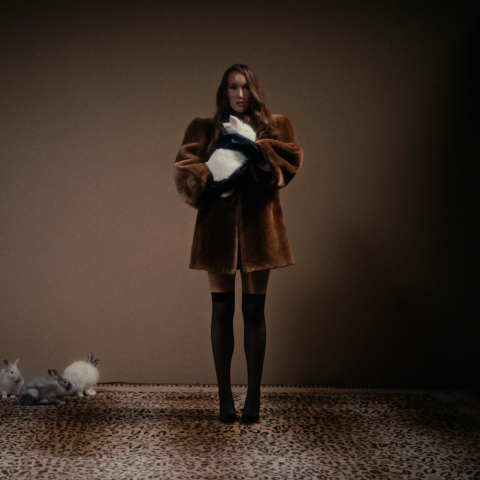
Halifax artist and producer Katharine Fountain introduces her solo project with a deeply personal electronic pop single exploring grief, identity, and the search for healing.
Halifax-based singer-songwriter and producer Katharine Fountain introduces her solo project with “When Good Girls Go Bad,” a dark, cinematic electronic pop single that explores the loss of innocence and identity following trauma.
The release marks the first glimpse into her forthcoming EP, Dark Days, a deeply personal collection shaped by grief, emotional struggles, and the journey toward rediscovering oneself.
Combining shadowy electronic beats, atmospheric production, and emotionally charged vocals, the single introduces listeners to an artist unafraid to explore life’s most difficult experiences through music.
Katharine Fountain When Good Girls Go Bad – The Story Behind the Single
Written during a period of emotional upheaval, “When Good Girls Go Bad” emerged as Fountain struggled to recognize the person she had become.
Following profound personal loss, she found herself navigating feelings of shame, isolation, and destructive coping mechanisms that only intensified her pain.
“I no longer recognized the face I saw in the mirror and asked myself where I went wrong,” Fountain explains.
That painful realization became the foundation of the song, with its central question reflecting the emotional conflict between who she once was and who she felt she had become.
Rather than offering simple answers, the track explores the complicated relationship between trauma, identity, and the ways people attempt to cope with overwhelming emotions.
A Cinematic Blend of Electronic and Organic Sounds
Written and produced by Fountain herself, “When Good Girls Go Bad” retains much of the original demo she created several years earlier.
The recording combines atmospheric synthesizers and programmed drums with organic instrumentation, creating a layered sound that moves between vulnerability and intensity.
A Fazioli grand piano performed by Dean Holbrough adds richness to the arrangement, while powerful live drums from Sekou Lumumba bring additional depth and energy.
Fountain’s interest in blending analogue and electronic sounds plays a central role in the track’s production.
Through carefully constructed melodies, dramatic arrangements, and shifting vocal dynamics, she allows the music to reflect the emotional tension of the lyrics.
Her vocals move between delicate, ethereal moments and commanding intensity, giving the song a cinematic quality that reinforces its deeply personal message.
Katharine Fountain Explores Grief and Identity on Dark Days
Fountain’s forthcoming EP, Dark Days, was written in the years following the death of her only sibling to suicide.
The project explores depression, abusive relationships, and the search for comfort in places that ultimately cause more harm.
During this difficult period, songwriting became a way for Fountain to process emotions and experiences she had struggled to express.
Rather than separating her personal life from her creative work, she began transforming those experiences into an intimate musical narrative.
The result is a collection of songs that examines the complicated realities of grief, self-destructive behaviour, and the search for identity after profound loss.
With “When Good Girls Go Bad” serving as the project’s introduction, Fountain establishes an emotionally honest foundation for the music still to come.
Finding Connection and Understanding Through Music
For Fountain, music has long provided comfort during moments of loneliness and uncertainty.
That personal connection to songwriting continues to shape what she hopes listeners will take away from her work.
“I hope that someone will listen to my music and feel seen,” she shares.
Through her willingness to explore difficult emotions and experiences, Fountain hopes to create music that resonates with listeners who may be navigating similar struggles.
As she prepares to share more from Dark Days, “When Good Girls Go Bad” offers a compelling introduction to her solo artistry, blending cinematic electronic production with deeply personal storytelling.
Katharine Fountain – Interview
“When Good Girls Go Bad” introduces listeners to your solo project in a deeply personal way. What made this particular song feel like the right starting point, and what do you hope listeners take away from their first introduction to Katharine Fountain as a solo artist?
To be honest I had mixed feelings about releasing this song as my debut, mainly because it was written from a headplace that I very much no longer exist in. This song, and all of the songs from my upcoming EP Dark Days, were written nearly a decade ago while I was still a student at Berklee.
Everything I wrote back then was basically me trying to process a series of traumatic events in my life through songwriting. I desperately wanted to be seen and understood, but I knew that the quality of my work didn’t quite match my own taste yet. “When Good Girls Go Bad” was put away on a hard drive but remained in the back of my mind as something I hoped would one day come to life.
In the spring of 2025 I was working on some new material with Maïa Davies and David Mohacsi, and I ended up showing them some of my older material, which included this song. A handful of these songs ended up being developed further and became Dark Days. With this song we added a bridge, but otherwise it is quite similar to my original production. I guess it was just waiting for that missing piece in order to be complete.
Story telling is really important to me. As a listener I think it’s interesting to follow along the journey of an artist as they develop their voice and sound. When I thought about how I wanted to present myself to the world it only made sense that we start from the beginning. These songs are thematically quite different from what I was working on with Maïa and David, and it didn’t make sense to me to release two completely separate concepts together just because they were recorded around the same time. I believe in the concept of albums and a fully developed body of work. Dark Days stands alone and I felt it deserved its own moment.
The title “When Good Girls Go Bad” carries a lot of weight, especially when we consider how society often judges people for the ways they cope with pain. Do you think we’re sometimes too quick to label someone’s behaviour without understanding what they’ve been through?
I appreciate you acknowledging that. There have been a few instances where I told people the title of the song and was met with either eyerolls or laughter. At face value I think some may receive it as vapid or hedonistic, but it’s deeper than that.
To answer your question – in short, yes. One of the greatest gifts of being forced to confront major trauma at a young age is that it has expanded my capacity for empathy. (Though I felt bad for inanimate objects as a child, so it’s not like ‘overfeeling’ was new to me).
Of course there comes a time when one must take responsibility for their own actions, but I think if we met people with compassion and curiosity instead of judgement people might be more willing to seek help and be honest about what they are going through. Secrets keep you safe for a while, sure, but secrets also keep you sick.
Your upcoming Dark Days EP was born from an incredibly difficult chapter of your life, including the loss of your only sibling. How did songwriting help you navigate emotions that might have been difficult to express in everyday conversations, and did creating this project reveal anything about yourself that you hadn’t fully understood before?
None of the songs on Dark Days are about (my brother) Alex directly. Sometimes I really don’t want it to be about him, but the impact his suicide has had on my life has been undeniable and at this point I’ve accepted that grief never truly goes away. It just keeps changing shape. I’ve learned to live with it. This EP explores what some of the early days of ‘learning to live with it’ felt like.
I mentioned Berklee earlier, but prior to attending Berklee I went to McGill. My brother took his life when I was 18 years old on the day I moved into my dorm at Gardner Hall. There is no ‘good’ day to experience a loss like this, but something about it being effectively my first day of real adulthood has been something I’ve struggled to reckon with. Like I never got to know adulthood without carrying this burden. I feel like a lot of my youth and innocence was robbed from me – to this day I feel at least 5 years behind people my age.
I don’t remember a lot from this period, but I know that I felt incredibly alienated at McGill. Partying was the default activity, so I went out with people but I struggled to make actual friends. I found it difficult to find people who could relate to my experience. The conversation around mental health then was not what it is today. Where I found comfort and community was in music, both in the records I listened to and the friends I would eventually meet once I started playing small gigs around Montreal.
Playing music gave my life purpose again and made me feel like maybe I’d be alright. I always hoped I could create something that made someone feel seen or safe in the way music did for me back in those Dark Days. I think that is ultimately the reason why I chose to release these songs now. I may have moved on from those experiences, but someone else out there is living that now and maybe would like to hear it.
The thing about songs is that they aren’t really about you anymore once they are released into the wild. They belong to the world at that point, and how the world chooses to receive them is out of my hands.
As both an artist and producer, you have the freedom to shape every aspect of your sound. What’s your favourite part of the production process, and have you ever experimented with something in the studio that unexpectedly took a song in a completely different direction?
Learning to produce was life changing for me. The creative agency pursuing this skill has given me cannot be understated. I can’t imagine being an artist and not being involved in my own production, to me it’s the same thing.
Incoming freshmen at Berklee were required to take a class called Music Technology 101. Everyone seemed to groan about this course leading up to it, so when it came time for me to take it I was kind of dreading it. This class ended up changing the trajectory of my studies and pushed me in the direction of an Electronic Production & Design major as opposed to the Performance major I thought I’d end up in.
I can still quite viscerally remember the absolute wonder I felt firing up “Xpand! String Ensemble” in ProTools for the first time for a project in that class. I was like “Wow I can have strings now, I can have literally any sound that I want and I can make it right here in the comfort of my bedroom at 2am”. I am a loner and an introvert at heart, and being able to make my ideas come to life on my own was a major turning point for me.
Before that, songwriting looked like me sitting with my guitar surrounded by mountains of paper and never feeling like anything was getting done. I didn’t even want to make guitar music, which was a whole other thing, it was just all I knew how to do. I am a visual person, and seeing things laid out in Ableton really made the process of creating music feel like painting a picture to me. I’ve always had strong visual associations with sound.
When something feels stagnant in the writing or production process I find that swapping out the beat or quickly flipping the song to a different key can help refresh my mind. I’ve also learned the value of breaks. Sometimes you can destroy something by trying to perfect it. Many times I’ve tried taking something in one direction only to find out that my initial instinct was correct.
The addition of Dean Holbrough’s Fazioli grand piano and Sekou Lumumba’s live drums brings another dimension to the track. What drew you to these particular musicians, and how did their contributions help bring your original vision to life?
I love a blend of electronic with organic/acoustic sounds. I knew that I wanted to replace the piano and in some cases the drums in several of the songs on both this record and the follow up. As someone with a background in sound design, you can start to hear the uniformity of samples and it can feel quite lackluster and robotic. Of course there are things you can do about this – adjust the velocity of individual MIDI notes, play with timing and groove, try a subtle LFO on pitch drift…you can tinker with it until the end of time. Alternatively, you can hire someone who has devoted their life to learning that specific instrument and have them deliver a wonderfully human performance in one pass.
I had the fortune of being connected to Sekou and Dean through Maïa and David who had worked with them both in the past. It was amazing to hear them play in real time what up until that point had just been programmed MIDI & samplers.
I mentioned earlier that I am a true introvert, but I am always trying to step slightly outside of my comfort zone. Inviting others into the process has been something new for me and is something that has been for the most part quite rewarding. It has also been more fun.
“Having fun and enjoying myself” has very much been a personal mandate of this entire process. I’ve spent a lot of my life feeling tortured and frustrated and I’m just ready to be done with that. I can’t control how this album is received, but I can somewhat control the process of creating and releasing it. I’d like to try and enjoy the process as much as possible.
With Dark Days exploring such personal experiences, sharing these songs with the world must bring a mixture of emotions. What are you most looking forward to as you prepare to release the EP, and what do you hope listeners take away from these deeply personal songs?
I am looking forward to these songs finally existing in the world! They were written so long ago, it’s time. I overcame a lot of obstacles and setbacks to even get this music out, and I’m glad I never gave up on it.
I would be lying if I said I wasn’t nervous about how certain people in my life might receive both the songs and visual universe that I have created for them, but it would be a disservice to myself, the music and my collaborators to water things down.
I think it will help me close that chapter of my life. To have said what I wanted to say and to make room for something new to manifest. Secrets are disempowering. I hope people will feel seen and understood by what they hear and know they aren’t alone.
Let’s lighten things up a little! If you could spend a day in the studio with any artist, past or present, who would you choose, and what kind of musical magic do you think you’d create together?
Dangerous question. The proverb “don’t meet your idols” seems to have proven its validity in my life on more than one occasion, but in a perfect world, I would gather myself, Benjamin Gibbard (Death Cab For Cutie) and ODESZA into the studio for an iconic afternoon of “Sadstep” (my term) creation.
Emotional electronica, hurts so good kind of music. It would be iconic, I’d never shut up about it.