Cobourg, ON Celtic Folk Duo Lo & The High Road Confront History’s Echoes On New Single “Salem”
Cobourg, Ontario based Lo & the High Road release “Salem,” the latest single from their sophomore album, Standing Stones, out October 2. Written by Lauren Halász and Colin McMahon, “Salem” trades the duo’s usual fantasy and folklore for real history, drawing directly from the Salem Witch Trials and the words of the women who did not survive them.
While researching the trials, Halász came across a list of last words attributed to the accused and found herself returning again and again to those of Sarah Good, one of the first three women condemned.
According to historical accounts, asked to confess by Reverend Nicholas Noyes moments before her execution, Good responded,
“I am no more a witch than you are a wizard, and if you take away my life, God will give you blood to drink.” Halász knew immediately that the line belonged in her chorus. “In a way, Sarah Good was my co-writer,” she says.
“Salem” builds outward from that history into something with a longer reach. “I never signed the devil’s book, but I start to think that you did,” Halász sings, before the chorus turns the accusation back on the accusers: “All ye who stack up the stones, God will give you blood to drink, tear innocents out of their homes, God will give you blood to drink.” The bridge shifts the song’s focus from the past to the present, softening the record’s anger into something closer to a plea: “I will call out this pain through the centuries, using the voices of those who still remember me, and we will cry out for peace, we will cry out for empathy, when you repeat the pages of our history.” For Halász, the song is less about condemning history than recognizing how easily fear of an othered group can still be stoked by those in power, then and now.
Musically, “Salem” pushes further into indie rock territory than most of the duo’s catalogue, built around electric guitar and a full drum kit rather than the band’s usual folk instrumentation. Halász layered her backing vocalist practically yelling the “God will give you blood to drink” line beneath the lead vocal, a moment the whole band recreates live, and worked with McMahon to layer the bridge melody directly over the pre-chorus and chorus, a piece of vocal counterpoint she hadn’t planned when writing but that came together once they tried recording it. The track was written and recorded, like the rest of ‘Standing Stones,’ in the duo’s home studio in Cobourg.
“Salem” was produced by McMahon, with lead vocals from Halász, additional vocals from Christine Dando, mandolin and guitar from McMahon, percussion from Martin Gladman and background vocals from Amanda Weatherall. The single’s cover art comes from Abbey Spear.
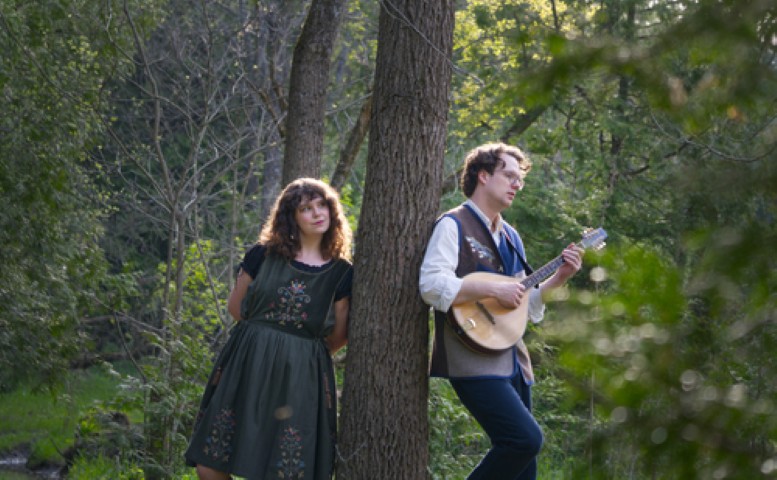
Halász (songwriting, vocals, bass, bodhrán) and McMahon (songwriting, arrangement, production, guitar, mandolin, bouzouki) have built Lo & the High Road into one of Canadian folk’s most devoted followings, drawing more than 200,000 fans worldwide who turn to their music for tabletop role playing soundtracks, woodland weddings and Renaissance faires alike. Their 2023 debut, ‘Jackalope Tales (& Other Stories),’ has surpassed 2.8 million streams on Spotifyacross nine tracks exploring growing up, resilience and childhood wonder. This year the duo toured Eastern Canada from Toronto to Halifax, including Kingston’s Ironwood Fantasy Fair, and will be performing at Port Hope’s Cultivate Festival, joined live by Dave Finneran on guitar, Christine Dando on vocals, and Jordan Baldwin on violin.
‘Standing Stones’ expands the duo’s world building across 14 tracks, pairing four traditional songs with 10 originals drawn from Greek mythology and real historical events, including previously released singles “The Fawn & the Huntress,” featuring Lunar Bloom, and “Dance of the Dryads,” alongside new songs like the title track, “Salem” and “The Weaver.” Guest artists Christine Dando, Jordan Baldwin, Saskia Tomkins on nyckelharpa and Steáfán Hannigan on uilleann pipes, bodhrán and Irish flute all join the record.
With “Salem” out now and Standing Stones arriving October 2, Lo & the High Road continues proving that the line between myth and history, and between the past and the present, is thinner than it looks.
Care to introduce yourself to the readers for those not familiar with your music?
My name is Lauren (or Lo!) and I’m originally from Ottawa, now based in Cobourg, Ontario. The other half of our duo is Colin McMahon — from London, Ontario, now based in Cobourg as well.
“Lo & the High Road” is our indie folk project. What started as a fantasy-inspired recording project has grown into a full indie band. We now write on a variety of subjects, from folklore to myth to real-life history to our own lives. We perform as a five-piece folk band and we’ve so far gone as far as Halifax.
We’re very much Celtic-inspired in our sound. We use a lot of Celtic instruments and often perform and record traditional music as well.
You’ve built much of Lo & the High Road around fantasy, folklore and mythology. What made the Salem Witch Trials feel like a story you needed to approach through songwriting rather than simply history?
These past few years have been really challenging. When we were writing our first album, the world felt like it was in a different place, and we were writing from a place of joy and optimism. Though I still try to be optimistic, I think, given the state of the world now, that has become more difficult.
This song, along with our second album, releasing October 2nd, is a direct reaction to that. I have found myself pivoting towards darker stories, both real and mythological. I think confronting these stories has been a way for me to cope. If I can get my anger out through songwriting, it can help me keep a level head in real life so I can approach real-life issues and conflicts peacefully and calmly.
“Salem” is ultimately about how fear can be directed toward an “othered” group by people in power. When you were writing it, how consciously were you thinking about events happening in the world today?
I can point to the exact moment that I decided to write this song.
In early 2025, the late Pope Francis had a clash with the Trump administration — particularly with Vice President J.D. Vance — over the term ordo amoris, or “order of love.” Vance was quoted saying, “You love your family, then your neighbour, then you love your community, and then you love your fellow citizens in your own country, and then after that you can focus and prioritize the rest of the world.” He was, of course, using his version of Christianity to justify the mass deportation of immigrants out of the United States.
The late Pope Francis responded in a letter to the U.S. bishops critiquing this use of the term, saying, “the true ordo amoris that must be promoted is that which we discover by mediating constantly on the parable of the ‘good Samaritan’ (cf. Lk 10:25-37), that is, by meditating on the love that builds a fraternity open to all, without exception.”
I don’t claim to know everything about Christianity as I am not a Christian, but I have spent a fair amount of time with the Bible. Here are a few verses I think apply to this conversation: “Love the foreigner as yourself” (Leviticus 19:34), “You shall also love the stranger, for you were strangers in the land of Egypt” (Deuteronomy 10:19).
I understand that historically Christianity has been used to justify so many terrible things: the Crusades, the Witch Trials, now the mass deportation and detainments of immigrants in the United States. I have always found it baffling that Jesus, a man who famously preached peace, could ever be invoked as a justification for violence. And yet, it has happened time and time again.
“Thou shalt not murder” — and the people of Salem executed twenty people.
“Thou shalt love thy neighbour as thyself” (Matthew 22:39).
I’ll end with a more recent quote from Pope Leo XIV, from earlier this year.
There’s a danger when revisiting something like the Salem Witch Trials of turning real suffering into mythology or entertainment. How did you make sure the song remained respectful to the people whose lives you were writing about?
The first thing I knew I needed to do was properly learn about the Salem Witch Trials. Sarah Good’s famous quote, “if you take away my life, God will give you blood to drink,” appeared very quickly, though it’s considered more of a legend surrounding the Salem Witch Trials as there are no first-hand reports of this from the time of her execution.
There are a few great resources online, particularly the “Salem Witch Trials Documentary Archive and Transcription Project,” compiled by Benjamin Ray at the University of Virginia, which digitized primary sources relevant to the trials, including court records, personal letters, sermon notes, and more. The Salem Witch Museum also has detailed online resources. Reading through them is a harrowing experience.
Twenty people executed, and more who passed away while in prison. No real evidence given in court records. Sermons that declare that “There are Devils as well as Saints in Christs Church” (The Sermon Notebook of Samuel Parris, March 27th, 1692).
A document that really stuck with me is “The Petition for Rebecca Nurse.”
Rebecca Nurse was a 71-year-old woman who was considered an upstanding citizen prior to her arrest. On the petition, 39 neighbours signed a document stating that they have never had any cause to suspect her of anything she is now accused of. Salem was not a large town, and 39 people came to Rebecca Nurse’s defence. There was no evidence against her except for “spectral evidence” — Rebecca Nurse was “seen” as a “spectre” in a rocking chair. She was executed on July 19th along with Sarah Good.
There’s obviously no way to know if the victims of the Salem Trials would have considered the words of this song respectful. But I think my approach was to keep this song as earnest and truthful as possible. I learned about the Trials, I felt horrified over what happened to the women and men executed in Salem, and I wanted to tell their stories while maintaining a message of peace.
“We will cry out for peace / we will cry out for empathy.”
I know a lot of this song is angry, but I needed to make sure it wasn’t a call for violence. I think that is likely the last thing they would have wanted.
Your audience includes people who discovered you through Renaissance faires, fantasy culture, tabletop gaming and folk music. As your writing moves toward subjects like injustice, persecution and political power, do you see the project becoming more explicitly connected to the present-day world?
I think our project was, in many ways, always connected to the present-day world. I’ve often used fantasy imagery to talk about my own, very real feelings about the world. I’ve written songs about some of the more upsetting stories in Greek Mythology as a parallel to our present-day as well. Mythology isn’t history, of course, and “Salem” is much closer to home. But I think a lot of those sentiments were already there, and already connected. I choose the stories I want to write about very intentionally.
I know that from the outside it might seem like we’re playing characters. We play on a lot of older instruments (two songs on our upcoming album use a lute, a stark contrast to the electric guitar we’ve used in this song), and the way I sing also invokes a bit of an “old” sound. I get likened to a bard in comments on social media.
The reason I like to write about fantasy, mythology, history, and folklore is because those are subjects I really resonate with. I know that perhaps on a first listen our music might feel a little detached from the present, but it won’t take long for people to draw the parallels. I’ve already received a comment online that this new song “feels timely despite taking place in 1692.”
I think a lot of people feel the same as I do right now. We need empathy and understanding more than ever, and I hope we find it soon.