
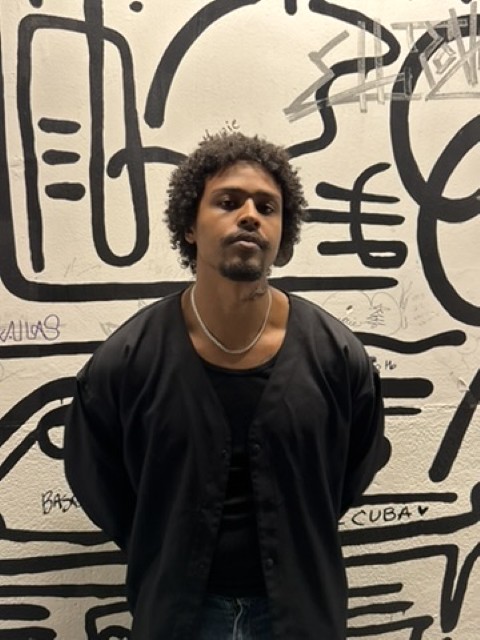
Toronto Artist And Producer LADJI MOUFLET Channels Taino Defiance On New Single “Hatuey”
Toronto-based producer, DJ, and beatmaker Ladji Mouflet unveils “Hatuey,” a warrior of a single that pulls its title and its spirit from one of Caribbean history’s most defiant figures.
Built on the hypnotic percussion and rolling low end that have become his signature, the track finds Ladji at his most physical, a record made for the dance floor that carries something much older underneath it.
The name is not incidental. Hatuey was a Taino Indigenous chief who led resistance against the Spanish conquistadors in the sixteenth century and was burned at the stake for it, choosing defiance to the end rather than surrender. Through his mother’s lineage, Ladji carries Taino heritage himself, and the parallel is intentional: a song about refusing to bend, released by an artist who understands what it costs to keep standing. The connection runs through the visuals as well, with cover art that weaves together Taino imagery and the tribal tattoos Ladji and his brother wear in tribute to that same history.
Ladji built “Hatuey” the way he builds everything: at first, alone in the studio, composing, producing, and arranging every layer himself before working on it with his family, team and label to share with the world. The result sits at the intersection of baile and the wider electronic sounds he has spent years refining, hypnotic Afro percussion set against sleek, modern production, a combination that has become unmistakably his own. It is a fitting way to introduce the sound of what comes next.
That sound was shaped long before Ladji ever touched a fader. Raised between Harlem, the South Bronx and the Lower East Side of New York, he grew up inside a household built entirely around rhythm. His mother, from the Dominican Republic, danced salsa on stages alongside Tito Puente and Celia Cruz. His father, Senegalese and Martinican, founded a dance and music school where the family lived and worked, blending West African tradition with ballet and jazz. Ladji, now based in Toronto, has spent his career translating that inheritance into a sound built from Latin America, West Africa, the Caribbean, and New York all at once.
That sound has already found a massive audience without the backing of a major label. Ladji’s breakout single “Baiana 2022” has passed 35 million streams and became one of the unofficial anthems of the last World Cup, shared by names including Tom Brady, Lamine Yamal and Wayne Rooney. “French Bossa Nova” followed with more than 44 million streams of its own, cementing a devoted global following. Today Ladji reaches 1.5-2.2 million monthly listeners on Spotify and more than 350,000 followers across social platforms, with nine songs past the one million stream mark, all of it built independently through his own label, Alkebulan Records.
“Hatuey” arrives as the first single from Ladji’s upcoming album, The Pilgrimage, a project he describes as a journey back to himself. Where his biggest records to date have introduced him as a hitmaker and a live sensation behind the decks, The Pilgrimage finds him tracing his family’s roots one track at a time, reconnecting with the heritage that shaped him and letting it lead the record from the ground up. “Hatuey” sets the tone for everything the album is reaching for, rhythm as inheritance and resistance as celebration.
With “Hatuey” out now, Ladji Mouflet continues to prove that some of the most compelling sounds in global electronic music are being built entirely on his own terms, one rhythm, one story and one record at a time.
Hi, Ladji! Good to meet you! Care to introduce yourself to the readers for those not familiar with your music?
Hello! My name is Ladji, and I’m a native New Yorker with Dominican, Martinican, and Senegalese roots. I’m currently based in Toronto. I’ve been officially releasing music since 2020 and found my sound in 2021 when I decided to do a TikTok series called “Sampling Random Sh-t Till I Make A F-cking Hit”. What started as a challenge for myself ended up becoming the foundation for the music I’ve released up until now. My two most popular songs, ‘French Bossa Nova’ and ‘Baiana 2022’, were born from this series! I would describe my music as body moving; music that makes you want to move. Whether you’re tapping your finger, nodding your head, or dancing like no one is looking, my goal has always been to get people moving and grooving no matter the genre I explore. There’s a wide range of music in my discography and it’s reflective of all of the music I’ve grown up listening to. Growing up in an African Drum and Dance school that taught dances throughout the African Diaspora exposed me to a wide range of percussive sounds which is at the core of my music. Drums and Percussions were my entry into music; it’s the bedrock I always use to build my songs.
“Hatuey” is named after a Taíno chief who resisted Spanish conquest and was executed for refusing to surrender. What about his story felt personal enough that you wanted to put his name on a dance record?
His resistance to the Spanish Conquistadors till the end of his life is very inspiring. Refusing to submit to the Conquistadors demands courage, and finding peace in death by staying true to your roots is honorable and represents the indomitable human spirit to me. Nowadays, assimilation is very common and you don’t realize how deep it is until you make the effort to unlearn it. I think his story is one of many stories about fighting power, fighting colonization and reclaiming sovereignty. Hatuey, the song, is the expression of my Taino heritage. It’s a reminder that his will still lives on and that battle against domination continues to this day.
You’ve described the song as being about refusing to bend. When you were making it, what did resistance sound like to you musically—was it in the percussion, the low end, the repetition, or something else?
The percussion was definitely at the core of the sound of resistance in this song, while the metal clinks made me think of a group of warriors coming together to resist their oppressors. The grandiose choir also gives a very tense cinematic atmosphere that has you waiting for the signal to go to battle. The entire build up of the song feels like two camps sizing each other up until one side eventually makes the first move. Those two song elements really embodies the resistance I was channeling into the song.
The song is built for movement and the dance floor, yet its inspiration comes from violence, colonialism and defiance. How did you balance making something celebratory without losing the seriousness of the history underneath it?
By naming this song ‘Hatuey’, I hope it encourages people to look into who he was and what he stood for. I hope that this song acts as an entry way to the curious listener who wants to understand who Hatuey was and why his act of rebellion is important. Hatuey is a chapter of the grander story of human resistance throughout history, and is relevant to this day. In a time where capitalism demands your time and your body to feed into the system, dancing and leisure inherently become acts of resistance. The song ends up becoming both celebratory and serious by nature of it being music, and through its name.
This idea is deeply rooted in Latino music and culture. It’s common to hear an upbeat salsa song with lyrics about colonization, slavery, and revolution. For us, music and dance are ways of processing experiences that would otherwise be incredibly difficult to confront. Our history as Latinos has been shaped by colonization and genocide, and I believe part of our culture’s strength and beauty lies in our ability to transform that painful history into something uplifting, like a salsa song.
Your sound pulls from Latin America, West Africa, the Caribbean and New York. On “Hatuey,” were you consciously trying to represent all of those influences, or do they now come through instinctively when you produce?
It’s definitely something that comes instinctively when I produce. The major commonality between all of the sounds is the polyrhythmic drums. I like to build my songs from the drums/percussions upwards so I end up pulling patterns and rhythms that have marked me throughout my life. I don’t actively try to represent all of those influences, but I do actively make music that sounds like me. Latin America, West Africa, the Caribbean and New York are all a part of me, so they will always come out when I make music that is authentic.