
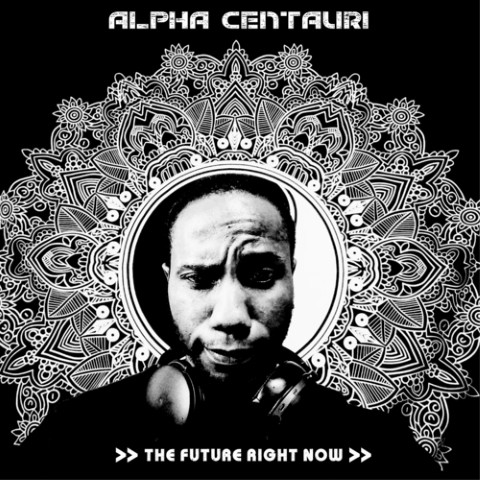
ALPHA CENTAURI Arrives As Hip-Hop’s Next Rising Star With Debut Album, The Future Right Now
After five years of work, six singles, and a rollout that has steadily built him into one of the most electrifying new voices on the West Coast, ALPHA CENTAURI is here with his full debut album, The Future Right Now, out now via Rogue Planet. “Never Be,” “Grow,” “Get Your Money Up,” “I’ll Fly,” “Higher Up” and “We Rise” each landed with their own moment in the spotlight, and together they were only the warmup. The ten-track album that follows is the real arrival, a genre blending, funk soaked, Afrobeat charged, jazz-tinged hip-hop statement recorded entirely live off the floor with his eight-piece band, and it is the sound of a star fully stepping into focus.
ALPHA’s own story is exactly the kind that makes a debut like this hit harder. Trained and licensed as a lawyer in Zimbabwe, he walked away from a secure, respected career to chase the thing he could never actually let go of, music. It started long before law school, back when he was 13 years old breakdancing with his crew, Blade Squad, at pageants and basketball halftime shows. When people warned him that no one would respect a lawyer who breakdanced, he didn’t quit, he transformed.
“I took what I understood from dancing, rhythm and movement, and turned it into rap,” he says. “I tapped into my background in English literature and realized, I know how to write poems. I understand rhythm. Maybe I can do this.”
That leap of faith is the entire album in miniature.
Even his name carries that same spark. Searching the sky for answers one night, ALPHA caught his own reflection in a window and realized he’d had the answer inside him the whole time. He named himself after the closest star system to our own, a symbol of the inner light he’d carried all along, quietly waiting to be turned all the way up.
The Future Right Now is built entirely around that idea: self belief as fuel, motivation as philosophy, the present moment as the only place the future actually gets built. “Everything I do today, everything I did all these years, has brought me here, because my future was always in the present,” ALPHA says, and the record delivers on that promise track after track. “We Rise,” now the unquestioned crowd favourite of his live show, was originally written back in 2014 while he was finishing his law degree, an almost prophetic vision of a life he hadn’t lived yet and now is, word for word. “Aria’s Lullaby” closes the album as a tribute to his daughter, written as a diary entry in 2016 before she was even born, its lyrics never changed since. “Expect Us” channels real testimony, drawn directly from ALPHA’s own experience as a practicing lawyer in Zimbabwe supporting the movement built by activist Evan Mawarire against corruption and injustice. And “Never Be” is a full display of technical firepower, stacking wordplay, literary references and mythology into bars built to be replayed just to catch everything packed inside them.
Behind ALPHA stands a genuinely stacked eight-piece band, brought to life by producer Wes Smith and mixed by acclaimed engineer Justin Hicks, with more than 20 guest musicians contributing across the sessions. Drummer Richard Brown supplies the relentless, room shaking energy that anchors every show, guitarist Cuyler Biller threads in guitar licks pulling from Zimbabwean Sungura tradition, and keyboardists Alli Bean and Max Zipursky round out a live unit ALPHA says turns every performance into something completely alive.
That live reputation has already put ALPHA on some seriously big stages. He has shared bills with Method Man & Redman, Ja Rule, Chali 2na and Cut Chemist of Jurassic 5, The OBGMs, Moka Only and Tanika Charles, and lit up major festival stages across Western Canada including the Khatsalano Street Party, the Calgary Stampede and Victoria’s official Canada Day party. He was set to share the True Rhythm Festival stage with Public Enemy and G-Eazy this year, a dream bill postponed by regional wildfires but very much still ahead of him, a sign of exactly the level ALPHA is now operating at.
And he is only getting started. Beyond The Future Right Now, ALPHA has two new creative outlets already in motion, pop project Star Maps, led by forthcoming single “Juliet” and mixed in Los Angeles by Matt Bishop, whose credits include U2, The Killers, Modest Mouse and Taylor Swift, and R&B venture The Golden Hour Collective, both paving the way toward a sophomore LP in 2027. Vinyl and CD editions of The Future Right Now arrive early next year, alongside cross Canada touring and potential UK and European dates still to come.
“I want people to hear this and see themselves inside the music,” ALPHA says, and with ‘The Future Right Now’ now fully in the world, that is exactly what a genuine star in the making sounds like, unmistakably himself, and only rising from here.
Hi, Alpha! Good to meet you! Care to introduce yourself to the readers for those not familiar with your music?
Absolutely. I’m Alpha Centauri. I’m a Zimbabwean-born artist, songwriter and performer based in Canada.
Before music, one of my first languages was dance, so rhythm and movement have always been a huge part of how I experience music. I think you can hear that across The Future Right Now. Even when a song is introspective, I still want there to be something physical about it—something that moves you emotionally or literally.
I’ve never been very interested in putting myself into one genre. I grew up around Zimbabwean music, R&B, soul, pop, hip-hop and all kinds of different sounds, and I’ve carried all of that with me.
More than anything, my songs are pieces of my life. They document where I’ve been, what I’ve learned, what I’m afraid of, what I’m reaching for.
The Future Right Now is really the clearest introduction to Alpha Centauri that I’ve made so far.
You spent five years making The Future Right Now. How different is the artist who started this album from the person who finally finished it?
Very different, but also strangely the same.
That was actually one of the discoveries I made while finishing the album.
Some of these songs had been living with me for years. We Rise comes from a much earlier version of me. Grow has had this long life through different recordings and performances. Evermore and Never Be also travelled with me for years before becoming what they are now.
So at some point I stopped thinking, “I need ten brand-new songs,” and started asking, “Which songs actually tell the story?”
The person who started this process was still trying to prove a lot. I had spent years teaching myself how to write, record, produce and build things independently, so there was always this feeling of proving that I could do it.
The person who finished the album understands collaboration much more. I understand patience more. I understand that an idea doesn’t become worthless because it’s old.
Sometimes the reason a song isn’t finished is simply because you haven’t become the person who knows how to finish it yet.
That happened repeatedly with this album.
And I love that because it makes the title feel even more true. Songs that began years apart are suddenly standing beside each other saying the same thing from different points in my life.
You were already a trained and licensed lawyer in Zimbabwe when you chose music. What was the moment when staying with the safer career began to feel riskier than leaving it?
It wasn’t really one dramatic moment.
Law was something I worked incredibly hard for, and I’m proud of that part of my life. It represented stability and accomplishment and, in a lot of ways, the life I thought I was supposed to build.
But music wouldn’t leave me alone.
I was constantly writing. Recording. Learning production. Performing. Working on other people’s music. Making my own projects.
Eventually I had to ask myself: how long can something be called a hobby when it occupies this much of your heart and your life?
I think the real fear became the idea that I could spend the rest of my life being responsible and sensible and then wake up one day wondering what might have happened if I had actually committed to this.
That scared me more than failing.
And law hasn’t disappeared from who I am. Neither has literature. They taught me structure, language, discipline and how to look at something from different angles.
You can hear some of that in the way I write songs like We Rise, Grow or Expect Us. I’m always turning an idea around and asking what else it means.
So I don’t really see it as throwing one life away for another.
It all came with me.
“Expect Us” comes directly from your experience as a lawyer in Zimbabwe during a movement challenging corruption and injustice. How did being that close to political activism change what you believe an artist’s responsibility should be?
One thing I would clarify is that I’ve never really thought of myself as somebody whose role is to tell everybody what they should believe.
What those experiences gave me was an understanding of how important it is to document what something felt like while you were living through it.
When you’re around questions of injustice, opportunity, corruption, fear and people trying to create change, you realize very quickly that the official version of events and the human experience of those events aren’t always the same thing.
That stayed with me.
So I think my responsibility as an artist is first to be honest.
If something affected me deeply, I don’t want to remove it from the music just because it makes the story easier to package.
But I’m also naturally an optimistic person. Even when I’m writing about difficult things, I’m usually searching for the possibility of transformation.
That’s why a song like Expect Us can sit beside We Rise or Grow. They are different songs, but there’s something underneath all of them that says: your circumstances do not have to be the end of your story.
I’m not trying to give people instructions.
I’m trying to tell the truth about what I experienced and hopefully leave enough room in the song for somebody else to recognize themselves.
You named yourself ALPHA CENTAURI after realizing that the answer you were searching for was already inside you. After leaving law, moving countries, becoming a father and finally releasing this debut, what are you still searching for today?
I think I’m searching for something different now.
When I first became Alpha Centauri, a lot of the searching was about identity. Who am I? Am I making the right decisions? Where am I supposed to go?
I don’t feel that same need to find one definitive answer anymore.
Now I’m much more interested in possibility.
How much better can I become as a writer?
What happens when I take something I recorded years ago and hear it with completely different ears?
What happens when I put musicians in a room and allow a song like Grow or We Rise to become something I couldn’t have created by myself?
What happens when I bring my Zimbabwean identity into a song like Rugare without feeling like I need to explain or dilute it?
And becoming a father changed the scale of time for me too. You start thinking about what you’re leaving behind. Not just the finished records, but the story of how you got there.
That’s part of why The Future Right Now matters so much to me. It’s almost a conversation between different versions of myself. The person who wrote something years ago and the person standing onstage performing it today get to meet each other on the same record.
So I don’t think I’m searching for myself anymore.
I’m trying to see how far I can go while remaining myself.
I still want to make people move. I still want to make people feel something. I still want to surprise myself.
And I’m probably always going to be looking toward the next thing.
Everything I’m doing today is for tomorrow.
Because the future is right now.