
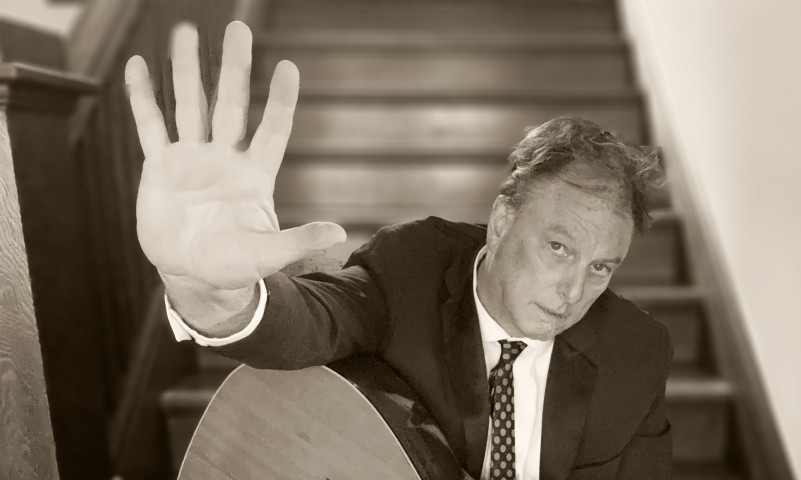
Award-Winning Game Composer Dren McDonald Announces Vox Pterous, Shares New Single “Fading” Featuring Sophia James
San Francisco Bay Area composer, producer, and musician Dren McDonald announces Vox Pterous (Appearing Records), a stunning new album due July 31, 2026 on which he takes the instrumental architecture of his celebrated 2023 record Pterous and opens it up entirely, inviting a remarkable ensemble of vocalists into those layered, sonic worlds to create something wholly new. The result is one of the most emotionally resonant records of his career that sits at a unique intersection of contemporary classical composition, songwriting, and the warmth of the human voice.
Pterous, (latin for ‘with wings’) the record from which Vox Pterous grows, was itself an act of devotion, built into structures McDonald described as guitar orchestras: layers upon layers of single-note phrases recorded over and over on different instruments from different distances. Each song was dedicated to a different person he had lost within a three-year span. As he wrote at the time of those sessions, “sometimes the only way to work through grief like that is to make something.” WVIA heard in those pieces “a pleasing journey into the kind of minimalist musical world pioneered by people like Steve Reich, with the kind of obsessive layering of instrumental sounds that lends a distinctive texture to the work.” With Vox Pterous, McDonald returned to those same pieces and discovered there was still more to say, beginning with an experiment that would unlock the entire project.
That experiment was “Fading,” the album’s sixth track, recorded with vocalist Sophia James, whose song “Somebody New” has earned over 25 million streams on Spotify and whose recent TikTok trend “Group 7” brought her to a vast new audience. McDonald knew James through her grandfather, Chuck Wackerman, his high school jazz band teacher, and understood that she possessed both the musicality and the emotional depth to carry a vocal performance capable of elevating the piece beyond its instrumental origins. The strength of her performance gave McDonald the confidence to arrange the remaining songs and set out in search of the remarkable group of collaborators who would complete the album.
That search became its own essential part of the creative process, a series of loose connections, and cold calls into the void, combined with the slow process of composing each lyric and melody before anything was sent to a vocalist. The ensemble McDonald assembled is a wide assortment of musicians hailing from their own unique musical corners: Amelie Anna (Death Stranding 2 Soundtrack) appears on three tracks, Carla Kihlstedt, whose work with Sleepytime Gorilla Museum, Tin Hat Trio and Tom Waits has long placed her among the most distinctive voices in contemporary experimental music, is featured on “Resting of Light.” Paula Frazer (Tarnation) lends her unmistakable presence to “Aviation Eyes” alongside artist, Girl Swallows Nightingale, and Lily Bloom and Daria Novo share the luminous “She’s The Sky.” The album was produced, engineered, and mixed by McDonald himself, with additional mixing from Bryan Jerden on two tracks, stereo mastering by Piper Payne, and artwork by Christine MacTernan. The album is also available in Atmos on platforms that support immersive music.
McDonald’s credentials as one of the most versatile and widely heard composers working in immersive and interactive media today. His game credits include Counter-Strike: Global Offensive/2 for Valve, Ghost Recon Commander for Ubisoft, and the award-winning indie title Gathering Sky for Pontoco, which earned him three Game Audio Network Guild Awards in 2016 including Best Indie Game Audio. His music has been heard in Stranger Things VR for Netflix/Tender Claws, VR animated films such as Mescaform Hill: The Missing Five (Tribeca 2022), and Perennials (Venice Film Festival in 2023).
His solo catalogue is equally distinguished, encompassing The String Arcade (2014), which won a GANG Award for Best Cover/Remix, his collaboration project, polyheDren, (Psychic, 2022), which featured collaborations with Josh Freese (Foo Fighters/NIN), Nels Cline (Wilco), The Residents, and Iva Bittová (Nonesuch), and Oceanic (2024) on Appearing Records, which The Answer Is In The Beat likened to “an underwater equivalent of Daniel Lanois’ spacious Americana.”
With Vox Pterous, McDonald has created something that honours its origins in loss while reaching toward something generous, and alive. The lyrics of “Anchors Up,” the album’s opening track, set the tone with quiet, circling precision: “Drawing little circles, drawing little circles rise and fall / Pulling in the anchor, pulling up and anchors away.” It is music made for listening deeply, from a composer who has spent a career proving that the most immersive sonic experiences are built not from spectacle but from patience, accumulation, and care.
Hi, Dren! Good to meet you! Care to introduce yourself to the readers for those not familiar with your music?
Hello, thank you for chatting with me. I like to dabble in a lot of different types of music and media, so this is sometimes difficult for me to answer succinctly. Primarily I’m a composer/songwriter who produces/engineers my own work and I usually play a lot of the instruments on my recordings. I started out in bands in the 90s, ran a record label (art rock weirdo label, Vaccination Records Co.), then eventually started to write music for other mediums like games, advertisements and theme parks. And obviously I continue to release my own music, unrelated to the other mediums that I work in. Looking through my catalog of releases, I think it’s difficult to come up with a genre that covers what I do. And it’s my own fault. I have some ambient music releases, but also garage rock Mariachi, Balkan Brass street party music, big band 60s spy music, and tiki-vampire influenced surf guitar rock. One (or all) of these things doesn’t belong with the other…and this new release, (& the two previous soundtracks) don’t quite fit any genre, as there are ambient elements, minimalism influences and pop inspired melodies, but that’s tough to fit into a streaming platform category.
Pterous was born from grief and loss, with each piece dedicated to someone you had lost. When you returned to that music years later, what did you discover about those emotions that you couldn’t express the first time around?
I worked on the instrumental version of this record, Pterous, throughout most of 2022. At that time, the most therapeutic aspect of making that record was the recording of these repetitive guitar parts, over and over again (to achieve the sound of a large guitar ensemble)…just having that specific recording/playing process to focus on as I zoned out and thought about these folks, did something helpful. I mean, you can’t cry all day. Maybe some days. But doing this just seemed to help with the grieving process.
When I went back to these pieces to write lyrics, the difference was that it was time to revisit my memories with these folks a bit more specifically with words. This is one reason this record took a long time. It often took several weeks to do one song, working a few hours a night on lyrics, to come up with something that felt right. I’d look through emails with them, or find old photos to spark ideas/memories. Some nights resulted in writing only one or two words. Progress is progress though. Sometimes the best that I could do would be to paint little scenes of my memories with these folks, scenes that they’d remember about our time together. It may not be significant to others, or even make sense, but it felt right.
You’ve said that “sometimes the only way to work through grief is to make something.” Looking back now, did creating Pterous and Vox Pterous change your relationship with loss, or simply give it a place to live?
I think my first reaction to the question is that the process changed my relationship with the people who are important to me and are still around. I don’t want to take these relationships for granted, whereas before making these recordings, I don’t know if I thought about that as consciously as I do now. It’s easy to let our friends fade into the background as we move through life, it just happens. So I’m trying to be a little more conscious about keeping connected and making new friends.
“Fading” became the spark that unlocked this entire project. What was it about Sophia James’ performance that made you realize these instrumental compositions could become songs?
I knew that Sophia has a big talent for presenting a song…she just doesn’t sing, she has an innate ability to bring dimension to a song. I think of Otis Redding singing “I’ve Been Loving You too Long” when I think about this kind of talent. And she writes her own songs. So she was the first person I’d thought of, especially after I’d recently seen her sing at a memorial concert for her grandfather (who was my high school jazz band teacher, and someone that I credit for believing in me early in my career). If that recording session had gone another way, I’m not sure I would have kept pushing on the project.
Much of your career has involved creating music for worlds that other people built—whether in games, VR experiences, or film. How different is it to create a world entirely of your own and then invite other artists into it?
That’s a great question, because I think that a lot of composers who make music for film/games/tv often struggle with their point of view when they aren’t writing for a project that isn’t their own. I know some people who can’t even write unless there is a project to write for. And I totally empathize with this idea. In the early part of my media composing career I was often struggling with the idea that I should be able to sound like other composers/games/film music etc. I wanted to be able to prove that I could do that too. For some reason. I don’t really know why I had that idea back then. Maybe to show others that I was ‘hireable’?
Thankfully I’ve gotten away from that idea. There are some soundtracks that I’ve done that really contained a lot of my personality (like “Gunman Taco Truck” – there’s a lot of my personality in that music). But when you are challenged to ask yourself “What do I want to say? What music would I make that is meaningful to me?” that’s when your perspective really changes. Throughout the pandemic, this question really took over my thoughts. And that’s where the polyheDren record, “Psychic” came from. I kept asking myself this question, which was a bit scary, and finally a clear idea of a genre (more accurately, a specific mix of genres) that I wanted to try came to me. With everyone at home during those days, it seemed like a good time to see if other folks would like to contribute to it.
So how is that different from working in an existing ‘world’? For me it was important to establish what my ‘world’ was. I think the polyheDren record is a pretty clear musical world that we established, and I wouldn’t have been able to go forward with that record if I wasn’t confident about that vision. The same could be said for Pterous and Vox Pterous (especially).
You’ve worked on everything from Counter-Strike to Stranger Things VR. How has composing for interactive media influenced the way you think about space, immersion, and storytelling in your solo work?
There are definitely elements of composing or songwriting that are part of my process that come from thinking about music in other mediums…the problem is naming them because a lot of those elements start to simply bake into your process and I don’t think about it consciously. One of the big differences in writing music for a game/film/tv is that the music is only part of the equation that tells a story. And in games, that music isn’t linear. It is usually a series of loops and stingers that will always play back in a different way when the game is played. So those considerations sometimes take precedence.
When I’m working on my own music, I get to remove those filters. I can think about it as a singular form of art or experience, and I don’t have to concern myself with the technical side of making those parts of the music work within the confines of a game engine, or worry about certain frequencies that might interfere if there is voice over happening during the music. I can simply focus on the emotion in the music, and how it moves me.
On the other hand, working with game designers is a treat because they often challenge your creativity. They might imagine a blend of styles, genres or characters in the game music that I would have never thought of. Since having the experience of working with creative folks who think like that, I now probably consider a much wider world of sonic options while working on my own music.