
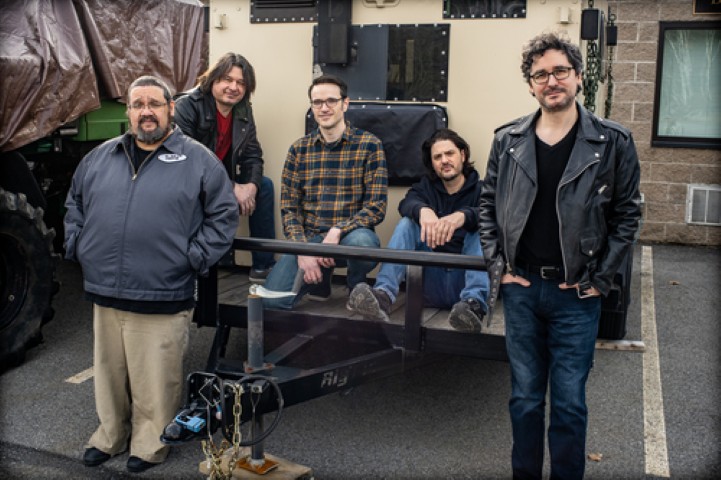
Massachusetts Rockers D-Tension & The Secrets Release Self-Titled Debut Album Led by Single “Hate To See You Go”
D-Tension & The Secrets have released their eponymous debut album, D-Tension & The Secrets, a nine-song set led by the single “Hate To See You Go.” The record spans rock, alt rock, punk and power pop without settling on any single lane for long.
The band exists because of an unlikely pivot. D-Tension built his name internationally as a hip hop artist, most recently touring with the late DMX, Ja Rule and the late Biz Markie, so his sudden turn toward rock and roll caught the indie world off guard. It started in March 2020, when pandemic lockdown gave him nothing but time and, thanks to what he calls a shady Instagram contest, a Fender Jazzmaster he had no idea how to play.
That combination proved productive. A hip hop producer with deep sampling instincts, known for work with Slug of Atmosphere, Blackalicious and Mr. Lif, D-Tension had also grown up with hippie parents and a sprawling record collection, giving him a walking knowledge of rock music long before he could play a note of it. YouTube lessons closed the gap fast. By Christmas of 2020 he was recording his own material, released the following year as ‘Secret Rock & Roll Project,’ with contributions recorded remotely by Craig Silverman of Agnostic Front, Frank Pino of the Andrew W.K. band, and Dresden Dolls and Violent Femmes drummer Brian Viglione. “Lock down had its advantages,” D-Tension says. “All I did that year was play guitar.”
D-Tension, who is on the autism spectrum, has always described music as his superpower, and that instinct carried him straight through the shift from rapper to rocker without much hesitation.
Once the world reopened, the songs needed a band behind them, and The Secrets came together in D-Tension’s hometown of Lowell, Massachusetts, the same creative pocket of New England that produced Jack Kerouac. A second album, ‘Tales From The Pub,’ followed on Boston indie label Red on Red Records as the group started playing shows and entered the world-famous Rock & Roll Rumble, proving in the process that this was never a rap-rock project. The songs lean on melody, hooks, tight musicianship, harmony and storytelling instead.
What the band had not yet done was record together, and D-Tension & The Secrets finally closes that gap. Opener “Hate To See You Go” nods toward the Irish punk sound tied to Boston acts like the Dropkick Murphys, with echoes of Rancid and Flogging Molly, built around a drinking-song, sing-along chorus in tribute to friends the band has lost. From there the record moves through the psychobilly of “Banned,” the Warren Zevon-style dark humour of “Crime Spree” and an AC/DC-worthy rocker in “Violated.” D-Tension sums up the whole set simply: “Your favorite hour of rock and roll radio, where no two songs sound alike but are all rock and roll.”
“Hate To See You Go” began with the sudden death of D-Tension’s friend Lesley, a soul singer he had long talked about making a record with and never got the chance to. She died in isolation during the pandemic, without the proper send-off her life deserved, and the song became his way of giving her one. The lyric opens with a phrase from his own neighbourhood, a toast rather than an elegy, and widens from there into other losses that shaped him: a cat named Frankie he bottle-fed as a teenager after its mother died in childbirth, and a childhood friend nicknamed Turtle, the first person close to D-Tension to die young. Rather than write something mournful, he built a drinking song, an Irish punk send-off that felt right for someone raised in greater Boston, even if his own claim to the tradition amounts to little more than a rounding error on a DNA test.
D-Tension was inducted into the New England Music Hall of Fame in 2024, and has won two Boston Music Awards, a New England Music Award and a New England Urban Music Award along the way.
Hi, Steve! Good to meet you! Care to introduce yourself to the readers for those not familiar with your music?
I’m a musician/producer from Lowell, MA via The Bronx, NY. Growing up in New York in the late 70’s and early 80’s had a massive impact on who and how I am. I grew up surrounded by music. My parents were Woodstock era hippies who then became Studio 54 disco fans. They each had their own records, which I have in my collection to this day. My mother was constantly playing Simon & Garfunkel, Peter, Paul & Mary and Cat Stevens at home. My dad was into E.L.O., The Who and Led Zeppelin. That alone is an education in riffs, harmony and lyrics.
Like any kid, I had my own music that I learned about in the streets of NYC. I was there as hip hop was literally being invented. I started break dancing in 78. The block parties in my neighborhood featured DJ’s like Kool Herc and Grandmaster Flash. Hip Hop was the predominant culture, and it was amazing to see its birth and infancy.
Meanwhile, after my parents divorced, I was introduced to the club near his apartment, a club where years later I would perform, CBGB. I would walk by and see these rebellious people wearing leather and chains. It was nothing like The Bronx music scene. My first favorite band was The Plasmatics because I saw this scary yet very sexy woman walk by. When she walked by everyone went nuts trying to get her attention. That was Endy O. Williams.
So before age 10 I was hooked on music and was part punk rock and part hip hop. It’s easy now for me to see that those two scenes had a lot more in common than people might think. Rap and Punk were both D.I.Y. They were both rebellious. They were both new. They were both making a statement about the state of New York City at that time. I didn’t really understand until I grew up that these two music scenes were intertwined and were exclusively New York. We had Blondie rapping and Grandmaster Flash and The Furious Five opening for The Clash. Yes, they both spread worldwide, but if I had grown up anywhere else, I would have missed their beginnings, and I might be a very different person today.
You’d already built a successful career in hip-hop when a lockdown and a Fender Jazzmaster completely changed your direction. Looking back, do you think you found rock music, or do you think it had been waiting for you all along?
Oh, it was waiting for me. As I was saying, hip hop and punk rock were both in my blood. I got rock and folk from my parents and went on to get into new wave, hard rock and metal. I always knew I would eventually take the time to learn to play guitar, I just needed time. When my rap career took off, I was too busy touring, producing and recording to buckle down and let the rock and roll person living in me to come out.
“Hate To See You Go” is about loss, but it doesn’t sound defeated—it sounds like a celebration. Why was it important to honour the people you’ve lost with a song people can sing at the top of their lungs instead of one that quietly mourns them?
I learned this from the Irish people I became friends with when we moved to Boston. I had never heard the term “celebration of life” until I moved to New England. Death always involves mourning but my new home has a tradition of imbibing and sharing good memories of our fallen loved ones. The concept of “pouring one out” in remembrance is something I first saw in the Ice Cube film Boyz n The Hood. So, this song combined my hip hop roots with the very Boston tradition of Irish punk rock. It’s basically an Irish inspired sing along drinking song. When you think about it, we are sad because we loved someone for the experiences we had with them. So let’s remember them with fondness and hold a party in their honor.
The only trouble with this song is that it’s our only Irish sounding song. But people are so caught up in genre that they can’t fathom that this is one song, not my entire sound. I recently was interviewed by a radio station that introduced me as “Irish Punk Rocker D-Tension”. But I’m Puerto Rican!
You describe music as your superpower, and you’ve gone from sampling records to writing rock songs from scratch. How has being on the autism spectrum shaped the way you hear music, and did learning guitar unlock a different part of your creativity?
Being on the spectrum sometimes I don’t even realize that I did something that other people can’t. I won a guitar in February of 2020, during lockdown, and by Christmas I had released a rock album. I played guitar, drums, bass and keys on it because we were all stuck inside. I had no band. Only after I released it did musicians say things like “wait a minute. You’ve only been playing guitar for 9 months?”
The same thing happened when I started making hip hop beats. I bought a sampler in ‘97 and was making a living selling beats by ’98.
Some people actually didn’t believe me when I told them how quickly I pick up a new musical skill. It isn’t “normal”. I hear music in colors and see music in shapes, so I was able to follow the color and shape patterns to understand how music works. That’s great until you start a band and my bandmate says “what key is this song in” and I say “it’s a red square but the bridge is a plaid oval.” Luckily, my band mate Jared Holaday is an accomplished musician who is proficient in a dozen or so instruments, so he’s able to tell my band mates what the chords in the song are. My bandmates are all amazing and they take what I have done and make it come to life. Thank goodness.
This is the first album D-Tension & The Secrets recorded together as a full band, and every song heads somewhere different stylistically. Was the goal to make a record without boundaries, or does that wide range simply reflect everything that’s been living inside you as a musician all these years?
The thing about rock and roll is this: What is it? I ask this question when the Rock and Roll Hall of Fame inductions are announced. Every year, social media is full of people saying “that isn’t rock and roll!”. I always reply, “what is rock and roll?”
50’s rock and roll is piano, upright bass and sax. There were often no guitars, or the guitar was a background instrument. Black Sabbath has no sax, is that rock and roll?
Rock and roll is like porn. You know what it is when you see it. So my goal with this album was to wear all of my influences on my sleeve and try to make a record that sounds like the perfect hour of a rock radio show. Rock is many things and I wanted to try to capture that and not be cornered into being a specific sub genre. I think the perfect example of that is The Clash discography. It’s punk, it’s ska, it’s reggae, it’s dance music. What is it? It’s rock and roll!
Connect with D-Tension & The Secrets:
Website
Bandcamp
Facebook
Instagram
TikTok