
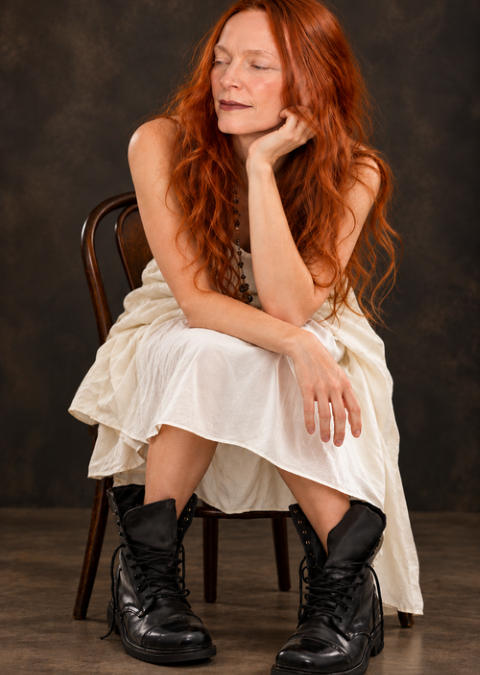
Dundas, Ontario singer-songwriter and visual artist Joan Krygsman embraces the strange, the funny, and the deeply personal on her new five-track EP, Bag of Fingers, released October 31, 2026.
Blending dark humour, imaginative storytelling, and moments of vulnerability, Bag of Fingers introduces listeners to a wonderfully unconventional musical world where independence, relationships, and personal boundaries take centre stage.
From a woman carrying a bag of lost fingers to an unlikely romance involving an octopus, Krygsman isn’t afraid to take her songwriting in unexpected directions. Beneath the absurd characters and clever wordplay, however, are relatable reflections on connection, autonomy, and finding the confidence to make art on your own terms.
Joan Krygsman Finds Creative Freedom on Bag of Fingers
The new EP represents a significant turning point in Krygsman’s musical journey.
After eight years with her band Trout Lily, which performed its final show at Hamilton’s Supercrawl in 2025, Krygsman began reconsidering her relationship with live performance and the creative process.
Rather than stepping away from music altogether, she discovered a new approach to songwriting and recording that allowed her to maintain greater control over her artistic vision.
Working with producer Ashton Price, Krygsman began recording in January 2026, combining electronic elements with live instrumentation and her distinctive lyrical style.
The resulting five-song collection moves between playful absurdity and emotional honesty, exploring everything from complicated relationships to the importance of saying no.
Joan Krygsman Explores Humour, Boundaries, and Relationships
Each track on Bag of Fingers offers a different perspective on human connection.
“Little Spoon” takes a humorous look at independence and the complications of intimacy, while “No” delivers a powerful message about establishing personal boundaries.
“Sid” transforms mismatched romance into a surreal love story involving an octopus, and “Poking the Hive” uses clever honeybee imagery to explore the aftermath of a relationship.
The title track, “Mama’s Got a Bag of Fingers,” introduces a delightfully bizarre character whose missing fingers each have a story to tell.
Together, the songs showcase Krygsman’s ability to balance imaginative storytelling with genuine emotion.
Joan Krygsman Brings Visual Art and Storytelling Together
Krygsman’s creative background extends well beyond songwriting.
A graduate of the Ontario College of Art, she has built an accomplished career as an illustrator, working across ink, collage, acrylic, and digital media.
Her illustrations have appeared in numerous children’s books, including her own Esther and the Avocado Tree, as well as projects by authors Robert Priest and Lynne Kittredge Fox.
That visual imagination carries naturally into her music, where unusual characters, vivid imagery, and playful language become essential parts of the storytelling.
With Bag of Fingers, Krygsman brings these creative instincts together in a project that feels distinctly her own.
Five Questions With Joan Krygsman – Interview
Care to introduce yourself to the readers for those not familiar with your music?
I’m Joan Krygsman. I’m a visual artist and songwriter, and I’m probably not the best person to ask for sensible advice. I’ve spent most of my life making things – I’m not happy unless I’m putting things into the world that weren’t there before.
I was the songwriter and front person for a band called Trout Lily for about eight years, and more recently I’ve started making music on my own. Bag of Fingers is the first collection of songs under my own name.
I write lyrics first, usually in the middle of the night, when the sensible part of my brain has gone off duty. They often take me places I hadn’t necessarily intended to go. I like things a little strange, a little funny, a little inappropriate. I’m far more comfortable expressing myself through a drawing or a song, than through awkward conversation.
My songs are a blend of humour, longing, and defiance. I have a fondness for the absurd, the slightly grotesque, and the emotionally inconvenient.
I suppose I’m interested in what happens when you take something quite personal and dress it up in something ridiculous. Sometimes you end up with a song. Sometimes you end up with a woman carrying a bag of severed fingers..
Joan, what fascinates me about Bag of Fingers is that it came from a period when you were questioning whether you even wanted to make music anymore. Your relationship had ended, Trout Lily had come to an end, and you’d gone through a recording experience that hadn’t turned out the way you’d hoped. When you look back on that period, were you genuinely ready to walk away from music? And what did you discover about yourself when you realized that maybe it wasn’t music you wanted to leave behind, but the way you’d been making it?
Oh, I was completely prepared to bin the whole thing.
A long relationship had ended, Trout Lily had come to an end, and I’d had a recording experience that left me deflated. I was also increasingly aware that performing live was doing terrible things to my nervous system.
There’s this peculiar set of expectations that comes with being a musician. You’re supposed to form a band, rehearse, play gigs, promote yourself, cultivate an audience, and generally behave like someone who enjoys being looked at. I don’t particularly enjoy being looked at. I’d much rather be at home making something peculiar. So I thought I was finished with music.
The songs didn’t get the memo, so I kept writing things down. Odd phrases would turn up in the middle of the night, demanding attention. And I realized that I wasn’t tired of making music. I was tired of the way I’d been making it.
And that was liberating. I didn’t have to be in a band. I didn’t have to play in bars. I didn’t have to do any of the things I thought I was supposed to do. I could just make a record.
I think Bag of Fingers came out of that realization. It wasn’t so much a grand artistic rebirth, as it was an exasperated admission that apparently I wasn’t finished after all.
There’s this wonderful tension running through the EP between wanting to be close to people and fiercely protecting your independence. In “Little Spoon,” you sing that you’d rather be a shovel, which might be one of my favourite declarations of independence in a love song. Has getting older changed your understanding of what you need from relationships? And did writing these songs help you recognize boundaries that you might have struggled to establish earlier in your life?
Oh, absolutely. I think one of the benefits of getting older is that you can simply decline to participate in someone else’s idea of what you should be.
I used to be much more inclined to accommodate, to compromise, to try to make things work. To bend myself into whatever shape seemed necessary to keep a relationship going. I was fairly good at it, actually; practically a contortionist. And while there’s certainly nothing wrong with compromise, at some point you have to ask yourself how much of yourself you’re prepared to give away.
Little Spoon is probably the most obvious example of that tension. There’s a desire for intimacy, affection and companionship, but there’s also a fairly robust desire not to be swallowed whole by another person.
The line about preferring to be a shovel is my way of expressing that. It’s a ridiculous image, but it gets the point across. Why should I have to be the little spoon? Perhaps I’d rather be a large, useful garden implement.
I think I’m much more interested in relationships where two people can be close without becoming a single, alarming organism.
And yes, I think writing these songs helped me recognize some things about myself. Although I wouldn’t say I sat down with the intention of exploring my emotional boundaries. That sounds far too sensible. I start with something that amuses me, and then discover I’ve accidentally exposed some deeply personal aspect of my psyche. Surprise.
You describe yourself as painfully shy, and you’ve been remarkably open about how stressful performing live can be for you. Yet you’ve spent years putting yourself onstage, sharing these incredibly personal, funny and sometimes outrageous songs with strangers. What happens inside you in those moments before a performance? Is there a version of Joan who appears when the music begins that you don’t always recognize in everyday life? And have you started to question whether being a musician necessarily has to mean being a performer?
Before a performance, I generally experience a powerful desire to be somewhere else. Preferably somewhere with a locked door and no audience. I’d knock back two beta blockers with a large glass of wine, and then head out there with a big old smile, ready to crack wise and sing my heart out.
I want so much to connect with the audience, but this fear keeps a wall between us, a distance. It keeps me from delivering an authentic performance.
Because I do find performing live genuinely stressful. Yes, I’m a shy person, and the whole idea of standing in front of a room full of people and asking them to look at me feels fundamentally misguided.
And yet I’ve been doing it for years. It seems a little psychotic, looking back on it.
I do a fairly good imitation of a performer who is bold, suggestive, even outrageous. I think the songs give me permission to behave in ways I wouldn’t, ordinarily. It’s a bit like putting on a person suit. I’m still me, but with fewer inhibitions. And a microphone.
But. The need for the beta blockers and the wine started to make me question whether this was really a healthy way to go about things.
Does being a musician necessarily mean being a performer? Why should it? Nobody insists that a novelist stand onstage and act out their book.
I love writing songs. I love experimenting with recordings. I love the process of taking some ridiculous idea and turning it into something that sounds wonderful.
In the studio, I feel like I belong. Making strange noises and leaving the public appearances to people with more robust nervous systems.
I’m not saying I’ll never perform again. But I’m increasingly attracted to the idea that I really don’t have to.
You’ve spent much of your creative life as a visual artist, and your songs are filled with these wonderfully surreal characters, from a woman falling in love with an octopus to a mother carrying a bag of severed fingers. But beneath all that absurdity, there are some deeply personal feelings about rejection, intimacy and self-worth. Do you find it easier to tell the emotional truth when you disguise it inside a ridiculous story? And when someone laughs at one of your songs, do you ever wonder whether they’ve also heard the sadness or vulnerability hiding underneath?
Absolutely. Absurdity is a useful disguise. You can smuggle all sorts of uncomfortable truths past the guards, if you dress them up in something sufficiently ridiculous.
I’ve always been drawn to the surreal. As a visual artist, I love putting things together that don’t belong together. Songwriting is much the same. You start with a perfectly ordinary human emotion, and then you introduce an octopus.
I think writing directly about loneliness or rejection or the desire to be loved can feel terribly exposing. There’s something unbearable about being completely earnest. But if I can make the same point through a bizarre character or an absurd situation, it is far more comfortable, for everyone involved.
It’s emotional camouflage. With tentacles. Humour gives you a bit of cover. You can say something quite vulnerable and then immediately undercut it with something ridiculous. I suspect I do that quite a lot in life, too.
And I do think there’s also sadness buried in some of these songs. There’s a fair amount of longing, insecurity, frustration. Bruised ego. But I don’t want to wallow in it. I’d rather poke it with a stick, and see if it makes a noise.
When people laugh, I’m delighted. I love making people laugh. But I also hope that occasionally something else sneaks through. Maybe a line catches them off guard. Maybe they recognize a feeling they weren’t expecting to find, in a song about something completely preposterous.
I like that possibility. I like the idea that something can be funny and sad and slightly disturbing all at once.
If you can make someone laugh while quietly breaking their heart, that’s a pretty good day’s work.
Connect with Joan Krygsman:
Website | Bandcamp | Facebook | Instagram