
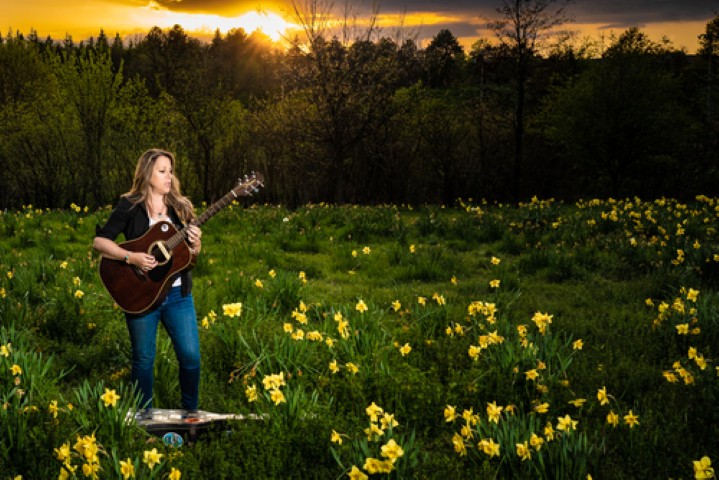
Toronto singer-songwriter Raina Krangle turns a life-changing concussion into a deeply personal musical journey with her new EP, HEADBANGERS.
For Toronto singer-songwriter Raina Krangle, music has always been more than a creative outlet. But following a concussion in 2019, something that had once brought her comfort became physically difficult, leaving her searching for a way to reconnect with the art form that had shaped her life.
Rather than allowing the experience to define her, Krangle gradually found her way back through music therapy, treasured memories, and unexpected moments of inspiration. That journey became HEADBANGERS, a deeply personal EP exploring love, resilience, nostalgia, and the power of finding your voice again.
The project began with “My Beautiful Dear,” a heartfelt tribute to her parents’ 54-year love story. Its melody arrived in a dream, eventually leading to an unexpected connection with Canadian music legend Bruce Cockburn, whose song “All the Diamonds” is referenced in the track with his permission.
Working alongside longtime musical partner Brian Siegel, Krangle brought the songs to life, including “The Beginning of Something Big,” “Troy Donahue,” and “What’s It Gonna Take?” Each offers a different perspective, from reflecting on changing times to encouraging connection in an increasingly divided world.
Krangle’s musical roots run deep. From performing at Toronto venues as a teenager to releasing her 2012 debut Solstice, she has continued developing her voice as a musician, songwriter, and educator. Her work has earned a Colleen Peterson Songwriting Award nomination, while her recent releases include “Holy Land” and a cover of Joni Mitchell’s “Big Yellow Taxi.”
Now, Krangle is preparing to celebrate HEADBANGERS with a special release show on November 14 at The George Event Space in Newmarket, Ontario, where she’ll perform the EP live with her full band, Raina & The Wranglers.
We caught up with Raina Krangle to discuss the journey behind HEADBANGERS, the inspiration behind its songs, and how music helped her find her way forward.
Raina Krangle Interview: The Story Behind HEADBANGERS
Hi, Raina! Good to see you again! Care to introduce yourself to the readers for those not familiar with your music?
Lovely to reconnect, and thank you for having me back! I’m a Toronto-area singer-songwriter blending folk-rock, country roots and Americana. My parents were big folkies. As a young kid, I was mesmerised by the sounds of them singing in harmony and my dad’s guitar fingerpicking. Those memories made a lasting impression, along with artists like Joni Mitchell, James Taylor and Bob Dylan, whose story-driven songs inspired me as a singer and songwriter.
I was always singing. Piano was my first instrument, followed by harmonica and guitar, which let me accompany myself at open mics. We all played by ear, nobody was formally trained, and creativity was encouraged.
Music became a way of expressing myself through the chapters of my life and responding to the world around me. I love a catchy melody with a story to tell, often turning something difficult into something positive that lifts me up—and hopefully others, too.
My new four-song EP, HEADBANGERS: A Musical Recovery After Concussion, carries that spirit, alongside a companion artistic journal with photographs and QR codes linking to voice notes and videos that capture my music-making and early recovery in real time.
Your concussion in 2019 changed your relationship with music, something that had been part of your life since childhood. What was it like when listening to and performing music suddenly became physically difficult, and how did you begin finding your way back to something you loved so deeply?
It was a strange and frustrating contradiction. Music was woven into almost everything I did, yet singing could leave me feeling shaky, nauseous and exhausted. My mind still wanted it. My body couldn’t always tolerate it.
It also wasn’t just about music in isolation. Ordinary daily activities used up energy, and music added to that cumulative load. Even singing high notes created pressure in my head, so watching videos of myself performing before the injury was bittersweet. I hadn’t realized how much I took that freedom for granted.
Finding my way back meant learning to stop before I wanted to. Sometimes I could spend only a few minutes with music, then I needed to rest. Those few minutes could also bring enormous happiness.
During this period, songwriting changed fundamentally for me. Rather than writing music in separate stages, I began composing everything at once—lyrics, melody, and structure emerging together in real time. It was a more immediate and intuitive process shaped by shorter bursts of energy and heightened creative focus. It changed how I understood songwriting entirely.
I began dictating notes because I was having trouble remembering what I had done and how it had affected me. Those recordings eventually became the foundation of the journal. At the time, I was simply trying to understand my days.
A Spotify email celebrating Joni Mitchell’s Clouds led you to sing “Chelsea Morning” by candlelight, which became an important moment in your recovery. What do you remember about that experience, and how did it help reconnect you with your musical identity?
I recognized the album artwork in the email and went to find my own copy of Clouds. I didn’t recognize the first song until I put the needle down on the record and heard “Chelsea Morning.” My immediate reaction was, “I know this song!” Hearing it by candlelight transported me back.
It took me back to university, when I would practise it over and over, trying to master the switch into falsetto. I remember thinking that if I could sing like Joni, I could sing anything! But as I began singing along, I realized I couldn’t remember all the lyrics. That was frustrating because I had sung it so many times and once knew it by heart.
Just weeks before the accident, I had attended a workshop at the Royal Conservatory about how singing and music support language acquisition in young children and engage different parts of the brain. That experience came back to me, and I wondered whether music could help me find the words and activate my brain in a way I was struggling to do at that moment.
I didn’t really understand what was happening in my brain, but I felt determined to try. Remembering the lyrics became something I could work towards, a little at a time. Music became my own form of therapy. I couldn’t think beyond the moment I was in, but music transported me out of it and into a happy place. There were still symptoms and pushback from my body, but it brought me back to my soul, to the joy.
“My Beautiful Dear” began as a melody in a dream and grew into a tribute to your parents’ 54-year love story, eventually receiving Bruce Cockburn’s blessing to incorporate part of “All the Diamonds.” How did that song come together, and what did it mean to have an artist connected to your family’s memories become part of your own music?
The melody came to me in a dream and was so beautiful that I was actually crying in my sleep. When I woke, I carried that feeling with me all day until the song was written. I knew it was a love story, and the only successful love story I knew was my parents’—so I decided to tell theirs. In doing that, I was also telling the story of my childhood.
My parents used to sing Bruce Cockburn’s “All the Diamonds” to me at bedtime—we had “sing time” instead of story time. Incorporating it into “My Beautiful Dear” felt natural, and I was surprised by how perfectly it fit with the chord progression and melody I had written.
At Colin Linden’s suggestion, I contacted Bruce’s manager, Bernie Finkelstein. They needed to hear the song before approving it, which gave me the push to get into the studio. Bringing that emotional dream song to life—and simply being back recording—meant a great deal during early recovery.
Receiving Bruce’s approval was especially meaningful because his music was already part of my childhood. Now it could become part of my own musical tribute to my parents.
You’ve said you never wanted to become the poster person for concussion, but instead wanted to tell the story of what you chose to do with the experience. With HEADBANGERS now released and your first full-band performance of the EP coming up, what do you hope listeners take away from these songs, particularly anyone facing a difficult chapter in their own life?
I hope people find something in these songs that speaks to their own lives, whether or not they know the story behind the project. There’s uncertainty and change in “The Beginning of Something Big,” nostalgia and escape in “Troy Donahue,” a call for compassion and speaking up in “What’s It Gonna Take,” and family and love in “My Beautiful Dear.”
I didn’t choose concussion as my story. I chose what I did with it. That doesn’t mean everything became easy, that recovery followed a straight line, or that I’ve recovered completely. Music could be physically difficult and still bring me joy, help me express myself and give me something to look forward to.
As I learned more about brain injuries and listened to podcasts, one idea stayed with me: having something creative to work towards. For me, a song or a project gave me a goal, even when progress was slow. It helped me find hope and build resilience in ways I hadn’t expected. That’s what I hope people take from HEADBANGERS—the possibility of finding something meaningful that helps them move forward.
The more I share this project, the more people tell me about their own concussion or someone they know who has had one. I’ve been surprised by how many people around me have been affected. Those conversations have made sharing this story feel even more meaningful.
The companion artistic journal lets readers experience the creative process through photographs and QR codes linking to original voice notes and videos. It captures the beginnings of “My Beautiful Dear” and plenty of unreleased material as it unfolded during early recovery—so perhaps there’s a HEADBANGERS Part Two waiting to happen!
The November 14 release show at The George Event Space in Newmarket will bring those pieces together in an immersive evening with Raina & The Wranglers. A short film will introduce the project, and copies of the artistic journal will be available alongside CDs and a very limited run of cassette tapes—a nod to the nostalgia woven through the music. After seven years, I’m excited to bring these songs to life with the full band and bring all the pieces of HEADBANGERS together. It’s going to be a full-circle kind of night!
Raina Krangle – HEADBANGERS Release Show
November 14, 2026 – Newmarket, ON @ The George Event Space
Performing with Raina & The Wranglers
Doors: 6:30 p.m. | Show: 8 p.m.
Connect with Raina Krangle:
Website | Bandcamp | Facebook | Instagram