
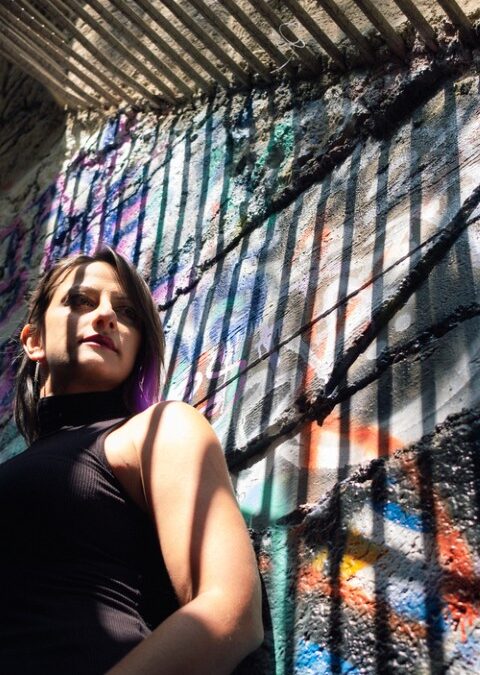
Los Angeles alt-rock collective MASHA. and the Fam explore social unrest, creative growth, and the power of music to inspire change on their new single, “New Normal.”
Los Angeles alt-rock collective MASHA. and the Fam are confronting difficult questions about society, injustice, and the possibility of healing with their powerful new single, “New Normal.” More than nine years in the making, the track combines explosive alternative rock with cinematic arrangements and a striking 15-piece horn section recorded in Cape Town, South Africa.
Written by frontwoman Masha Alexis in the aftermath of Freddie Gray’s death in Baltimore in 2015, “New Normal” began as a personal response to the unrest unfolding in neighbourhoods where she grew up. Although the lyrics came together that year, Alexis spent nearly a decade developing the musical skills and vision needed to bring the song to life.
The finished track moves through anger, frustration, and destruction before arriving at a message of resilience and hope. With contributions from William Haubrich of the South African College of Music, “New Normal” transforms a deeply personal experience into a larger conversation about the world we live in.
Known for their theatrical performances and cinematic alternative rock sound, MASHA. and the Fam feature Alexis on lead vocals and keys, Pedro Aquino on guitar, Servio Maldonado on bass, and Kyle Dombroski on drums, alongside a rotating cast of collaborators.
In our MASHA. and the Fam interview, Masha Alexis opens up about the nine-year journey behind “New Normal,” the personal experiences that inspired it, and the role music can play in challenging what society has come to accept.
Listen to MASHA. and the Fam’s “New Normal”
MASHA. and the Fam Interview: The Story Behind “New Normal”
Hi, Masha ! Good to meet you! Care to introduce yourself to the readers for those not familiar with your music?
Hi! I’m so excited to meet you and say hi to everybody. Like you said, my name is MASHA. I’m Russian, originally from Baltimore, and now based in Los Angeles, where I create most of my music with my collective, the Fam. People always ask how I’d describe our sound, and I always say: Florence and the Machine meets lots of Tori Amos pianos, but a little angrier.
I took the most roundabout journey ever to begin my career in music. It took me everywhere, from singing classical choral music, to dancing professionally, to co-founding an organization that brings life-saving spinal surgery to children in East Africa, and eventually, right here. What I make is the fight and the tenderness both. I’m angry enough to scream and big enough to hold you, and I want everyone who hears it to feel that power in themselves.
You began writing “New Normal” in 2015 following the death of Freddie Gray in Baltimore, but it took nine years to complete. How did your relationship with the song evolve during that time, and how did watching society become increasingly accustomed to disturbing headlines influence both your artistic growth and the message you ultimately wanted to share?
The crazy thing is that when I wrote this song, nobody was really using the expression “the new normal.” Honestly, I felt so innovative and creative when I put it in a song. It’s amazing that nine years later, it’s become something we hear every day. But the fact that we hear it every day is exactly why this song is meant to be in the world right now.
The definition of normal is “something that is ordinary, usual, and expected.” I don’t want to live in a world where we accept something just because it’s become usual, just because it’s become “normal.” And this is exactly where art comes in. Art can paint a picture that helps us realize maybe none of this should be ordinary. It can show us the absurdity, the ridiculousness. It can make it unacceptable again.
I’m glad I waited nine years to release this song in its full form. Yes, it was inspired by what happened in Baltimore to Freddie Gray, and that was the impetus for everything. Watching buildings burn to the ground where I grew up shook me to the core. But then, a few days later, it felt like there was just another headline, and another, and another after that. As I watched the world evolve over the past nine years, I realized this song was bigger than one specific incident. It’s talking about something much deeper: what we’ve come to accept.
I felt it was really important to start asking the question: When are we going to stop accepting all of this? When is it going to change? Because no one is going to change it for us. We have to be the ones to change it, right here, right now.
As for what I learned as an artist, I learned patience. This song, more than any other, taught me patience and self-reflection. I can’t tell you the number of times I shoved it in a drawer and swore I would never touch it or play it again. But a few months, or even years, later, it would start rattling around in my head again. I had to learn to wait until the song was ready, until the world was ready, and until I was a strong enough musician to do what this song required. It taught me what I didn’t know yet, and gave me the patience to develop those skills so it could become what it is today.
There’s an incredible contrast in this song between the anger and chaos of the first half and the hope and healing that emerge in the second. Why was it important for you to leave listeners with a sense of possibility, and do you believe music can genuinely change the way people see the world?
I absolutely believe that all art can change the world: not just music, but film, dance, writing, visual arts, all of it. Art allows people to experience a new way of thinking, a new perspective, and things they may never have seen before, without triggering the natural defensive or fearful response many people have when their views are challenged. Artists are always at the forefront of social change. Then, eventually, the mainstream catches up.
This is why the transition in the song from anger and chaos into hope was crucial. Right now, I feel like everyone is talking about the anger, the frustration, the vitriol. It permeates the energy around us every day, from the news to social media to the conversations you overhear walking down the street.
I think anger is important. Protesting is important. It might not seem like it on the surface, but those things are driven by hope. Without the hope that things can improve, without the hope that people can change, without the hope that this world can be better than it is right now, what are we angry and fighting for? Without hope, we become complacent, and nothing changes. That’s what the second half of ‘New Normal’ is…it’s the hope underneath that helps us keep fighting everyday, even when it seems like it may never change.
MASHA. and the Fam began in a converted refrigerator in the basement of a door factory, and now you’re creating these enormous cinematic arrangements with a 15-piece horn section recorded in South Africa. How has your creative ambition evolved since those early days, and what have you discovered about the kind of artist and band you want to become?
I am not the same person I was when I first wrote this song. Not only did the song have to grow and evolve, but so did I. I had to strip away the fear: the fear of being wrong, the fear of being too much, the fear of getting in trouble, just to name a few. I’m not sure I really knew what my voice was nine years ago. I never realized back then how much I was stifling myself to try to fit in. It took a lot of self-reflection, a lot of therapy, and a lot of risk to become this version of myself. But for the first time in my entire life, I feel like my life is my own, that I am enough just because I’m a part of this world. Finding that completely freed me to create the music you’re hearing today, music that is resonating with people on a much deeper level than just “that’s a cool song.”
“New Normal” is part of my upcoming EP, FRIC/TION, which delves even deeper into those journeys. From rehearsing in a refrigerator in the basement of a door factory to a 15-piece horn section, the music got bigger because I finally stopped making myself small.
Connect with MASHA, and the Fam:
Website | Bandcamp | Facebook | Instagram | TikTok