
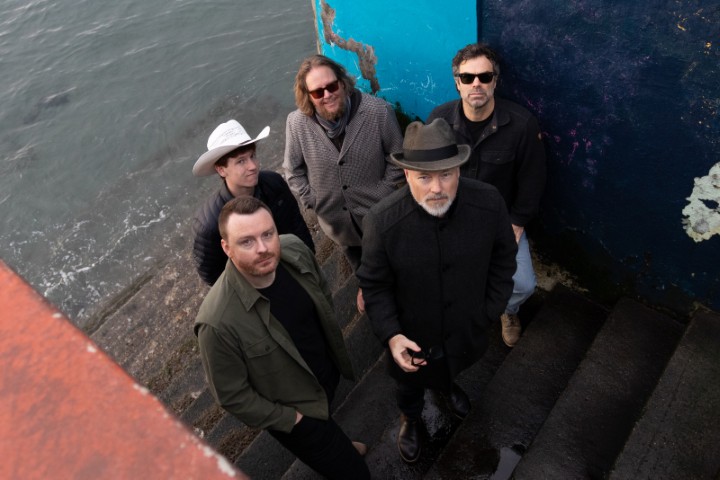
Door d’Or Explore Connection, Consciousness, and Modern Life on New Single “Fibre Optics”
Victoria’s Door d’Or are stepping into a bold new chapter with the release of their latest single, “Fibre Optics,” the first glimpse of their forthcoming debut album, The Exquisite Dream, arriving May 1. Moody, guitar-driven, and threaded with echoes of ’90s alternative rock, the track – written by vocalist and guitarist Mat Geddes – introduces a band exploring big ideas about connection, consciousness, and the unseen forces that shape our world. Recorded with Juno Award-winning producer Colin Stewart, the album captures Door d’Or’s expansive live energy while weaving together atmospheric guitars, post-punk textures, and an underlying sense of optimism. We spoke with Geddes about the inspiration behind “Fibre Optics,” the philosophy running through The Exquisite Dream, and how reconnecting as a band helped ignite this new era.
“Fibre Optics” explores ideas of connection, consciousness, and technology. What was the initial spark for the song, and how did those concepts translate into the music itself?
I would say I’m an intuitive songwriter, and this riff was picked out of the air one night for no good reason. It’s a bit unusual to sing the guitar riff as the melody, but I went for it here. I am mesmerized by the fact that we can send audio, video, and data as light through fibre optic cables. I mean, how does that even work? Communication at light speed, it’s a miracle! As the lyrics took shape, I began to explore the idea of doing this with our minds—“on the grid lines of telekinection”—a spin on telekinesis and telepathy. When the band got at this song, it felt transformed, really energizing and fresh.
The track feels rooted in ’90s alternative and grunge while still sounding forward-looking. How did you balance nostalgia with a sense of futurism when shaping this song?
Being from Victoria, we had a front-row ticket to the Seattle scene, alongside exciting Canadian rock acts like The Tragically Hip, Sloan, and The Watchmen, as well as legends like Neil Young & Crazy Horse. Those roots grew into the performances throughout The Exquisite Dream.
I think the future focus comes from two things: sonically, the excitement and newness of our reconnection and evolution as musicians, and lyrically, a deep curiosity for what lies beyond our current state of reality.
This single is the first introduction to The Exquisite Dream. In what ways does “Fibre Optics” set the tone for the album – sonically, emotionally, or philosophically?
“Fibre Optics” begins the journey in an immediate and perhaps ominous way, highlighted by Ry ripping open the void sonically on lead guitar. The way forward is uncertain, so “Where we’ll go, we’ll go.” The Exquisite Dream imagines humanity at its highest level of awareness – a future without violence, where we move through darkness toward light and a more radiant way of being.
To me, living The Exquisite Dream involves moving through our lives with open hearts and hands, being aware of the synchronistic moments that are there to guide us. To quote Steve Turnidge, who mastered the album, “The universe makes the setlist.”
You reunited after years apart and rediscovered your chemistry in a jam space marked by the golden door. How did that physical space and shared history influence the writing and recording process this time around?
There is a level of comfort, trust, and tension that exists between us from our shared experiences. When the right time arrived, we came together when we all needed connection. The golden door has been a wonderful metaphor for all of us as the threshold, the opening to transcendence from darkness to the radiance of The Exquisite Dream—the dream of creation, the dream of friendship, the dream of making an album of our own, the dream of…
The album was recorded with Colin Stewart, with a focus on capturing your live energy in the studio. What did that process look like, and were there any moments that surprised you once you heard the recordings back?
We had an amazing experience with Colin at The Hive. His energy perfectly mixed with ours, and he balanced us sonically, personally, and spiritually. We are so grateful to have had the opportunity to work with such an incredibly talented and wonderful person.
I think we took a fairly typical indie rock approach, recording live drums and bass alongside scratch vocals and scratch rhythm guitar. This ensured that we channeled the emotions of each song authentically. Darin leads the way dynamically on drums, connecting with two performers on bass. Mike’s creative bass lines form the backbone of the album and are showcased throughout, while Owen bursts into the groove. We then added my rhythm guitar and Evan on piano and Rhodes before Ry layered his unique blend of atmospheric guitar leads on the first six songs. Vocals came last. Along the way, Colin dialled in each instrument’s sound, shaping the atmosphere before expertly mixing it all together. The final four tracks are live off the floor. Finally, Steve baked the mix to apply the sparkle and shine to master the record.
Honestly, I am still blown away by the magic of the process. We are really proud of the songs themselves, and I am proud of each of our performances.
There’s a strong undercurrent of optimism running through your music, even when dealing with heavy or complex ideas. What do you hope listeners feel or reflect on after spending time with The Exquisite Dream?
I hope the music can transport the listener into the dreamspace. We seem to go there less and less as we stare at our screens. It is vital that we daydream and explore the worlds of the mind. Also, our perspectives and our perceptions are creations of our own minds. Therefore, while we can be our own worst enemy, we can also be the solution to our problems. By questioning our own thoughts to identify self-deceptions, we can break those cycles. We can strive to be compassionate with each other, to gain mutual understanding through the power of peace and dialogue. This will improve our individual lives, our families, our communities, and then our society. In other words, we can use the lessons of history to guide us to genuine peace through evolution, not revolution, where the future has no violence.