
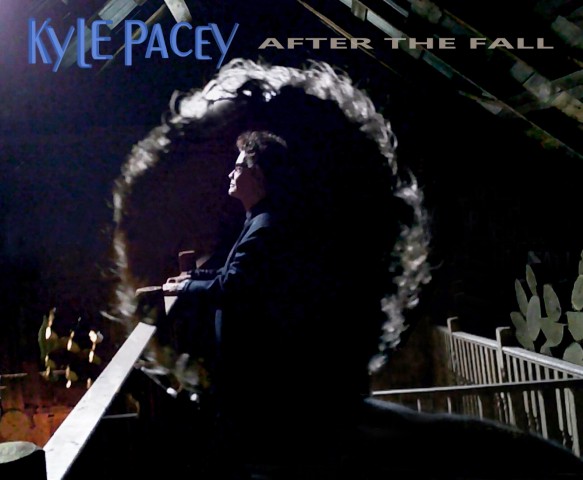
Hamilton Guitarist Kyle Pacey Returns With Powerful New EP, After the Fall
There are artists who make music to entertain, and artists who make music to understand the world. Kyle Pacey, the Grammy-nominated Hamilton guitarist, singer, and songwriter, has always belonged firmly in the second category. On After the Fall, his luminous new five-song EP out now, Pacey brings the full force of that lifelong curiosity to bear — spinning R&B heat, jazz-inflected melody, funky locked-in groove, and blues-rooted soul into a cohesive and deeply felt statement about endurance, empathy, and what it means to be alive and paying attention in this moment.
At the center of the collection is the EP’s title track, a piece of breathtaking compositional ambition that deploys improvised jazz-scat phrasing against a driving rhythmic bed to pose the questions that animate the entire project. “What will remain / after the fall,” Pacey sings, his voice both urgent and luminous, before opening the lyric outward to encompass the sweep of human experience: “Farewell my friends now / there’s nowhere to hide — / oh sweet woman / please comfort me.” The song does not offer easy resolution; instead it offers something rarer and more nourishing — the comfort of being asked the right questions in exquisite company.
“What will remain after the fall… oh sweet woman, please comfort me.”
The EP moves through five distinct sonic worlds with the ease of a player who has inhabited all of them for decades. Back Against the Wall leans into rousing blues-rock, its propulsive funk bottom and insistent groove physically lifting the body even as the lyric grapples with the sensation of being hemmed in. Brave New World arrives on a reggae-styled pulse and draws openly from the philosophy of Aldous Huxley — a meditation on personal autonomy and the power each of us holds to chart a new course. I’m Here for You trades in a warm country-blues tenderness, its message of inner strength and self-reliance arriving with the quiet authority of earned wisdom. And Beware, the EP’s most strikingly cinematic moment, conjures a swampy, Lynchian unease — a soulful blues warning about division and the urgent need for common ground, delivered in a growl that would make Tom Waits take notice.
Pacey’s musical authority is built on a foundation that stretches back to lessons under Tony Braden — the celebrated guitarist and teacher who also shaped Kim Mitchell and Ed Bickert — and a run of local and international guitar championships before he turned eighteen. He went on to serve as opening act for the Duke Ellington Orchestra at Hamilton Place, became the first local musician ever to play that storied venue, and built a reputation whose arc runs from an invitation to audition for Chicago to a 2007 Grammy nomination as a member of the John Gora Band. His octave work draws comparison to Wes Montgomery; his full chordal approach recalls Freddie Green and Charlie Christian. After the Fall was recorded at Pine Street Studios in Hamilton, Ontario, with a stellar ensemble of collaborators — Kevin Christoff and Gordon Hall on bass, Michael Sloski, Johnny Winiarz, and Bruno Farrugia on drums, Michael Birthelmer on acoustic guitar, and Ed Roth on keyboards — each song matched to the precise combination of players that best serves its emotional weather.
What sets Pacey apart from the wide field of singer-songwriters working in blues, R&B, and jazz fusion is the particular lens through which he views his subject matter. His lyrics have always been informed by a restless intellectual life — a sustained interest in world events, the visionary culture of the 1960s and ‘70s, metaphysics, philosophy, and the New Thought movement — and After the Fall is his most fully realized expression of those preoccupations to date. From Huxley’s writings on individual agency in Brave New World to the Lynchian surrealism of Beware, Pacey positions contemporary feeling inside a much larger frame, inviting listeners to locate their own experience within the sweep of ideas that have shaped our culture. As broadcaster Kevin Barber has written of Pacey’s work: “He has lived through those times, and the passion and conviction he carries ensures that those who get to hear him are treated to something real and good.”
“I am captivated by music that is always changing,” Pacey says of his approach, “and like to incorporate a fusion of popular music genres. I am a very expressive player and like to push boundaries with my unorthodox style.”
That restlessness is everywhere in evidence on After the Fall — in the sudden pivot from a jazz scat to a reggae groove, in the blues-country warmth of a song that could sit comfortably on a late-night radio playlist as easily as a Hamilton club stage, in the audacious Huxley reference tucked inside a propulsive beat. The EP is the work of an artist in the full command of his powers, making exactly the music he wants to make, and certain that the world is ready to receive it.
Hi, Kyle! Good to see you again! Care to introduce yourself to the readers for those not familiar with your music?
I am a Grammy-Nominated, Hamilton Music Award Nominated, guitarist, singer-songwriter. I feel fortunate with these achievements. My music is influenced by many different genres from blues-rooted soul to jazz, rock and funk. My song writing often focuses on the human condition, why we are here, and how we can come together to help ourselves and each other. I use music as a vehicle that can inform, entertain and engage. I like to mix things up and shake things up.
The title track asks a powerful question: “What will remain after the fall?” What sparked that idea, and what kind of “fall” were you thinking about when you wrote it?
The fall, often referred to as the fall of man, is an engaging theme found in ancient and contemporary literature. The fall of an individual or of a society. This song gives me the chance to ask questions about “the times” that we are in and what may be coming our way! How do we rebuild the self and our community? “Will we survive?”
The EP moves through blues, jazz, reggae, R&B, and country textures. Do you think of these genres as separate languages, or are they all part of one musical vocabulary for you?
I like to explore the strengths and diversity of different genres in the modern musical landscape. My music doesn’t fit into a single box. I like to express myself by blending the genres together. This allows me to create a more dynamic listening experience.
“Brave New World” draws directly from Aldous Huxley. What about his writing speaks to you as a songwriter today?
I feel that Huxley’s exploration of dystopian societies and his critique of the optimistic idea that technology will solve all of our problems remains as relevant today as when he first wrote this novel. Will continuing advancements in the sciences and technologies including AI, free us or end up oppressing us. It’s important to remain engaged and aware.
You studied under Tony Braden, who also taught players like Kim Mitchell and Ed Bickert. What was the most important lesson you took from that experience?
Tony Braden taught me to remain true to my own sound and to continue to develop and explore my own unique and very rhythmic playing style.